
Leaderboard
-
Troy
Administrators5Points14,765Posts -
.jpg.d4fb312047b54efe30f6c08b8f8eada2.jpg)
Kiran H. J. Dellimore
Members1Points16Posts -
Morris Junior
Members1Points2Posts



Popular Content
Showing content with the highest reputation on 05/23/2020 in Posts
-
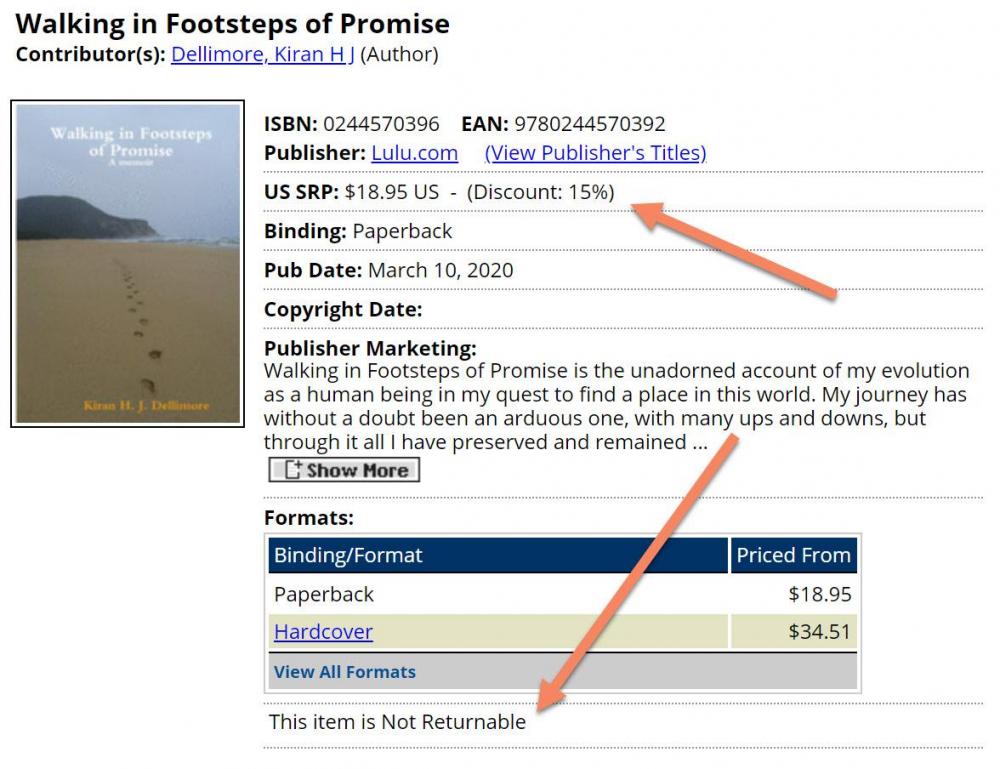
@Kiran H. J. Dellimore, thanks again for your thoughtful and informative response. I said I would add Fresh Ereba to the website if the book is in distribution. Unfortunately the book is not in distribution; it is not in the database of America's largest distributor Ingram. In fact the only place the physical book can be found is by going to Amazon and searching direct for it there. A Google search on the ISBN you provided : https://www.google.com/search?q=979-8642874554 turns up only AALBC (the page with the post you made a few days ago). All booksellers are most concerned about the ISBN13, as it uniquely identifies a book bringing in all the book's metadata (provided the publisher provides it). Now I do sell books that are not in distribution, but this is a very small percentage of my inventory. In most cases, when I get an order for a book not in distribution I email the author, they send the book to the customer, and I send the author 50% of the retail price and shipping costs. Now most readers will search for the book's title https://www.google.com/search?q=Fresh+Ereba which brings up a variety of conflicting information different publication dates, book covers, etc. Readers could also search on your name, but name and title searches presume that the reader already knows that information in advance -- which means they discovered the book or author in some other manner before running the query. So how does an author get their book noticed? Amazon encourages authors to give aways their books because it help to get their books noticed. Amazon used these "free" books they encourage authors to give away, because it bolsters the value of their Nook ebook platform. Amazon attracts subscribers because they provide access to so many free books. Amazon limits this for their benefit not author's. If you think it through you'll easily conclude why. I was able to find Walking in Footsteps of Promise in distribution and have added it to the website. It is available for sale now. But here is the problem with selling Walking in Footsteps of Promise: First, check out the screen shot from Ingram's database (shown below). You'll see that the book can not be returned once purchased by a bookseller. This all but guarantees that the book will not be stocked by any bookstore -- especially a physical bookstore. Since the book is in distribution, if someone goes to a physical bookstore, asks the store to order it, the store can do it, but they run into the next problem with the book; and that is the book's 15% discount. That means the bookseller will clear $2.84 for the sale on this book. This does not cover the shipping, handling, and insurance to get the book from the distributor to the store. Now a large bookseller will have shipments coming into the store all the time so the until cost of insuring and shiping the book is offset by being bundled with other books being ordered. For smaller booksellers this may not be the case. As mentioned AALBC would not stock this book; I would have the distributor "drop ship" this book, but again $2.80 simply does not cover the least expensive way I ship books, which is media mail insured. Now I could ship the book media mail without insurance which costs $2.80, which means I would break even (make 4 cents) on the sale but incur the risk of the book getting lost in transit. So while this book has distribution, for all practical purposes it really does not. But here is the real kicker. Ingram has about 500 copies of these book in stock. What happens if these book do not sell? Given the terms described, the likelihood of Ingram selling all 500 copies to bookstores does not seem very good. (*Now of course some Black books may being very well in stores, unbeknownst to me, despite these terms. That seems unlikely -- but I can't know how well all Black books are doing 🙂 ) Basically all of these unsold books go back to the publisher and are usually destroyed (maybe remaindered I don't know much about this side of the business), but in any event the authors royalties are adversely impacted. Of course all of this discourages authors from even seeking distribution, which booksellers can not easily sell their books. All of this encourages authors to go to Amazon to publish print and even exclusively retail their books. Amazon has been brilliant in aligning author, and consumer motivation and behavior to maximize Amazon's own revenue while freezing out potential competitors. Any perceived benefit by the reader and author/publisher is purely incidental. That said, Kiran I would be happy to add Fresh Ereba to the website please complete this form. I can also complete your author profile page: https://aalbc.com/authors/author.php?author_name=Kiran+H.+J.+Dellimore of you'd be kind enough to complete this form.
 1 point
 -
1 pointThanks for taking the time to point out those typos Kiran. I fix that page and add the new rule for linking to Amazon too.1 point
-
Yes, my apologies. Black Stoicism is a poetic way of clarifying the highest virtue. It's an attempt to expound on the in-depth range of emotions the Black community possesses. Other cultures' inability to see outside of their hatred and ignorance fuels their blindness and their empty-headed perspectives to view the Black community as immune to pain. Because of our determination and spirits, I attempt to clarify Stoicism's meaning by expanding on how the Black community re-shapes any terminology and language. The Black community endures much deeper emotional, physical, spiritual, and psychological agony; we provide new meaning to words and definitions. Being Black in the Black community is the highest virtue. Here is an excerpt. Endurance Purchased us for jail cells Purchased us for stem cells Purchased us for plant cells Sell us your addictions Sell us your deceptions Sell us your convictions Farewell to your blackmail Knock over your cocktail Staring at your marcel Say hello Black-owned businesses Say hello Black millionaires Say hello Educated black women Say hello First Black President Our journey is hell But we know our story Our souls refined We know how to feel Being Black is lovely Being Black is beautiful Being Black is joyful Being Black is amazing We are the definition Stoicism1 point
-
You are asking all the right questions @Troy! There is another way to promote your book for free on Amazon other than giving it a way for free. Previously, I have used a countdown deal, in which the price of the e-book starts off low, say 99c, and is gradually increased in stages until it returns to the normal price. However, I did not see many sales with the latter approach, while after the free book giveaway I did see a boost in sales, especially of the paperback. For completeness, one can also pay for advertisements on Amazon to promote your book. Although I have not yet tried this out, since I am first exploring unpaid options. As I plan to publish more books in the future I am using Fresh Ereba (ISBN-13: 979-8642874554) as a learning book so that I can better understand how Amazon works. Your questions speak ultimately to the psychology of book buying. On one hand giving away a book for free encourages buyers to have a lower perceived value for books by creating a norm around cheap or free books, and may discourage them from paying for books in the future. On the flip side most buyers purchase books based on the buying behavior of others, i.e., based on a herd mentality. This makes sense since many books are written by people the buyers do not know, and are of uncertain quality. As a consequence of this most buyers rely on the Amazon Best Sellers rank and reviews by previous buyers to inform their book purchasing decision. Giving a book away for free increases the book's Amazon best sellers rank and the likelihood that your book will be reviewed, which should help in the long run to sell more books. By the way it is important to mention here that the free book give away is only temporary. It is allowed for a maximum of 5 not necessarily consecutive days out of the 90 day enrollment in the KDP Select program. There are also a couple of other effects at play on Amazon such as the "30-day cliff" (the first 30 days are the most important for a newly published book on Amazon) and the "also bought" purchasing behavior of customers (the other items purchased along with your book influences whether Amazon will recommend your book to other potential customers in the future) . There are also seasonal factors linked to holidays since more books are sold before long weekends and holiday periods. However, I suspect the main logic of the Amazon algorithm is driven by the herd mentality. By the way I have previously published my memoir Walking in Footsteps of Promise on Amazon (ISBN-13: 978-0244570392), when I had even less understanding of Amazon. That book has thus far not done nearly as well as Fresh Ereba, despite the fact that it took me 14 years to write it. So that experience spurred me to experiment and to learn as much as I can from blogs of more seasoned writers.1 point
-
Yes. In fact, financial institutions were called on the fact that they were trading stocks own their own accounts while their analysts were generating "reseach" to improve their firms firm's position.1 point
-
I agree, which is why I hijacked your post. Hopefully I will make worth your while. Is it possible to promote your book on Amazon without giving it away? Is the idea that giving your book away would ultimately encourage the reader to pay for the ebook, or physical book, down the road? Do you believe giving something away depresses the percieved value of it? Why do you think Amazon encourages authors to give away their entire book rather than just a few chapters? Is your physical book in distribution? If so, please post the ISBN13, I'll add it to the website.1 point
-
... assuming we have emerged from the global pandemic by then. History of our Annual Black Pack Party — 2021 Will be the 20th Anniversary of its Start Does Amazon host parties to celebrate Black book professionals? I'm just saying...
 1 point