

Phil Lamar
Members
-
Joined
-
Last visited
Everything posted by Phil Lamar
-
Troy, That is a BIG deal! You may have had an impact on white readers that a Black writer would not have had the opportunity to make. I hope so. It may be that many Black readers are hesitant to read a novel about enslavement and lynching written by a free white man. Do you think that's an issue with Black potential readers?
-
Hi Phil, I'm sorry but we are not going to do the free book review for The Short Happy Life of Wyatt Outlaw, despite the fact that I believe it deserves to be reviewed. The challenge for use is that "free" reviews,, like commissioned reviews, take resources. Reviewers are all paid for their work and of course there is my time. Free reviews are not really "free." So, like many other platforms, we are very selective when it comes to deciding which books we will review at no cost to the author. I trust you understand. Troy, I do understand, and thank you for your response. Also, thank you for posting the newspaper article on the Forum page. I've had a good response from white readers, many saying my story changed their entire perspective about racial issues. My main goal now, and always has been, is to get some response from Black readers---but I'm not getting any. It may be that many Black readers are hesitant to read a novel about enslavement and lynching written by a free white man. I admit it's difficult for me to empathize, but I tried hard to feel myself in Wyatt's place. In any case you've made me and many other aware of your book and Wyatt Outlaw, so the request was certainly not in vain 🙂I'm trying!
-
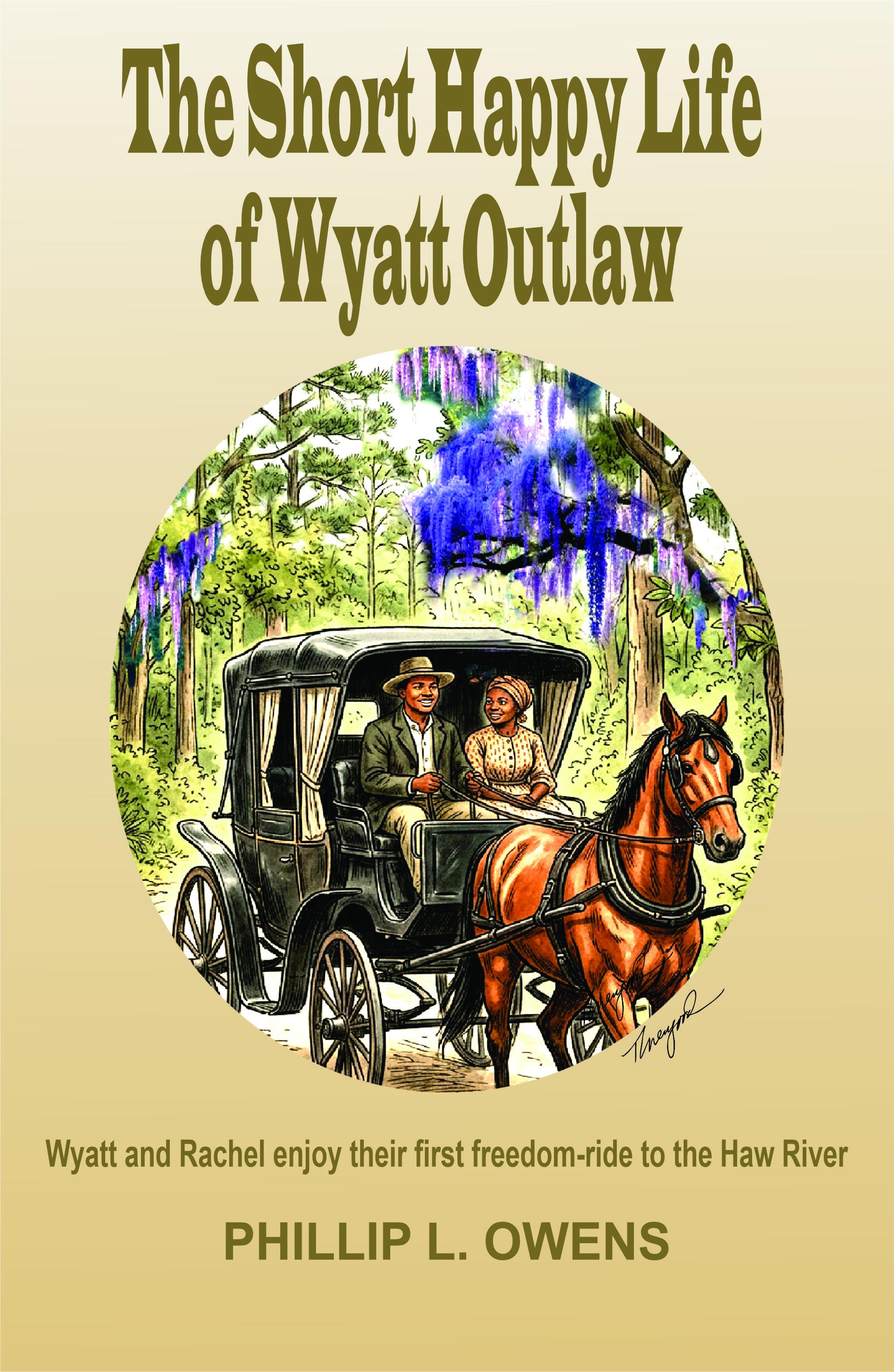
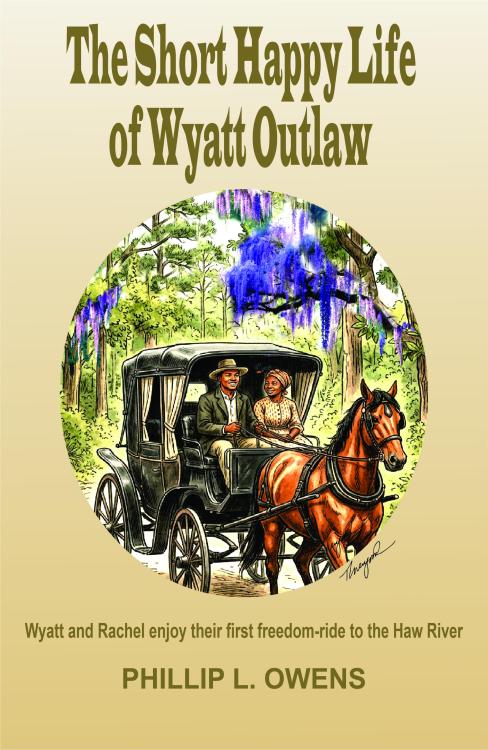
Please Help: Is it still possible to get a free book review as advertised? I can't find the African American Discussion Forum. I'm including the info as requested. My name: Phil Owens Author's name: Phil Owens Book title: The Short Happy Life of Wyatt Outlaw ISBN13: 979-8-9958249-0-9 E-edition; 979-8-9958249-1-6 Paperback; 979-8-9958249-2-3 Hardcover Publication date: April 26, 2026 Synopsis: THE SHORT HAPPY LIFE OF WYATT OUTLAW (Historical Fiction, about 82,000 words) A Black American Hero That History Has Tried to Forget Wyatt and Rachel’s Forbidden Love A Determined Mother's Strength Holds the Family Together A Book Club Choice for Discerning Readers Little is known about Wyatt Outlaw’s life, but his death is well documented. The Short Happy Life of Wyatt Outlaw tells the heroic story of an enslaved man that history wants to forget; it imagines Wyatt Outlaw as a son, husband, and father. The novel is framed with the murderous events that occur in Graham, North Carolina, on February 26, 1870. The atmosphere is thick with political tension and impending violence. Wyatt Outlaw, a Black town commissioner, master carpenter, and Union veteran, is marked for death by the White Brotherhood and KKK. Born the unacknowledged son of a white planter and an enslaved mother, Wyatt is sold to protect his father's fragile public image. After years of working as a slave on a tobacco farm and then being brutally beaten by a patroller or “pattyroller,” Wyatt's world improves when he meets Rachel. Because marriage is forbidden for slaves, their romance culminates in a secret jumping-the-broom ceremony. They begin a family, but when a violent clash with a pattyroller—to defend Rachel—forces Wyatt to make an impossible choice to flee North, he joins the United States Colored Cavalry to fight against the system that enslaved him. Following the Civil War, Wyatt returns to Graham a free man and a proud combat veteran. With the help of his strong mother, who takes care of his three sons, Wyatt attempts to create harmony out of the ashes of the Civil War. He builds a successful woodworking business. He is appointed town commissioner and becomes a leader in the Union League, working to forge a political alliance between newly enfranchised Black voters and poor white farmers. But this coalition is a threat to the old Southern aristocracy, and the planter class unleashes the White Brotherhood and KKK to crush Wyatt’s organizing efforts through terror, triggering a ticking-clock countdown leading to the Kirk-Holden War. The narrative is followed by a Book Club Discussion Guide that offers readers and book club groups a profound look at what it costs to build a family and community when the world wants to forget you. Front cover:
-
Troy, Thank you for your excellent detective work on the AI-generated book My First Juneteenth, and especially for the Evidence List section of your case against AI. Clearly there are many important ethical and legal issues with AI that must be While I knew that many "authors" were using AI to rapidly generate multiple books, which are often filled with content and grammatical mistakes, I had not considered how easy and fast it would be for AI to use cookie-cutter algorithms to generate Extreme Keyword Stuffing and "Template" Layout matching. Thanks for pointing that out. In a world where deceit and outright lies are commonplace---from our president and other politicians, business leaders, Facebook, etc., ---and apparently accepted by many or most people, it can be no surprise that "artificial" intelligence is replacing human intelligence. The bigger question might be which is preferable, AI or human "intelligence," which gave us slavery, Hitler and the Holocaust, wars and more wars to enrich the military industrial complex, etc.
-
God knows this is not a knock on Black people, whether they "read" or not, because they're primarily who I wrote The Short Happy Life of Wyatt Outlaw for. But I'm really struggling to secure Black readers (who I intended to be my primary audience), and so far I can't get any help locally. I've visited the local African-American museum twice, given them a copy, etc. with no result. Maybe I'm doing something wrong, or not doing something right. The main reason I haven't placed my book on AALBC yet is I'm wondering if Black readers might resent my intrusion and I'd just be wasting money and yours and my time.
-
Thanks for the info. I have some tentative plans for another book, but it will be a while. The article on my novel was in the printed paper and epaper, but if I send you a link you have to sign in with an account. I downloaded it, but it's a pdf and the forum page won't accept a pdf. Can I send it with your email or some other way? I hope you enjoy a good 250th anniversary Saturday. It's supposed to be over 100 degrees here in NC.
-
Troy, I'm tired of fooling around with Facebook ads. I'm impressed with what you've created at AALBC. I'm ready to stick my big nose in (you probably can't see that from the newspaper picture). Should I start with buying a profile or buying $100 worth of ad impressions?
-
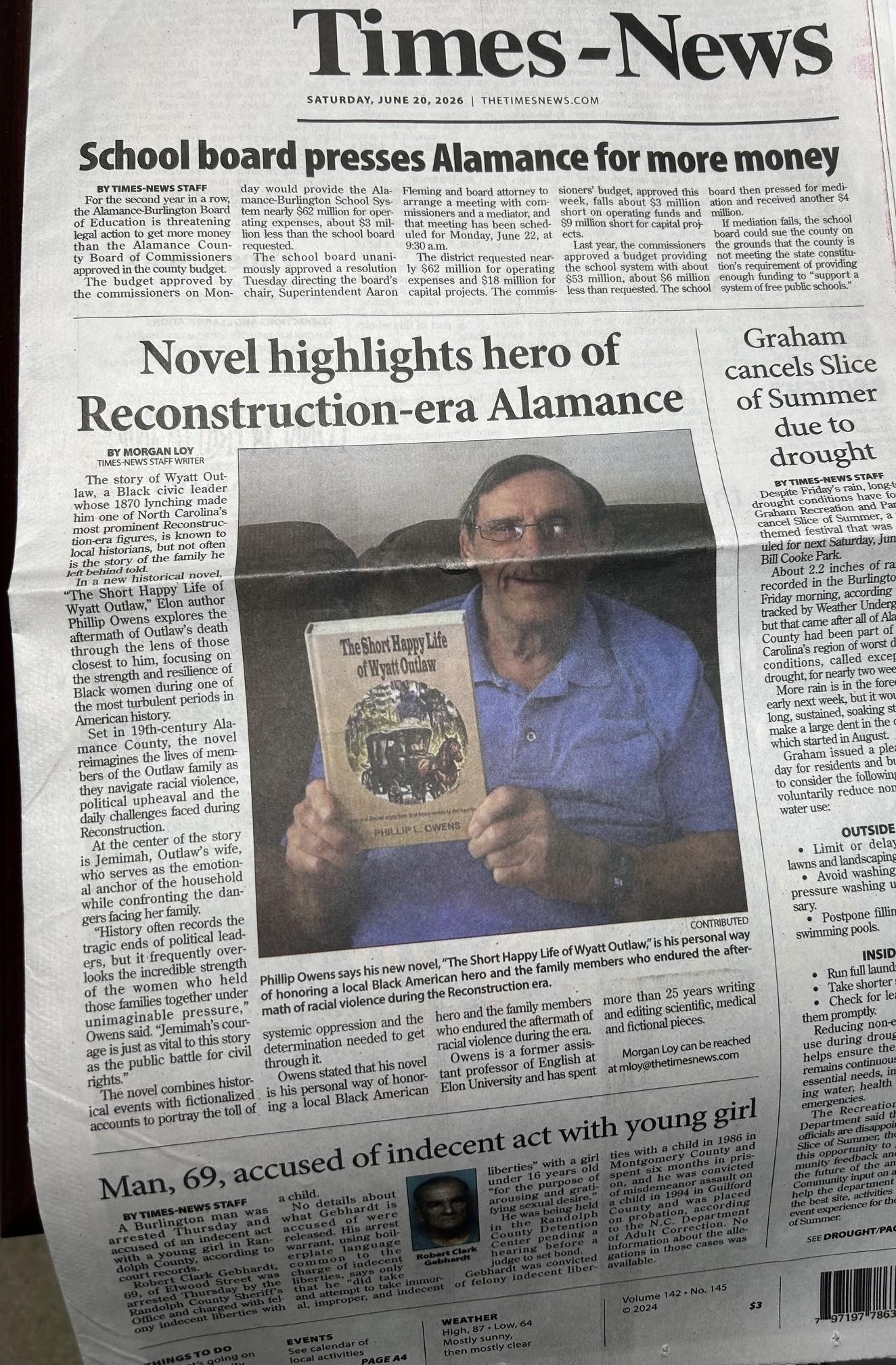
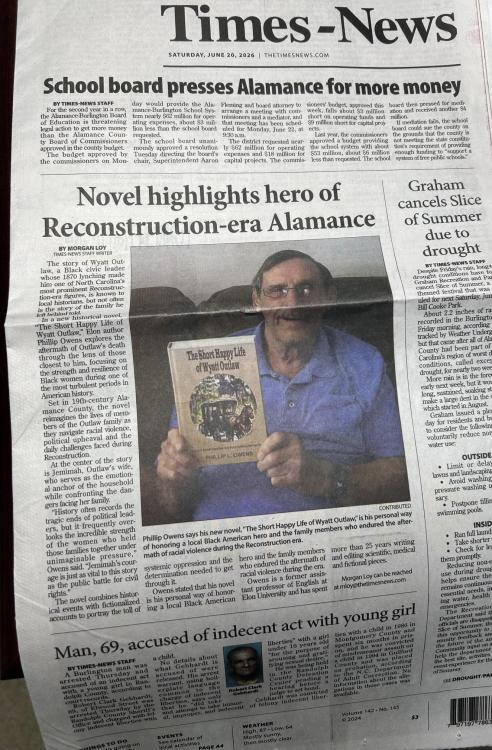
Thanks for the info. I did try to reply twice, but apparently it didn't work. I got lost in some of those forum conversations, and I guess replied to the wrong message. I did get an article on the front page of our local newspaper (see below). Do you think my novel is a good fit on AALBC? How challenging is it to list a book on your site? I'm not very experienced at creative.
-
Troy, you wrote: I say that all to say I don't want to read a book written a white man telling a Black family's story from the Black family's perspective. What I would want to read. possibly, is Outlaw's story from the white person's perspective. Which story are you telling? I’m telling Wyatt’s story from a white person’s perspective. I was born in 1942 of a working class family in High Point, NC. My father worked in a hosiery mill all his life and had only a 5th grade education. I grew up living next to a Black neighborhood. I did not witness any of the violent acts you mention, some of which occur with considerable brutality in my novel, but segregation, white and colored water fountains, the absence of Blacks in schools, swimming pools, movie theaters, etc. had a big impact on me. I was the first and last in my family to go to college. I use a third person limited point of view in present tense so you're there when it occurs. When Wyatt is whipped by pattyrollers, you feel his pain. Although my narrator is never named or described, I think you would quickly realize it's from a facetious white perspective. It mocks Faucette, Wyatt's father and plantation owner. It mocks the white Union officers who disrespect Wyatt and his cavalry friend, etc. Most of the story is from a Black character's perspective, Wyatt or his mother, who also is a heroine in the end. My goal is to make it onto a bestsellar list for Black readers. You probably know that the "Short Happy Life" of my title alludes to Hemingway's story. I use Hemingway’s stark writing style with short, readable chapters. I realize that time in our country's sordid history has been written do death, and parts of my novel sound like cliches because of that. For example, the jumping-the-broom scene when Wyatt and Rachel get “married.” But I tried and hope I achieved a fresh approach. Unlike Trump's cronies, I trust the expert, in this case you. Do you think Black readers will respond to my story? If you find this intriguing at all, I ask for your help in marketing my novel without breaking my bank account. I would love for you or a trusted colleague to read parts or all of my novel and tell me if you think Black readers will respond to it. If you don't think it's worth your time or trouble, I understand and I'll quit bothering you. If you think it's worth a try, I'll consider spending to promote it on your site. Can you get a better price through Ingram's than I get with author copies? Can we sell it from your site and cut out Ingram and am*zon? Maybe you have contracts that forbid that kind of collusion. Wouldn't it be refreshing to have an old white man (me) working together with a young book consultant like you?
-
In my humble opinion, Curiosity, a desire to learn, explore, or investigate the world around us, and Reading, which can enrich and fulfill that curiosity, are the two most important talents a person can have. And interestingly, both are virtually free. Not a day goes by that I don't search for an answer about something I don't understand and/or read about it. Below is several excerpts from the last chapter of my novel, The Short Happy Life of Wyatt Outlaw. Wyatt was trying to teach his children to read before a gang of white men broke into his house, brutalized his three children and mother, Jemimah, and dragged Wyatt to the courthouse square to be hanged. Julius stands tall in the early morning sunshine, trying his best to be brave. The slight breeze stirring the white blossoms makes the dogwood trees look like ghosts in the surrounding yard and woods. He knows how scared he feels, and he senses that the lingering fear must be much worse for his little brothers. At least he’s not still trembling at every unexpected noise. It’s a perfect day to be outside. Julius tries to focus on all the green leaves and birds, especially the robins, hopping around looking for worms. It’s much better outside where he can see if anyone bad is coming; when he’s inside the cabin, even though it’s a different house, he keeps hearing the door exploding and people yelling. Julius holds up a perfectly Y-shaped piece of a dogwood branch and says, “I been lookin for a week. See what I found, Mama. I’m tryin to make myself a slingshot so I can shoot somebody. Maybe I can kill a rabbit or squirrel to eat.” Oscar sits quietly on the cool ground. He still doesn’t understand that his daddy isn’t ever coming home again. A red ant crawls up his leg, and he screams and squashes it between his fingers. Jip lies patiently beside Oscar; since that terrible night, the puppy has stayed within a few feet of Oscar during the day and slept curled up with him at night. Little Wyatt asks, “Can I play with my sticks? I’m gonna make me a spear. Me and Julius can go huntin. We’ll be safe together, won’t we, Mama?” “No playin today, at least not til you work on your letters some more. Nancy Outlaw, she gonna help us again. You all did good yesterday. Your daddy said readin and writin are the most important things you can do to help yourself, and I believes him. I’m sorry I can’t do much good with writin, but at least I can read some.” Just then Nancy Outlaw walks up carrying a small book and hands it to Jemimah. It’s a dirty, beat-up Freedman’s Spelling Book she scrounged from a local Quaker friend. Its brown-spotted cover reminds Jemimah of a dried-up tobacco leaf. “Do we have to?” Little Wyatt and Oscar whine in unison. Jemimah looks at Julius. He’s eager, already opening the book and pointing his finger at the word T-R-Y. "Say it," Jemimah says. “Then name the letters. Boys, you pay attention to your brother. He knows it’s important. You got to learn to read and write like he is.” Her voice is urgent, pleading with the boys, but also commanding. Julius pronounces the word, then spells the letters. Jemimah says, “Read the words.” Julius wants to, but falters, then looks up at the sky, his eyes searching for his father floating by in the clouds. Julius has been told by Jemimah that Wyatt has gone to heaven. The main thing he remembers is that his daddy promised to talk about a book they had been trying to read together. His daddy promised a lot of things, got them a dog, and played with the boys often, but the one thing he kept insisting was that books and reading are important. That they make a person proud and free. “You boys listen to me. Your daddy gave you a book. He told me his plan. He was gonna read it with you. All three of you, when it was your turn. Don’t be afraid of books. There’s books everywhere. We just couldn’t ever have any cause the law says slaves can’t have no books. But we ain’t slaves no more. Together, we gonna finish your daddy’s plan." Julius looks back down. He finds F-R-E-E. He says the letters and the word clearly, louder than before. Both Little Wyatt and Oscar repeat the letters and then pronounce the word. Jemimah watches her boys hunkered over the page, their eyes tracking the letters like they’re hunting a rabbit or searching for the ripple of a catfish in Jordan Creek. Every syllable they get right is a crack in the courthouse foundation, a kick in the rears of the men in the hoods. Jemimah doesn't need to hear the words pronounced to know she’s winning; she just wants to see her oldest boy’s jaw set firm—just like Wyatt’s was at first when he refused to run. A slate-colored dove lands within arm’s length of Oscar. Ignoring the dove’s cooing, the boys sit transfixed, all their senses focused on Jemimah, expecting a miracle. She breaks the spell, asking, “Do you like that story? What does it tell you about life?” Oscar answers, “We don’t put no chain around Jip’s neck.” Little Wyatt says, “They is dogs and wolfs in the world. I’d rather be a dog.” Pondering, Julius finally responds, “It’s better to be a skinny wolf that’s free than a fat dog that’s kept tied up.” Jemimah and Nancy Outlaw both laugh and say, “That’s good answers.” “Mama,” Julius asks, “is that why them bad men dragged our daddy away? Cause he used to be a slave dog and now he’s free like a wolf?” Little Wyatt yells, “I hate them men in white. They took our daddy away. When I get bigger, I’m gonna kill them. All of them.” “Me too,” says Oscar. “Will you help us, big brother? Will you help us, Mama?” Julius doesn’t answer. Looking directly at Nancy Outlaw, Jemimah replies, “Boys, my boys, I knows how you feel. I wants to kill them, too. They’s bad people. But killing is bad. God says not to kill. “I don’t want to hear no more talk about shooting people or spearing people. We free now. We free to love, or we free to hate. Some people will choose hate, but not us. We done had enough of hate. We needs to choose love. “I knows you remember how much your daddy loved you. Remember him like he was that night, playing the bear. And I loves you, too, more than the sun loves the moon. Promise me you will choose love.”
-
Just another example of how Trump and his cronies will stoop to anything, any falsehood, to further his Kingdom.☹️
-
Troy, Someone asked how old I am. I'm 83, white, from Alamance County, North Carolina. My goal is to celebrate the life of an enslaved man as an American hero. There's been a controversy here for years because Wyatt Outlaw (he was enslaved on the Outlaw farm) overcome tremendous odds to serve as town constable and town commissioner of Graham, the county seat. He also tried to establish a church and school there, was a talented woodworker, etc. For his reward he was lynched in the Graham town square (don't share that with potential readers). I wouldn't expect you to have heard of him because hardly anyone here had heard of him either until recently. That's what motivated me to write this novel. Town protests in 2022 brought to our attention that there's no marker for Wyatt, he's hardly mentioned in textbooks, etc. Yet in the courtyard where he was hanged there's a statue of a Confedererate soldier. Hardly anything is known about Wyatt's life except that he had three children and a strong mother who survived, his last two years as a town leader in Graham, and the way he died. My novel creates a life for him. It's historical fiction, so if I checked the nonfiction box it was an error done in haste. I wrote this novel because I see Wyatt as an American (not African American, but American) hero people should know about, but that white history wants to forget because of the way he died. My target audience was Black readers but I'm struggling to reach them. My white readers (so far mainly friends and family) tell me it affects them emotionally and makes them reconsider how they view race relations and bias in America. Personally, I believe the current government has turned back the clock and is fostering much of the diviseness in our country. I would love to have a private or semi-private forum conversation to learn anything you can provide to help me market my book. I really believe it has an important message to share.
-
Forgive me, I should have said I'm an OLD white man, whose lived through a lot, seen a lot of unfairness in our country, still believe it's the best country, but frankly scared. Trump and his followers are bringing back the racial unfairness, worship of the wealthy class, antagonism for anyone who's different, etc., with a vengeance. What bothers me the most about what's happening in our country is that most people (I say white people because that's what I know best) are silent, standing by while the country goes to hell or disappears completely. Events, statements etc. are accepted as "normal" now that would have been totally rejected as obscene or racist or insurrectionalist 10 years ago. That's one of the reasons I joined AALBC, to find out what AA think, say, and do in our troubled times. I'm sad to say I have no close AA friends. And honestly, I'm trying to promote my new novel, The Short Happy Life of Wyatt Outlaw among AA readers. So far, almost almost all my readers are white, and they tell me they cry at the inhumanity of slavery and the tragic story about a heroic Black man who was murdered because he was "uppity." So someone here mentioned "the same Black women who could care less about exchanging opinions and conversing with Black men on ANY topic will often JUMP at the opportunity to exchange opinions and engage in stimulating conversation with the first "intelligent" White man open to do it with them." White, yes. Intelligent, remains to be seen. I say bring them on, come on ladies, because the real "hero" of my novel is Wyatt's mother, who holds the family together and survives to send Wyatt's young children into the future.
-
I'm white, so my opinion is biased, but to me, our country has made great strides in accepting people who are different, but we still have a ways to go. I hate to see us going backwards, which I believe is happening now with the Trumpsters. It would be nice if, on our 250th anniversary, we could celebrate for all Americans, and not just for a select group.
-
Wyatt Outlaw was a Black American hero that history has tried to forget. I’m trying to get my new novel, The Short Happy Life of Wyatt Outlaw, listed on AALBC but so far haven’t figured out how. It’s available on am*zon, B&N, Ingrams, and other sources. Little is known about Wyatt Outlaw’s life, but his tragic death is well documented. My novel imagines Wyatt Outlaw as a son, husband, and father. The novel is framed with the murderous events that occur in Graham, North Carolina, on February 26, 1870. The atmosphere is thick with political tension and impending violence. Wyatt Outlaw, a Black town commissioner, master carpenter, and Union veteran, is marked for death by the White Brotherhood and KKK. Born the unacknowledged son of a white planter and an enslaved mother, Wyatt is sold to protect his father's fragile public image. After years of working as a slave on a tobacco farm and then being brutally beaten by a patroller or “pattyroller,” Wyatt's world improves when he meets Rachel. Because marriage is forbidden for slaves, their romance culminates in a secret jumping-the-broom ceremony. They begin a family, but when a violent clash with a pattyroller—to defend Rachel—forces Wyatt to make an impossible choice to flee North, he joins the United States Colored Cavalry to fight against the system that enslaved him. Following the Civil War, Wyatt returns to Graham a free man and a proud combat veteran. With the help of his strong mother, who takes care of his three sons, Wyatt attempts to create harmony out of the ashes of the Civil War. He builds a successful woodworking business. He is appointed town commissioner and becomes a leader in the Union League, working to forge a political alliance between newly enfranchised Black voters and poor white farmers. But this coalition is a threat to the old Southern aristocracy, and the planter class unleashes the White Brotherhood and KKK to crush Wyatt’s organizing efforts through terror, triggering a ticking-clock countdown leading to the Kirk-Holden War. The narrative is followed by a Book Club Discussion Guide that offers readers and book club groups a profound look at what it costs to build a family and community when the world wants to forget you.
-
More than anything, my parents shaped my views growing up, but after a certain age it was school and reading. My parents were religious and not racist, and I don't recall ever hearing the "N" word from them, but they grew up poor in the South, with separate water fountains and facilities. They held distinct views about minorities, especially Black people. Our humble home was right next to what my parents called a "colored" neighborhood. So I frequently saw colored kids but was not allowed to play with them (and I don't think they wanted to play with me). There was only one colored girl in my high school class of 400. As I became a teenager and exposed to the news on TV and reading, I realized there was something fundamentally wrong with our society. Now that I'm am older white man, I see our country recently going backwards towards more unacceptance and hatred of others, especially minorities. It’s scary. To me, MAGA means pull minorities down or send them home to make some white majority greater. That's one of the reasons I wrote my novel, The Short Happy Life of Wyatt Outlaw. It tells the tragic story of an enslaved man that history wants to forget. The novel is framed with the murderous events that occur in Graham, North Carolina, on February 26, 1870. The atmosphere is thick with political tension and impending violence. Wyatt Outlaw, a Black town commissioner, master carpenter, and Union veteran, is marked for death by the White Brotherhood and KKK. To me, Wyatt Outlaw is a hero who overcame great odds to become successful. To me, our country has made great strides in accepting people who are different, but we still have a ways to go. I hate to see us going backwards. It would be nice if, on our 250th anniversary, we could celebrate for all Americans, and not just for a select group.