

Troy
Administrators
-
Joined
-
Last visited
Everything posted by Troy
-
Yes Cynique, life itself is lethal... ...and sure poor Black people smoke and engage in a variety of ill advised behaviors due to stress. It does not have to be that way, but I guess there is too much profit in it to be any other way.
-
I stumbled across this image on a Portuguese language blog truth is universal despite the language. I've been taking to my kids about my anti-facebook obsession. They liked my aversion to Facebook to any unwillingness to use the phone or email. I failed to communicate my dislike for Facebook in terms they can relate to or agree with. I notice there is a generation gap on this issue. Even if someone my age disagrees with me they "get it." I have not encountered a 20-something can related on any level to my impressions. I looked more into the experimentation The experiment indeed revealed that if Facebook presented members with information that skewed negative, their posts skewed negative. The practice of manipulating what we see raised numerous ethics questions by the scientific community.
-
WC in this case I'm not really clear on what you are saying or looking for in terms of a response. I read what you wrote and skimmed the attached pdf. For most of recorded history the continent of Africa and Black people represented the height of civilization. Sure the last few hundred years in North America have been disastrous for Black people but that is a relative blink of an eye relative to the dynasties of the Nile Valley. Blackness is denigrated because it servs an economic means. If equating Black people with animals made the permanent enslavement of Black people palatable to religious people great. If science could be contorted to "prove" Black people were inferior terrific. If the Black people, already robbed of their history, could be brainwashed into believing in the own inferiority by the perverted science and religion--perfect. The battle is about power. The "race" crap is a diversion. Unfortunately in the world we live in we have to deal with it, The history of Black people is available, the science on race is available too. The problem is people are not interested in this stuff and are quite happy talking about Black this and white that while being raped by the powerful without even knowing what happening--or better yet enjoying it.
-
My how times have changed: In terms of not being compromised. Sure there were some that not compromised. But it seems to me the trend since integration has led to the most successful of us selling out and doing whatever it takes to make the most money we can regardless of what it does to our people. They like ghetto pimps, drug dealers and charismatic preachers manage to exploit a community while being revered at the same time. The most financially successful are the gangsters whether they are on Wall Street or "da street," we worship money, or people with it, over everything else. Which is why tobacco companies used doctors and athletes to sell cigarettes at a time they knew they were lethal. Wait until marijuana is legalized... Today the poorest among us are the most likely to smoke. In NYC with cigarettes costing $13 a pack, 1 out of 5 people below the poverty line still smokes. In Vicksburg MS cigarette smoking is on the rise. The more things change the more they stay the same.
-
Of course they printed your letters Cynique--you are a talented writer with an opinion and the willingness to express it. I'd imagine now, given your experience, you are even better with much more to say... In fact I found your old letters pretty easily. Your perspective above is truly valuable as your first hand experience with Ebony magazine, in its heyday, is one we will be loosing very shortly. What was the sentiment surrounding all the liquor and cigarette ads. I guess no one knew cigarettes were poison. I'm old enough to remember when having a drink in one hand and a square in the other was the epitome of cool! Cap that off with being able to bed a bunch of honeys and you were the man! Like Billy Dee and Colt 45 it work every time! It is really sad those were our role models and going to school was for suckers. I think in our anxiousness to enter the white world were forgot who we were...then again we really really knew who we were did we? Yes I was aware of Lerome Bennet's role. I had the pleasure of meeting him about a decade ago and I have an autographed copy of Before the Mayflower. I believe he wrote the cover story of this issue. I may have this issue. Google definitely has (I really do hope Ebony is getting a piece of this action.
-
LA Leimert Park Book Fair 4001 West 22nd Place • Los Angeles, CA • 90018 • Phone: 323. 730.0628 July 8, 2014 Dear Author/Publisher, We are pleased to announce the addition of the Jessie Redmon Fauset Book Awards to the LA Leimert Park Book Fair! The LA Leimert Park Book Fair is produced by Cynthia Exum and Associates in partnership with the City of Los Angeles, LA Department of Cultural Affairs, and the Baldwin Hills Crenshaw Plaza. Our annual book fair has become a much-anticipated cultural tradition in the community; providing authors an opportunity to promote their latest work as well as meet some of their fans up close and personal. Named after one of the most prolific, intelligent women novelists of the Harlem Renaissance, Jessie Redmon Fauset, this inaugural awards program will honor well-deserving authors and books. The Jessie Redmon Fauset Book Awards will be presented as a “Best of” award in five categories. The top five titles in each category will be announced in late July and nominees will be notified via email. The winners will be announced during a special ceremony at the LA Leimert Park Book Fair on Saturday, August 9, 2014. For our 2014 awards program, we are now accepting submissions for works published between January 1, 2013 and May 31, 2014. In addition, the submission fee of $75.00 (per entry) will be waived for this inaugural event. Entry forms may be submitted via mail (address listed on form) or email to FAUSET@outlook.com. Please see the attached category listing and entry form for details, rules and restrictions. Thank you for your continued support LA Leimert Park Book Fair and the 1st Annual Jessie Redmon Fauset Book Awards. If you have any questions or require further assistance, please contact Awards Director, Annette Thomas at FAUSET@outlook.com | 562.761.2007. We look forward to receiving your submissions. Sincerely, Cynthia E. Exum Annette Thomas LPVBF Producer/Executive Director Awards Director 323. 730.0628 annettethom2@yahoo.com exumc12@gmail.com COMPETITION CATEGORIES OUTSTANDING LITERARY WORK: 502 *General Fiction: Novel, Novella, or Short Story Collection. Genre Fiction, Mystery, Detective, Popular and Commercial Novel. 503 *Non-Fiction: Literature that is not fictional; Memoir, History, Social Issues & Literary Criticism. 504 *Poetry, Spoken Word: Literary work or collection written in poetic form. 505 *Children/Young Readers: Literary works appropriate for children; Ages birth to 10. 506 *Youth/Teens/Young Adult : Literary works appropriate for children and teens; Ages 11-18.
-
Indianapolis based poet Mari Evans made 95 on July 16 See kwansaba below & attached w/photo of Mari, Maya & EBR from 1985. Mari Evans' Workswomanship: A Kwansaba for Her 95th Birthday Poeting throne & shackle's seesaw ntu utile dulci, "I am a Black Woman" rescued images from dish water, floors and pimp- stained flicks of fare. It was easy as grief. Needy as respite. Renew-able as dues-tithing blues. New bardic--& goddess-built--doorway of our (!yes) return. Maya Aneglou, Mari Evans (seated) and Eugene B. Redmon This photo was taken in 1985 at Maya's home in Winston-Salem, NC. It was provided courtesy of Eugene B. Redmond, and is one of hundreds of thousands of photos, books, letters, mags, newspapers, pieces of regalia, art works & other memorabilia in the Eugene B. Redmond Collection at Southern Illinois University Edwardsville (www.siue.edu).
-
I hear you Cynique. But Facebook uses you, me and everyone else far more than we use them. What we get in return, pales in comparison with what they earn as a result of our activity. They should share some of the wealth. That said, avoiding Facebook is actually not as easy as you might think. First, many Google searches on an author's name returns a Facebook page. Also many people link to Facebook from their own websites. I accidentally clicked a link to Facebook from an author's Blog moments ago. You can't just simply say I'm not going to use Facebook. You have to actively work at avoiding Facebook, if you are online as much as I am. Facebook as done a remarkable job dominating the web. Facebook's gangsta is prodigious and quite admirable in a notorious way. I don't know anyone else who has joined this experiment. Only 0.0019% or 24,136 people out of Facebook's approximately 1,300,000,000 users gave signed up as of now. I've had more people sign up for my eNewsletter. I guess, at the end of the day, those who have issues with Facebook aren't using, and those you use it aren't about to stop. These simply don't care enough one way or the other.
-
ReneeS1971 your entry is confirmed you have been assigned number 1 ariasu your entry is confirmed you have been assigned number 2 Michelle your entry is confirmed you have been assigned number 3 md-williams your entry is confirmed you have been assigned number 4 BabyBoomber your entry is confirmed you have been assigned number 5 LisaM, I can't validate your entry as the email address used to create your account, on this forum, is not currently subscribed to receive the AALBC.com eNewsletter. Only current subscribers are eligible for this contest. Sorry. No more entries will be accepted after midnight (EDST) July 27th. There is room for one more subscriber to win a 1 in 6 chance of winning 50 bucks.
-
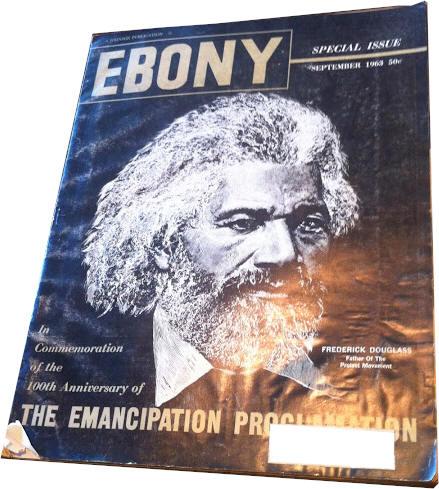
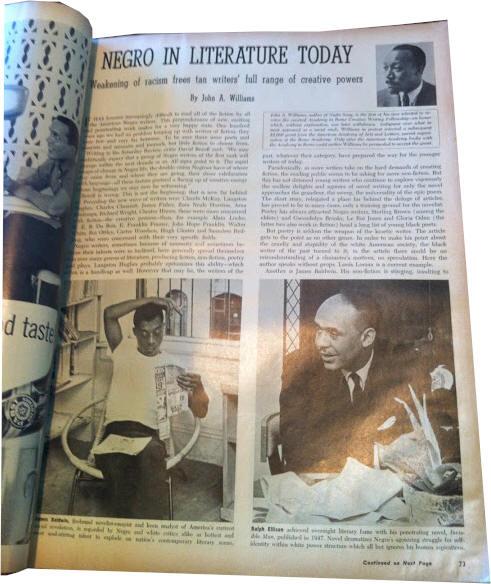
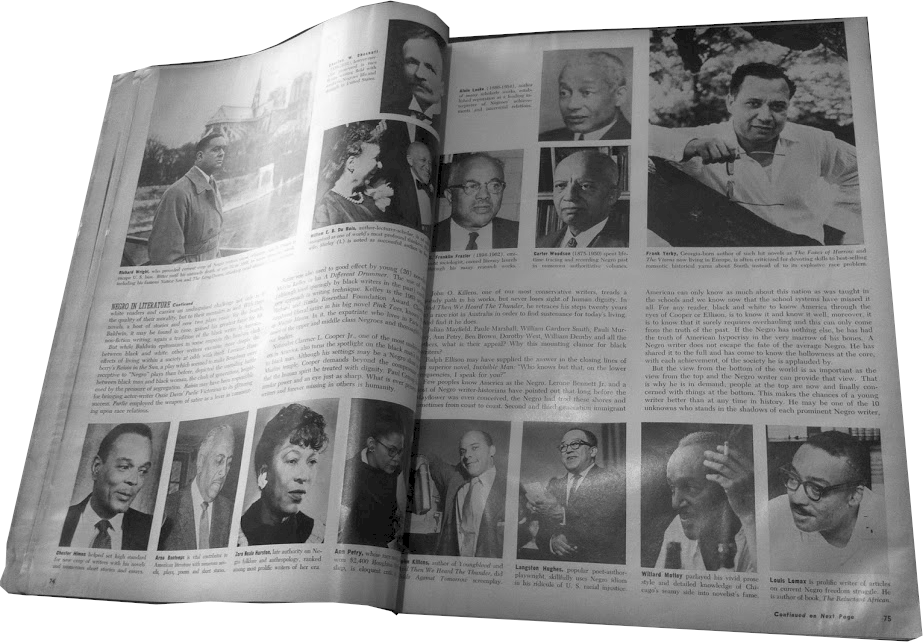
During a recent "vacation" I took to reading old issues of Ebony Magazine. I have a collection of about 30 issues from the 50's and 60's. The images below are from the September 1963 issue. I found the magazine simply fascinating. It can be purchased on Amazon (not for sale by me) and Google has made this issue available online, Interestingly, I see no indication that Ebony has provided an online archive on their website. I still find it amazing, annoying even, that Google profits from Ebony's content while Ebony loses out on traffic and associated revenue. Of course, I've been critical of Ebony's online presence in the past, but it still irks me when they blow opportunities by failing to take advantage of their wealth of information. Run a Google search on Ebony Magazine September 1963, as see how many pages deep you have to go before you even see a link to Ebony Magazine's website. The quality of writing was superb for a magazine marketed to a Black mass audience. The whole idea that these types of articles (long form, written above a 8th grade reading level, not celebrity or scandal driven) don't appeal to Black readers in 2014 does not hold water--particularly with so many more Black people holding college degrees in 2014 compared to 1963. The article depicted below, "Negro in Literature Today" was written by John A. Williams. Williams offered a terrific, now historical, snapshot about the best Black writers in 1963. Most of the authors cited are profiled here on AALBC.com, but there were a couple of writers I was unfamiliar with, but rest assure I will profile them here on AALBC.com shortly. I can't image Ebony or any mainstream magazine publishing a piece like this today. While the contest was the advertised products often left a lot to be desired. Advertisements for cigarettes and hard liquor dominated. I was also surprised to see ad for skin lightening creams. The dichotomy between the advertisements and the content was much more stark back then. Cynique in some ways I envy your generation. Don't get me wrong you can keep the overt racism and segregation you had to deal with, but I think the Black community was better served by their institutions (publications, churches, civil right organizations, HBCU's, etc). What do you think?
-
Win Fifty Bucks Just for receiving the Nina Foxx email! The rules are simple; there are only three steps: Follow the link from our eNewsletter to this page (I assume you did that to find this page). Create an account on our discussion forum (if you don't already have one), by clicking this link or the green Create Account button on the upper right hand side of this page. Finally, reply to this post by typing, "I enter the contest." That's it! The prize is $50 (payable via PayPal or Check). Only current subscribers to the AALBC.com eNewsletter are eligible to win (you must have received the Nina Foxx email announcing the contest, via email). The contest will close one week after the emailing was sent or when six (validated) entries have been submitted--whichever comes first. I will confirm the valid entries, here, on this discussion forum. Once six validated entries have been submitted (or one week has passed), I will close the contest and select a winner. I will assign a number from 1 to 6, to each validated entry, and the winner will be selected by a roll of a die. The winner will be announced in a video I post here. Good luck!
-
I just joined this effort. Right now there are 20,836 people with me. Sure that is less than a drop in the bucket as far as Facebook members are concerned, but for the individuals involved there may be some significant benefits. Provided the most obsessed can get over the withdrawal period. In reality the time I spend on Facebook is not a big deal. In fact, I rarely use Facebook for personal reasons now. So this effort is of little consequent in my own life. My motivation for participation has a selfish component. I am hoping people begin to spend time visiting other websites (including this one) rather than giving Facebook so much of their time. The Internet is drying up. The Black presence is most afflicted. For example, I just deleted 7 websites from my Black book website database, including Blackliterature.com, mosaicbooks.com, rawsistaz.com, and others. Some of these sites have migrated their web presence to Facebook, but a Facebook page pales in comparison to full blown website. But I understand why it is done; despite all the technology available to make building a website easy, running a viable one, that people actually, visit is much, much harder today. I hope my participation in this effort raises awareness of this fact. While I won't be using the Facebook platform directly, I will continue to share information from other websites to Facebook. That is not cheating is it?
-
WC, I like the way you think. Solution driven. I also appreciate your contributions here as well. It is probably worth emphasizing Cynqiue's point about this discussion forum; lurkers (visitors who read but don't post), were always the majority of visitors to this forum. However over the last few years poster activity has decreased dramatically. In many ways this is reflective of broader changes in the book industry. It is also worth emphasizing that "Net Neutrality" is a fight between the owners of the web and has nothing to do with small indie websites like mine. We lost what little power we had on the web years ago. Many of us have been duped into believing social media has compensated what was lost. AALBC.com is literally the oldest, largest, and most frequently visited website, on planet Earth, dedicated to Black Literature. This is not because I'm good at what I do; it is because all of the other sites are been beaten into obscurity or out of business. I spend about 25% of my time advocating for entities most would consider competitors but my survival depends upon an rich environment for Black books and one man, no matter how impassioned and dedicated, with a few websites, can not create this environment this alone. Now to your point. I like the idea and there are a number of ways to execute this; one could simply have palm cards with QR codes that people can scan with their smart phone for a free download sample. These cards could be placed in all of the venues you've described and the proprietor could be given a cut of any resulting sales. Again, this is one method and it is not particularly creative as it has been done umpteen times before The problem with it would simply be one of execution: Few of us have the free time, energy, money or ability to do this. The best and brightest of us of use our abilities to serve corporations or ourselves. I really did not appreciate this until I became a full-time entrepreneur. We simply do not have the infrastructure necessary to create an environment in which Black owned businesses can grow over the long term. I've seen the example of your comic book vending guy countless times. His reaction does not surprise me. Indeed it might even have been rationale from his perspective of making money for himself. But that mentality results in an environment where a few of us have a ton of money but most of us are struggling. In the last couple of years however I have noticed there has been more activity of businesses working together. This is largely borne out of necessity, as individual realize they need to work with others to grow. This does bode well for a positive future. I will pitch a variation of your idea to others over the next few months. We work together or we die alone.
-
I think this campaign is just brilliant. Anyone who has been reading my writing for the last couple of years already knows I think the impact of social media in general, and Facebook, in particular on the web has been quite negative. Basically the impact has been to lower the diversity and discoverability of content on the web. As a result, independent Black voices on the web are being silenced. We are running fewer sites the ones that remain are getting fewer visitors. Corporations run are many of our most popular websites and those sites focus primarily on celebrity gossip and hip-hop music. Facebook generally promotes the stuff that will generate the most activity on their platform. Posts with links off Facebook are simply not displayed as much as they used to be.. I rarely use Facebook for personal reasons nowadays but I generally share something from AALBC.com of a daily basis. I was never satisfied with the duplicitous nature (using it for business and for personal stuff) of my Facebook usage. So I'm joining this campaign for AALBC.com (and Troy Johnson) by default for 99 Days. We will see what happens This is on the heals of Facebook's ethically questionable practices on their visitors: Did Facebook and PNAS violate human research protections in an unethical experiment?
-
New Facebook mood experiment asks, "Are you happier without Facebook?" http://99daysoffreedom.com/ July 9, 2014 Leiden, The Netherlands - In response to Facebook's controversial mood experiment involving some 700,000 unwitting users, a new initiative has launched an experiment of its own -- determining how life without Facebook impacts user happiness. The non-profit initiative, known as "99 Days of Freedom," asks users to refrain from Facebook use for a period of 99 consecutive days and report-back on how the hiatus affects personal notions of happiness. The initiative's website, 99daysoffreedom.com, provides a set of simple user instructions, which include posting a “time-off” image as a profile picture and starting a personalized, 99-day countdown clock. From there, participants are asked to complete anonymous “happiness surveys” at the 33, 66 and 99-day marks, with results posted to the initiative's website as they're compiled. The initiative will also host a message board through which participants can post anonymous accounts of how an extended break from Facebook is impacting their lives. The initiative is the brainchild of Just, a creative agency based in Leiden, The Netherlands. Just's Art Director, Merijn Straathof, explains how what began as an office joke quickly morphed into an officially-funded project. "Like a lot of Facebook users, many of us were bothered by reports of secret mood experiments," says Straathof. "As we discussed it internally, we noted an interesting tendency: To a person, everyone had at least a 'complicated' relationship with Facebook. Whether it was being tagged in unflattering photos, getting into arguments with other users or simply regretting time lost through excessive use, there was a surprising degree of negative sentiment. Then someone joked, 'I guess that the real question is, 'How do you feel when you don't use Facebook?' There was group laughter, followed by, 'Wait a second. That's a really good question!”. A cursory look at Facebook usage stats certainly supports the question's legitimacy. According to Facebook, it's 1.2 billion users spend an average of 17 minutes per day on the site, reading updates, following links or browsing photos. Over a three-month period, that ads-up to more than 28-hours which, the initiative’s creators contend, could be devoted to more emotionally fulfilling activities -- learning a new skill, performing volunteer work or spending time (offline) with friends and family. The obvious question: Considering the remarkable levels of Facebook use, isn’t 99 days a pretty big ask? This, explains Straathof, is by design. “We had a lot of arguments about the experiment’s duration. If it’s too extended, participants will lose interest. If it’s too short, there’s no meaningful behavioral change to assess. In the end, we landed on a 99-day program with periodic surveys and posts, hoping that such interaction will serve as a support group of sorts. As everyone at our firm is participating in the experiment, we’ll be testing that one first-hand.” Although Straathof and his colleagues are eager to see the experiment's results, he stresses that the initiative is neither an anti-Facebook protest nor an attempt to harm the web’s most popular site. "Facebook is an incredible platform, we’re all fiercely loyal users and we believe that there's a lot to love about the service," says Straathof. "But we also feel that there are obvious emotional benefits to moderation. Our prediction is that the experiment will yield a lot of positive personal experiences and, 99 days from now, we’ll know whether that theory has legs.” Artwork for publication Artwork is available for download at: http://www.hostedbyjust.com/99daysoffreedom/press.zip About 99 Days of Freedom 99 Days of Freedom is a nonprofit initiative launched by Just B.V. (www.wearejust.com), a creative communications agency from the Netherlands. The company specializes in identities, brand strategy and online campaigns with a strong online focus. For questions about 99 Days of Freedom or Just, please contact merijn.straathof@wearejust.com.
-
While on my semi vacation I've been reading some old issues of Ebony Magazine. The writing in articles was quite impressive 50 years ago. What was even more surprising was the advertisements. They had professional athletes selling cigarettes; the variety and number of ads for hard liquor were also surprising. The advertisements boasted how good the cigarettes were for you. then there are the ads for skin lightening creams. Most of the products promoted in the 50+ year old magazines were just bad for you. We live in a culture where it is acceptable even encouraged that people will do anything for money--it is the American way. Whether it is cancer causing cigarettes or marijuana laced with something to it more potent it--makes no difference anymore than if it is Philip Morris operating out of a corporate suite or Raequan on the street corner. Our culture breeds the mentality where money is more important to us that another human being, our neighborhood, country or even the planet.
-
Cranky Old Man What do you see nurses? . . .. . .What do you see? What are you thinking .. . when you're looking at me? A cranky old man, . . . . . .not very wise, Uncertain of habit .. . . . . . . .. with faraway eyes? Who dribbles his food .. . ... . . and makes no reply. When you say in a loud voice . .'I do wish you'd try!' Who seems not to notice . . .the things that you do. And forever is losing . . . . . .. . . A sock or shoe? Who, resisting or not . . . ... lets you do as you will, With bathing and feeding . . . .The long day to fill? Is that what you're thinking?. .Is that what you see? Then open your eyes, nurse .you're not looking at me. I'll tell you who I am . . . . .. As I sit here so still, As I do at your bidding, .. . . . as I eat at your will. I'm a small child of Ten . .with a father and mother, Brothers and sisters .. . . .. . who love one another A young boy of Sixteen . . . .. with wings on his feet Dreaming that soon now . . .. . . a lover he'll meet. A groom soon at Twenty . . . ..my heart gives a leap. Remembering, the vows .. .. .that I promised to keep. At Twenty-Five, now . . . . .I have young of my own. Who need me to guide . . . And a secure happy home. A man of Thirty . .. . . . . My young now grown fast, Bound to each other . . .. With ties that should last. At Forty, my young sons .. .have grown and are gone, But my woman is beside me . . to see I don't mourn. At Fifty, once more, .. ...Babies play 'round my knee, Again, we know children . . . . My loved one and me. Dark days are upon me . . . . My wife is now dead. I look at the future ... . . . . I shudder with dread. For my young are all rearing .. . . young of their own. And I think of the years . . . And the love that I've known. I'm now an old man . . . . . . .. and nature is cruel. It's jest to make old age . . . . . . . look like a fool. The body, it crumbles .. .. . grace and vigor, depart. There is now a stone . . . where I once had a heart. But inside this old carcass . A young man still dwells, And now and again . . . . . my battered heart swells I remember the joys . . . . .. . I remember the pain. And I'm loving and living . . . . . . . life over again. I think of the years, all too few . . .. gone too fast. And accept the stark fact . . . that nothing can last. So open your eyes, people .. . . . .. . . open and see. Not a cranky old man . Look closer . . . . see .. .. . .. .... . ME!! Social media sharers claim this poem was found among the possessions of an old man who recently died in a nursing home. However the actual poem Too Soon Old in it's original form may be found on the poet, David L. Griffith's website: http://www.spotlightdavid.com/TooSoonOld.html There is so much misinformation circulating on social media that is is crowding out everything else. The poet's website gets little attention while all traffic (Read: money) goes to social media. One can argue that social media helped me discover this guys website. But the vast majority most people would not bother to look for an actual source, shoot the vast majority don't even leave social media. Social media IS the internet for most of us.
-
Read my latest Blog post to learn why Homefest stared
-
Jeffery's book is our book of the week: http://aalbc.it/bookoftheweek you order it here you'll get the lowest price available online (until Sunday) please share the link!
-
Community Book Center Hosts the 2nd Annual HOMEFEST July 4th Weekend COMMUNITY BOOK CENTER 2523 BAYOU ROAD NEW ORLEANS, LA, 70119 Contact: Vera Warren Williams 504.915.4782 or Jennifer Turner 504.948.7323 Activities for HOMEFEST 2014 start Friday, July 4 through Sunday, July 6, 2014 at 2523 Bayou Rd., New Orleans, LA 70119. Each day begins at 10:00 a.m. and includes workshops/discussions, storytelling, children’s activities, music, craft and food vendors plus much more, There will be enlightenment workshops on education with Dr. Adrienne Dixson; Black Faith Systems with Rev. Dwight Clay, Akan Priestess Sula Evans, and Rev. Dr. Denise Graves. Book signings with local authors Freddi Evans, Denise McConduit, Dr. Mona Lisa Saloy, along with guest authors Abiola Abrams, Tashera Simmons and Wahida Clark just to name a few. A health seminar and personal wellness consultations with New Orleans native Dr. Tursha’ R. Hamilton; along with spoken word by tosin gbogi make HOMEFEST the place to be. Local artist Amy Bryant returns to conduct youth centered artistic expression. Framed art by various artists is a new offering courtesy of LaBelle Galerie. Stock up on new releases, “classic” titles as well as T-shirts, natural soaps, handcrafted gifts from Brazil and more. Also visit and support the other businesses and cultural attractions in the area. We will also launch a Friends of Community Book Center Membership drive as well as a new initiative to help promote and support the dwindling number of Black bookstores throughout the United States. Community Book Center (CBC), a cultural and literary hub for over 30 years is a gathering place where conversations regarding education, social justice, economic empowerment and the overall health and well-being of the community are held. CBC is the place to catch up on what’s happening in the city, connect with friends and add new titles as well as replace others lost during Hurricane Katrina. Community based, community organized; HOMEFEST 2014, the heart, soul and essence of New Orleans. For more information call 504.948. (READ) 7323.This event is free and open to the public.
-
I don't know what the problem was Del both your account look fine.
-
We I get back to the office I'll take a look at your account(s) to see if there is anything amiss. Maybe so something funky happened with the Facebook connection. In theory you can only have one ID here per Facebook ID, you should not have been able to create a 2nd account using the same Facebook ID.
-
Del are you ok now? I can't replicate your problem. Right now I'm logged in via Facebook on my cell phone. Was the last post made using the new account you created?
-
Cynique, I always thought your true gift was in non-fiction writing. W.C. You are more familiar with Elombe Brath than I am, I'm so accustomed to people not even knowing who he is... man you are more culturally Black than you know "I don't believe in race, though I cannot deny what others want to see in me or what I'm made to see from the racist point of view." I agree 100% with this. Unfortunately, we live in America and if you walk around believing the artificial construct of race does not matter you'll get hurt financially, spiritually and even physically. It is unrealistic to expect unity in Africa -- it is a humongous place with over 50 countries. There certainly will not be unity among the Black people in the Americas because most so called African-Americans really want to be white, or rather their success is defined by white institutions, standards and people. Black immigrants don't consider themselves African American. They align themselves more with their country of origin. However the harsh economy has forced the hands of many Black people. The lack of jobs are forcing many of us to work together, in the same way that we worked together during the period of forced segregation. This gives me optimism. Now it is becoming clear to many Black people we have to work together to grow. The government--even with a Black president--is not going to help, and corporations damn sure are not going to help unless there is profit in helping. We have to help ourselves, together. Ultimately however, we will have to come to the realization that the race thing, like all other difference really just distract us from the larger problem of class. But we have to go one step at a time. Afrocentrics, whatever disagreement you (I) may have with them, they are the direct result of being in a hostile environment for hundreds of years. Of all the group Black folks have created in this country Black Greek letter organizations, religious groups, the NAACP, The democratic party, etc, I most close align myself Afrocentrism.
-
This was a project I've been talking to a number of people about. Deliberately choosing to make a book a NY Times Bestseller. I joined others in a national effort to place Victoria Christopher Murray's new novel, Forever an Ex (Touchstone, June 17, 2014), onto the NY Times Best-selling books list. Like opening weekend for a film, the date surrounding a book's publication are very important, specially the week before and the week after are crucial. We are trying to generate as many sales as possible up until Saturday June 21st. The book is available at where book are sold. Here are some links I recommend: MahoganyBooks: http://aalbc.it/4evermb Russo Books: http://aalbc.it/4everrb The Burning Bush Bookstore: http://aalbc.it/4everbb Amazon: http://aalbc.it/4everam B&N: http://aalbc.it/4everbn The MahoganyBooks (The official bookseller of the Power List), Amazon, and B&N links will generate commissions for AALBC.com. MahoganyBooks, The Burning Bush Bookstore, and Russo Books are independent booksellers that are also part of this effort. To learn more visit my Blog. Oh yeah, buy the book, we don;t want to embarrass ourselves