Hurston/Wright Legacy Award Nominees and Winning Books
← Back to Main Awards Page
Introduced in 2001 The Hurston/Wright Legacy Award was the first national award presented to Black writers by a national organization of Black writers. In tribute to Zora Neale Hurston, the Foundation has renamed the awards for each category for Fiction, Nonfiction, Debut Fiction, and Poetry – The Zora. These awards are presented at the annual The Hurston/Wright Legacy Awards.
Each October, the award winners are celebrated during the Hurston/Wright Legacy Awards that draws hundreds of literary stars, readers, representatives of the publishing industry, the arts, media, politics, and academia. Learn more at the Hurston/Wright Foundation’s website.
3 Books Honored by the Hurston/Wright Foundation in 2014
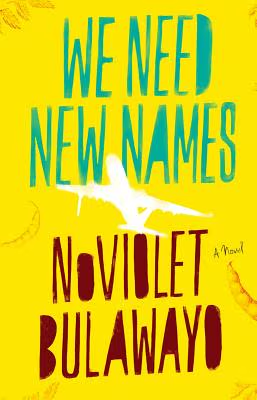
We Need New Names: A Novel
Buy from AALBC
Add to Cart — $25.00More Book Details
Fiction, Hardcover, 304 pages
Publisher: Reagan Arthur Books
ISBN: 9780316230810
 Bookshop
A remarkable literary debut shortlisted for the Man Booker Prize! The unflinching and powerful story of a young girl s journey out of Zimbabwe and to America.
Darling is only ten years old, and yet she must navigate a fragile and violent world. In Zimbabwe, Darling and her friends steal guavas, try to get the baby out of young Chipo s belly, and grasp at memories of Before. Before their homes were destroyed by paramilitary policemen, before the school closed, before the fathers left for dangerous jobs abroad.
But Darling has a chance to escape: she has an aunt in America. She travels to this new land in search of America s famous abundance only to find that her options as an immigrant are perilously few. NoViolet Bulawayo s debut calls to mind the great storytellers of displacement and arrival who have come before her-from Junot Diaz to Zadie Smith to J.M. Coetzee-while she tells a vivid, raw story all her own.
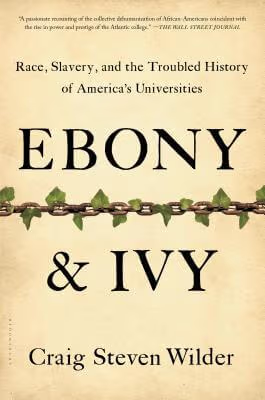
Ebony and Ivy: Race, Slavery, and the Troubled History of America’s Universities
Buy from AALBC
Add to Cart — $20.00More Book Details
Nonfiction, Paperback, 432 pages
Publisher: Bloomsbury Publishing
ISBN: 9781608194025
A 2006 report commissioned by Brown University revealed that institution s complex and contested involvement in slavery setting off a controversy that leapt from the ivory tower to make headlines across the country. But Brown s troubling past was far from unique. In Ebony and Ivy, Craig Steven Wilder, a leading historian of race in America, lays bare uncomfortable truths about race, slavery, and the American academy.
Many of America s revered colleges and universities from Harvard, Yale, and Princeton to Rutgers, Williams College, and the University of North Carolina were soaked in the sweat, the tears, and sometimes the blood of people of color. The earliest academies proclaimed their mission to Christianize the "savages" of North America and played a key role in white conquest. Later, the slave economy and higher education grew up together, each nurturing the other. Slavery funded colleges, built campuses, and paid the wages of professors. Enslaved Americans waited on faculty and students; academic leaders aggressively courted the support of slave owners and slave traders. Significantly, as Wilder shows, our leading universities were dependent on human bondage and became breeding grounds for the racist ideas that sustained it.
Ebony and Ivy is a powerful and propulsive study and the first of its kind, revealing a history of oppression behind the institutions usually considered the cradle of liberal politics.
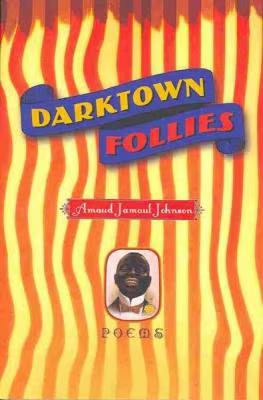
Darktown Follies: Poems
Buy from AALBC
Add to Cart — $16.95More Book Details
Poetry, Paperback, 70 pages
Publisher: Tupelo Press, Inc.
ISBN: 9781936797394
Darktown Follies, Amaud Jamaul Johnson s daring and surprising new collection of poems, responds to Black Vaudeville, specifically the personal and professional challenges African American variety performers faced in the early twentieth century. Johnson is fascinated by jokes that aren t funny particularly, what it means when humor fails or reveals something unintended about our national character. Darktown Follies is an act of self-sabotage, a poet s willful attempt at recklessness, abandoning the "good sense" God gave him, as an effort to explore the boundaries and intersections of race and humor.
Reader Comments (0)
Log In to Join the Conversation
Commenting is reserved for registered AALBC members to maintain high-quality discussions.
No comments yet. Be the first to share your thoughts!
Advertisement