Hurston/Wright Legacy Award Nominees and Winning Books
← Back to Main Awards Page
Introduced in 2001 The Hurston/Wright Legacy Award was the first national award presented to Black writers by a national organization of Black writers. In tribute to Zora Neale Hurston, the Foundation has renamed the awards for each category for Fiction, Nonfiction, Debut Fiction, and Poetry – The Zora. These awards are presented at the annual The Hurston/Wright Legacy Awards.
Each October, the award winners are celebrated during the Hurston/Wright Legacy Awards that draws hundreds of literary stars, readers, representatives of the publishing industry, the arts, media, politics, and academia. Learn more at the Hurston/Wright Foundation’s website.
17 Books Honored by the Hurston/Wright Foundation in 2015
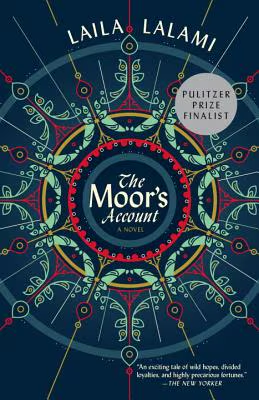
The Moor’s Account
by Laila Lalami
Buy from AALBC
Add to Cart — $15.95More Book Details
Nonfiction, Paperback, 336 pages
Publisher: Penguin Random House
ISBN: 9780804170628
 Bookshop
**PULITZER PRIZE FINALIST**
**NOMINATED FOR THE MAN BOOKER PRIZE**
**WINNER OF THE AMERICAN BOOK AWARD**
A New York Times Notable Book
A Wall Street Journal Top 10 Book of the Year
An NPR Great Read of 2014
A Kirkus Best Fiction Book of the Year
In these pages, Laila Lalami brings us the imagined memoirs of the first black explorer of America: Mustafa al-Zamori, called Estebanico. The slave of a Spanish conquistador, Estebanico sails for the Americas with his master, Dorantes, as part of a danger-laden expedition to Florida. Within a year, Estebanico is one of only four crew members to survive.
As he journeys across America with his Spanish companions, the Old World roles of slave and master fall away, and Estebanico remakes himself as an equal, a healer, and a remarkable storyteller. His tale illuminates the ways in which our narratives can transmigrate into history and how storytelling can offer a chance at redemption and survival.
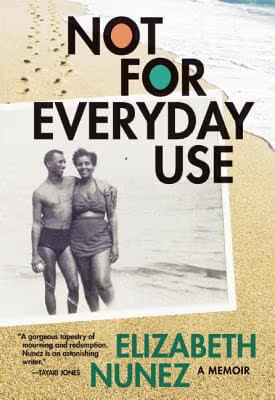
Not for Everyday Use: A Memoir
Buy from AALBC
Add to Cart — $15.95More Book Details
Fiction, Paperback, 256 pages
Publisher: Akashic Books
ISBN: 9781617752339
Selected by Oprah s Book Club as a memoir too powerful to put down.
Tracing the four days from the moment she gets the call that every immigrant fears to the burial of her mother, Elizabeth Nunez tells the haunting story of her lifelong struggle to cope with the consequences of the sterner stuff of her parents ambitions for their children and her mother s seemingly unbreakable conviction that displays of affection are not for everyday use.
But Nunez sympathizes with her parents, whose happiness is constrained by the oppressive strictures of colonialism, by the Catholic Church s prohibition of artificial birth control which her mother obeys, terrified by the threat of eternal damnation (her mother gets pregnant fourteen times: nine live births and five miscarriages which almost kill her), and by what Malcolm Gladwell refers to as the privilege of skin color in his mother s Caribbean island homeland where the brown-skinned classes came to fetishize their lightness. Still, a fierce love holds this family together, and the passionate, though complex, love Nunez s parents have for each other will remind readers of the passion between the aging lovers in Gabriel José García Márquez s Love in the Time of Cholera. Written in exquisite prose by a writer the New York Times Book Review calls a master at pacing and plotting, Not for Everyday Use is a page-turner that readers will find impossible to put down.
Not for Everyday Use - Reviews:
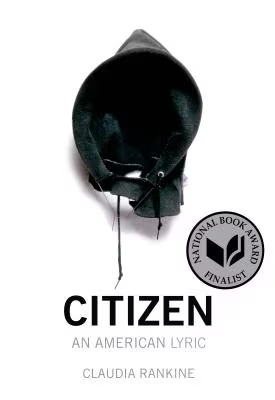
Citizen: An American Lyric
Buy from AALBC
Add to Cart — $20.00More Book Details
Poetry, Paperback, 160 pages
Publisher: Graywolf Press
ISBN: 9781555976903
* Finalist for the National Book Award in Poetry *
* Winner of the National Book Critics Circle Award in Poetry * Finalist for the National Book Critics Circle Award in Criticism * Winner of the NAACP Image Award * Winner of the L.A. Times Book Prize * Winner of the PEN Open Book Award *
ONE OF THE BEST BOOKS OF THE YEAR:
The New Yorker, Boston Globe, The Atlantic, BuzzFeed, NPR. Los Angeles Times, Publishers Weekly, Slate, Time Out New York, Vulture, Refinery 29, and many more
A provocative meditation on race, Claudia Rankine s long-awaited follow up to her groundbreaking book Don t Let Me Be Lonely: An American Lyric.
Claudia Rankine s bold new book recounts mounting racial aggressions in ongoing encounters in twenty-first-century daily life and in the media. Some of these encounters are slights, seeming slips of the tongue, and some are intentional offensives in the classroom, at the supermarket, at home, on the tennis court with Serena Williams and the soccer field with Zinedine Zidane, online, on TV-everywhere, all the time. The accumulative stresses come to bear on a person s ability to speak, perform, and stay alive. Our addressability is tied to the state of our belonging, Rankine argues, as are our assumptions and expectations of citizenship. In essay, image, and poetry, Citizen is a powerful testament to the individual and collective effects of racism in our contemporary, often named "post-race" society.
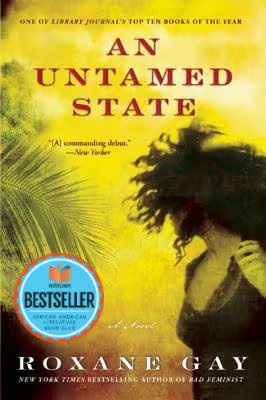
An Untamed State
by Roxane Gay
Buy from AALBC
Add to Cart — $16.00More Book Details
Fiction, Paperback, 368 pages
Publisher: Grove Atlantic, Inc.
ISBN: 9780802122513
Roxane Gay is a powerful new literary voice whose short stories and essays have already earned her an enthusiastic audience. In An Untamed State, she delivers an assured debut about a woman kidnapped for ransom, her captivity as her father refuses to pay and her husband fights for her release over thirteen days, and her struggle to come to terms with the ordeal in its aftermath.
Mireille Duval Jameson is living a fairy tale. The strong-willed youngest daughter of one of Haiti s richest sons, she has an adoring husband, a precocious infant son, by all appearances a perfect life. The fairy tale ends one day when Mireille is kidnapped in broad daylight by a gang of heavily armed men, in front of her father s Port au Prince estate. Held captive by a man who calls himself The Commander, Mireille waits for her father to pay her ransom. As it becomes clear her father intends to resist the kidnappers, Mireille must endure the torments of a man who resents everything she represents.
An Untamed State is a novel of privilege in the face of crushing poverty, and of the lawless anger that corrupt governments produce. It is the story of a willful woman attempting to find her way back to the person she once was, and of how redemption is found in the most unexpected of places. An Untamed State establishes Roxane Gay as a writer of prodigious, arresting talent.
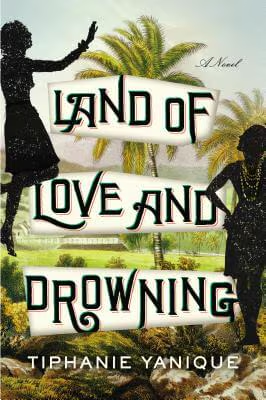
Land Of Love And Drowning
Buy from AALBC
Add to Cart — $27.95More Book Details
Fiction, Hardcover, 368 pages
Publisher: Penguin Random House
ISBN: 9781594488337
Recipient of the 2014 American Academy of Arts and Letters Rosenthal Foundation Award
A major debut from an award-winning writer an epic family saga set against the magic and the rhythms of the Virgin Islands.
In the early 1900s, the Virgin Islands are transferred from Danish to American rule, and an important ship sinks into the Caribbean Sea. Orphaned by the shipwreck are two sisters and their half brother, now faced with an uncertain identity and future. Each of them is unusually beautiful, and each is in possession of a particular magic that will either sink or save them.
Chronicling three generations of an island family from 1916 to the 1970s, Land of Love and Drowning is a novel of love and magic, set against the emergence of Saint Thomas into the modern world. Uniquely imagined, with echoes of Toni Morrison, Gabriel Garc a M rquez, and the author s own Caribbean family history, the story is told in a language and rhythm that evoke an entire world and way of life and love. Following the Bradshaw family through sixty years of fathers and daughters, mothers
and sons, love affairs, curses, magical gifts, loyalties, births, deaths, and triumphs, Land of Love and Drowning is a gorgeous, vibrant debut by an exciting, prizewinning young writer.
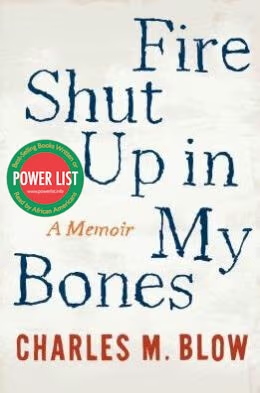
Fire Shut Up In My Bones
Buy from AALBC
Add to Cart — $27.00More Book Details
Nonfiction, Hardcover, 240 pages
Publisher: Houghton Mifflin Harcourt
ISBN: 9780544228047
A gorgeous, moving memoir of how one of America s most innovative and respected journalists found his voice by coming to terms with a painful past
New York Times columnist Charles M. Blow mines the compelling poetry of the out-of-time African-American Louisiana town where he grew up a place where slavery s legacy felt astonishingly close, reverberating in the elders stories and in the near-constant wash of violence.
Blow s attachment to his mother a fiercely driven woman with five sons, brass knuckles in her glove box, a job plucking poultry at a nearby factory, a soon-to-be-ex husband, and a love of newspapers and learning cannot protect him from secret abuse at the hands of an older cousin. It s damage that triggers years of anger and searing self-questioning.
Finally, Blow escapes to a nearby state university, where he joins a black fraternity after a passage of brutal hazing, and then enters a world of racial and sexual privilege that feels like everything he s ever needed and wanted, until he s called upon, himself, to become the one perpetuating the shocking abuse.
A powerfully redemptive memoir that both fits the tradition of African-American storytelling from the South, and gives it an indelible new slant.
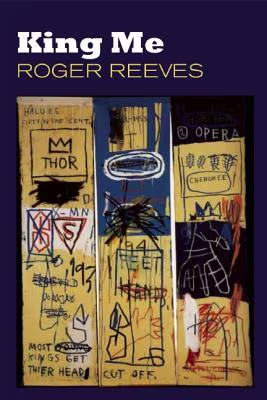
King Me
by Roger Reeves
Buy from AALBC
Add to Cart — $15.00More Book Details
Poetry, Paperback, 72 pages
Publisher: Copper Canyon Press
ISBN: 9781556594489
On the Best Poetry Books of the Year list from Library Journal A sophisticated and breathtaking writer, Reeves takes the reader on a harrowing journey: each poem comes packed with arresting imagery, relentless in its examination of how tragedy and trauma become internalized cleaning out the wounds to understand the pain. Los Angeles Review of Books Roger Reeves King Me stitches together many worlds into one startling and visceral book. His ranging, encyclopedic knowledge crosses history, medicine, biology, metapoetics and more, but he tackles it all with a bold and sonorous surrealist flow. American Microreviews From a horse witnessing the lynching of Emmett Till to Mikhail Bulgakov chronicling the forced famines in Poland in the 1930s, King Me examines the erotics of care and the place of song, elegy, and praise as testaments to those moments. As Roger Reeves said in an interview, "While writing King Me, I became very interested in the mythology of king, the one who is sacrificed at the end of the harvest season . For me, the myth manifests in the killing of young black men, Emmett Till, and in the ways America deems young, black male bodies as expendable Jean Michel Basquiat, Mike Tyson, Jack Johnson. These are the young kings whom we love to kill over and over again."From "Some Young Kings":The hummingbirds inside my chest,with their needle-nosed pliers for tonguesand hammer-heavy wings, have left a messof ticks in my lungs and a punctured lullabyin my throat. Little boy blue come blowyour horn. The cow s in the meadow. And Dorothy s alone in the corn with Jack, his black fingers, the brass of his lips, the half-moons of his fingernails clickingalong her legs until she howls Charlie Parker. Charlie Parker. Charlie Parker Roger Reeves earned his MFA from the James A. Michener Center for Creative Writing and his PhD from the University of Texas. His poems have appeared in Poetry, American Poetry Review, and Boston Review. He teaches at the University of Illinois, Chicago.
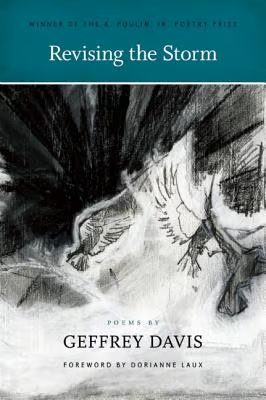
Revising the Storm (A. Poulin, Jr. New Poets of America)
Buy from AALBC
Add to Cart — $16.00More Book Details
Poetry, Paperback, 96 pages
Publisher: BOA Editions
ISBN: 9781938160288
This debut collection by Cave Canem fellow Geffrey Davis burrows under the surface of gender, addiction, recovery, clumsy love, bitterness, and faith. The tones explored tender, comic, wry, tragic interrogate male subjectivity and privilege, as they examine their "embarrassed desires" for familial connection, sexual love, compassion, and repair. Revising the Storm also speaks to the sons and daughters affected by the drug/crack epidemic of the 80s and addresses issues of masculinity and its importance in family.
Some nights I hear my father s long romance
with drugs echoed in the skeletal choir
of crickets.
Geffrey Davis holds an MFA and a PhD from Penn State University. A Cave Canem fellow, Davis is the recipient of the 2013 Dogwood First Prize in Poetry, the 2012 Wabash Prize for Poetry, the 2012 Leonard Steinberg Memorial/Academy of American Poets Prize, and the 2013 A. Poulin, Jr. Poetry Prize. He currently teaches at the University of Arkansas.
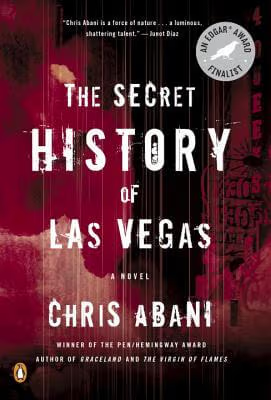
The Secret History of Las Vegas: A Novel
by Chris Abani
Buy from AALBC
Add to Cart — $16.00More Book Details
Fiction, Paperback, 336 pages
Publisher: Penguin Random House
ISBN: 9780143124955
A gritty, riveting, and wholly original murder mystery from PEN/Hemingway Award-winning author and 2015 Edgar Awards winner Chris Abani
Before he can retire, Las Vegas detective Salazar is determined to solve a recent spate of murders. When he encounters a pair of conjoined twins with a container of blood near their car, he s sure he has apprehended the killers, and enlists the help of Dr. Sunil Singh, a South African transplant who specializes in the study of psychopaths. As Sunil tries to crack the twins, the implications of his research grow darker. Haunted by his betrayal of loved ones back home during apartheid, he seeks solace in the love of Asia, a prostitute with hopes of escaping that life. But Sunil s own troubled past is fast on his heels in the form of a would-be assassin.
Suspenseful through the last page, The Secret History of Las Vegas is Chris Abani s most accomplished work to date, with his trademark visionary prose and a striking compassion for the inner lives of outsiders.
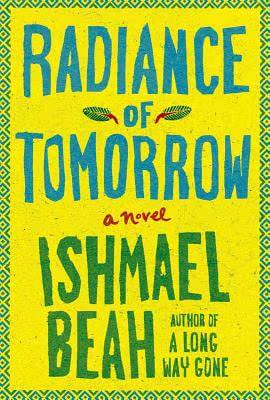
Radiance Of Tomorrow
by Ishmael Beah
Buy from AALBC
Add to Cart — $25.00More Book Details
Fiction, Hardcover, 256 pages
Publisher: Sarah Crichton Books
ISBN: 9780374246020
A haunting, beautiful first novel by the bestselling author of A Long Way Gone
When Ishmael Beah s A Long Way Gone was published in 2007, it soared to the top of bestseller lists, becoming an instant classic: a harrowing account of Sierra Leone s civil war and the fate of child soldiers that "everyone in the world should read" (The Washington Post). Now Beah, whom Dave Eggers has called "arguably the most read African writer in contemporary literature," has returned with his first novel, an affecting, tender parable about postwar life in Sierra Leone.
At the center of Radiance of Tomorrow are Benjamin and Bockarie, two longtime friends who return to their hometown, Imperi, after the civil war. The village is in ruins, the ground covered in bones. As more villagers begin to come back, Benjamin and Bockarie try to forge a new community by taking up their former posts as teachers, but they re beset by obstacles: a scarcity of food; a rash of murders, thievery, rape, and retaliation; and the depredations of a foreign mining company intent on sullying the town s water supply and blocking its paths with electric wires. As Benjamin and Bockarie search for a way to restore order, they re forced to reckon with the uncertainty of their past and future alike.
With the gentle lyricism of a dream and the moral clarity of a fable, Radiance of Tomorrow is a powerful novel about preserving what means the most to us, even in uncertain times.
Named one of the Christian Science Monitor s best fiction books of 2014
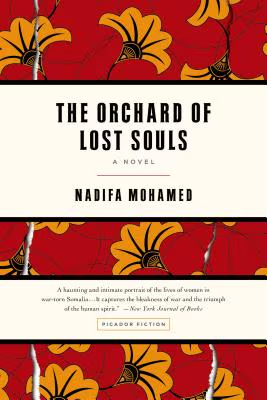
The Orchard of Lost Souls: A Novel
Buy from AALBC
Add to Cart — $17.00More Book Details
Fiction, Paperback, 352 pages
Publisher: Macmillan Publishers
ISBN: 9781250062369
From one of Granta s Best of Young British Novelists, a stunning novel illuminating Somalia s tragic civil war
It is 1987 and Hargeisa waits. Whispers of revolution travel on the dry winds, but still the dictatorship remains secure.
Soon, through the eyes of three women, we will see Somalia fall.
Nine-year-old Deqo has left the vast refugee camp where she was born, lured to the city by the promise of her first pair of shoes.
Kawsar, a solitary widow, is trapped in her little house with its garden clawed from the desert, confined to her bed after a savage beating in the local police station.
Filsan, a young female soldier, has moved from Mogadishu to suppress the rebellion growing in the north.
As the country is unraveled by a civil war that will shock the world, the fates of these three women are twisted irrevocably together.
Nadifa Mohamed was born in Hargeisa and was exiled before the outbreak of war. In The Orchard of Lost Souls, she returns to Hargeisa in her imagination. Intimate, frank, brimming with beauty and fierce love, this novel is an unforgettable account of ordinary lives lived in extraordinary times.Chosen as one of the 15 Best Works of Fiction by Black Authors in 2014 by The Root
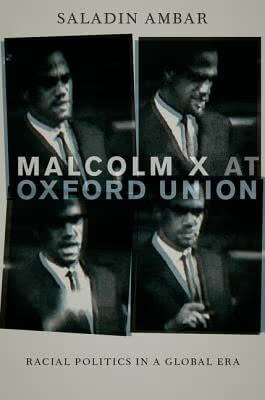
Malcolm X at Oxford Union: Racial Politics in a Global Era (Transgressing Boundaries: Studies in Black Politics and Black Communities)
Buy from AALBC
Add to Cart — $31.95More Book Details
Nonfiction, Hardcover, 240 pages
Publisher: Oxford University Press
ISBN: 9780199975471
In 1964 Malcolm X was invited to debate at the Oxford Union Society at Oxford University. The topic of debate that evening was the infamous phrase from Barry Goldwater s 1964 Republican Convention speech:"Extremism in the defense of liberty is no vice; moderation in the pursuit of justice is no virtue." At a time when Malcolm was traveling widely and advocating on behalf of blacks in America and other nations, his thirty minute speech at the Oxford Union stands out as one of the great addresses of the civil rights era.
Delivered just months before his assassination, the speech followed a period in which Malcolm had traveled throughout Africa and much of the Muslim world. The journey broadened his political thought to encompass decolonization, the revolutions underway in the developing world, and the relationship between American blacks and non-white populations across the globe-including England.
Facing off against debaters in one of world s most elite institutions, he delivered a revolutionary message that tackled a staggering array of issues: the nature of national identity; US foreign policy in the developing world; racial politics at home; the experiences of black immigrants in England; and the nature of power in the contemporary world. It represents a moment when his thought had advanced to its furthest point, shedding the parochial concerns of previous years for an increasingly global and humanist approach to ushering in social change.
Set to publish near the fiftieth anniversary of his death, Malcolm X at Oxford Union will reshape our understanding not only of the man himself, but world politics both then and now.
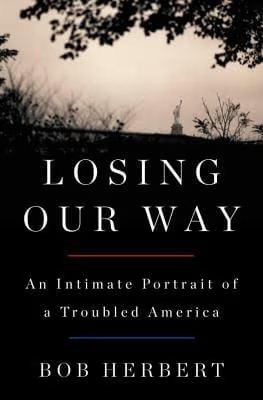
Losing Our Way: An Intimate Portrait of a Troubled America
by Bob Herbert
Buy from AALBC
Add to Cart — $27.95More Book Details
Nonfiction, Hardcover, 304 pages
Publisher: Penguin Random House
ISBN: 9780385528238
From longtime New York Times columnist Bob Herbert comes a wrenching portrayal of ordinary Americans struggling for survival in a nation that has lost its way
In his eighteen years as an opinion columnist for The New York Times, Herbert championed the working poor and the middle class. After filing his last column in 2011, he set off on a journey across the country to report on Americans who were being left behind in an economy that has never fully recovered from the Great Recession. The portraits of those he encountered fuel his new book, Losing Our Way. Herbert s combination of heartrending reporting and keen political analysis is the purest expression since the Occupy movement of the plight of the 99 percent.
The individuals and families who are paying the price of America s bad choices in recent decades form the book s emotional center: an exhausted high school student in Brooklyn who works the overnight shift in a factory at minimum wage to help pay her family s rent; a twenty-four-year-old soldier from Peachtree City, Georgia, who loses both legs in a misguided, mismanaged, seemingly endless war; a young woman, only recently engaged, who suffers devastating injuries in a tragic bridge collapse in Minneapolis; and a group of parents in Pittsburgh who courageously fight back against the politicians who decimated funding for their children s schools.
Herbert reminds us of a time in America when unemployment was low, wages and profits were high, and the nation s wealth, by current standards, was distributed much more equitably. Today, the gap between the wealthy and everyone else has widened dramatically, the nation s physical plant is crumbling, and the inability to find decent work is a plague on a generation. Herbert traces where we went wrong and spotlights the drastic and dangerous shift of political power from ordinary Americans to the corporate and financial elite. Hope for America, he argues, lies in a concerted push to redress that political imbalance. Searing and unforgettable, Losing Our Way ultimately inspires with its faith in ordinary citizens to take back their true political power and reclaim the American dream.
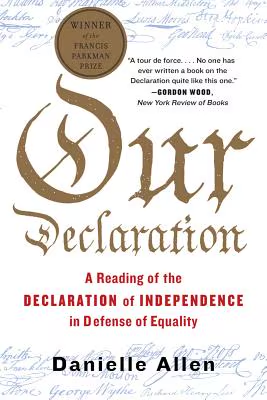
Our Declaration: A Reading of the Declaration of Independence in Defense of Equality
Buy from AALBC
Add to Cart — $16.95More Book Details
Nonfiction, Paperback, 320 pages
Publisher: W. W. Norton & Company, Inc.
ISBN: 9781631490446
Winner of the Francis Parkman Prize, Society of American Historians
A tour de force . No one has ever written a book on the Declaration quite like this one. Gordon Wood, New York Review of Books Featured on the front page of the New York Times, Our Declaration is already regarded as a seminal work that reinterprets the promise of American democracy through our founding text. Combining a personal account of teaching the Declaration with a vivid evocation of the colonial world between 1774 and 1777, Allen, a political philosopher renowned for her work on justice and citizenship reveals our nation s founding text to be an animating force that not only changed the world more than two-hundred years ago, but also still can. Challenging conventional wisdom, she boldly makes the case that the Declaration is a document as much about political equality as about individual liberty. Beautifully illustrated throughout, Our Declaration is an uncommonly elegant, incisive, and often poetic primer on America s cardinal text (David M. Kennedy). 35 illustrations
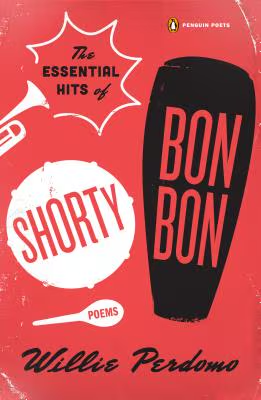
The Essential Hits of Shorty Bon Bon (Poets, Penguin)
Buy from AALBC
Add to Cart — $18.00More Book Details
Poetry, Paperback, 80 pages
Publisher: Penguin Random House
ISBN: 9780143125235
A National Book Critics Circle 2014 Finalist for Poetry
Through dream song and elegy, alternate takes and tempos, prizewinning poet Willie Perdomo s third collection crackles with vitality and dynamism as it imagines the life of a percussionist, rebuilding the landscape of his apprenticeship, love, diaspora, and death. At the beginning of his infernal journey, Shorty Bon Bon recalls his live studio recording with a classic 1970s descarga band, sharing his recollection with an unidentified poet. This opening section is followed by a call-and-response with his greatest love, a singer named Rose, and a visit to Puerto Rico that inhabits a surreal nationalistic dreamscape, before a final jam session where Shorty recognizes his end and a trio of voices seek to converge on his elegy.
We Didn’t Know Any Gangsters
Buy from AALBC
Unavailable from AALBCMore Book Details
Poetry, Paperback, 82 pages
Publisher: Cherry Castle Publishing
ISBN: 9780692273272
Brian Gilmore s We Didn t Know Any Gangsters weds the wily clarity of Lucille Clifton to the cultural acuity of James Baldwin. "Res ipsa loquitur" ("The thing speaks for itself"), Gilmore says in one poem, recasting William Carlos Williams dictum: "no ideas but in things," as a statement of self-determination and witness. Stereotypes, and clichés about African-American life are obliterated by poems that are vibrant, distinct and unequivocally American. Political, personal, exceptional this is a remarkable book about what it means to be us.
E. Ethelbert Miller, award-winning poet and Director of Howard University s African-American Resource Center
In We Didn t know Any Gangsters, Brian Gilmore creates a work of architecture, populating it with people we ll never forget. Novelists and playwrights do this all the time, but when a poet creates a big stage with fascinating characters, that is technique and that is triumph. Meet a young man growing up, meet his family, see a society sometimes unsafe and experience real life, expertly drawn, with pulsating, fast-moving, innovative, lyricism. The motor inside his poetry hums with prophecy and politics, but there is even more there is a beautiful heart at the center of his writing, and poems are messages torn from it, sorted out, and, put all together to make up our human history. Brian Gilmore proves he was obviously born to write, and it s our good fortune.
Terrance Hayes, MacArthur Fellow, 2010 National Book Award Winner
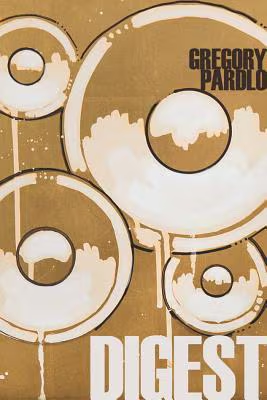
Digest (Stahlecker Selections)
Buy from AALBC
Add to Cart — $15.95More Book Details
Poetry, Paperback, 84 pages
Publisher: Four Way Books
ISBN: 9781935536505
From Epicurus to Sam Cooke, the Daily News to Roots, Digest draws from the present and the past to form an intellectual, American identity. In poems that forge their own styles and strategies, we experience dialogues between the written word and other art forms. Within this dialogue we hear Ben Jonson, we meet police K-9s, and we find children negotiating a sense of the world through a father s eyes and through their own.
Reader Comments (0)
Log In to Join the Conversation
Commenting is reserved for registered AALBC members to maintain high-quality discussions.
No comments yet. Be the first to share your thoughts!
Advertisement