National Book Award: Winners, Finalists, and Longlisted Titles
← Back to Main Awards Page
The mission of the National Book Foundation is to celebrate the best of American literature, to expand its audience, and to enhance the cultural value of great writing in America. National Book Awards are given in five categories: Fiction, Nonfiction, Poetry, Translated Literature, and Young People’s Literature.
Here we highlight the winners of African descent. The first African-American writer to win a National Book Award was Ralph Ellison, in 1953, for Invisible Man.
2 Books Honored by the National Book Foundation in 1997
Finalist – Nonfiction
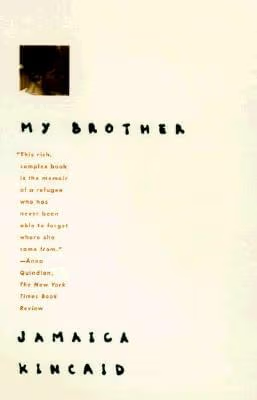
My Brother
Buy from AALBC
Add to Cart — $14.00More Book Details
Imprint: Farrar, Straus and Giroux
(Nov 09, 1998)
Fiction, Paperback, 208 pages
Publisher: Macmillan Publishers
ISBN: 9780374525620
Fiction, Paperback, 208 pages
Publisher: Macmillan Publishers
ISBN: 9780374525620
Categorized under:
 Bookshop
Book Description:
Jamaica Kincaid s brother Devon Drew died of AIDS on January 19, 1996, at the age of thirty-three. Kincaid s incantatory, poetic, and often shockingly frank recounting of her brother s life and death is also a story of her family on the island of Antigua, a constellation centered on the powerful, sometimes threatening figure of the writer s mother. My Brother is an unblinking record of a life that ended too early, and it speaks volumes about the difficult truths at the heart of all families. My Brother is a 1997 National Book Award Finalist for Nonfiction.
Jamaica Kincaid s brother Devon Drew died of AIDS on January 19, 1996, at the age of thirty-three. Kincaid s incantatory, poetic, and often shockingly frank recounting of her brother s life and death is also a story of her family on the island of Antigua, a constellation centered on the powerful, sometimes threatening figure of the writer s mother. My Brother is an unblinking record of a life that ended too early, and it speaks volumes about the difficult truths at the heart of all families. My Brother is a 1997 National Book Award Finalist for Nonfiction.
Finalist – Poetry
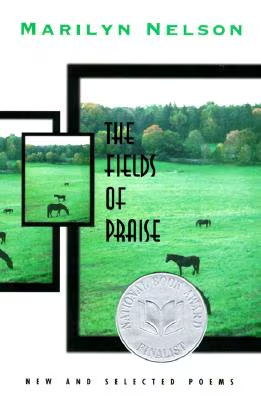
The Fields of Praise: New and Selected Poems
Buy from AALBC
Add to Cart — $21.95More Book Details
Imprint: LSU Press
(May 01, 1997)
Poetry, Paperback, 224 pages
Publisher: Louisiana State University Press
ISBN: 9780807121757
Poetry, Paperback, 224 pages
Publisher: Louisiana State University Press
ISBN: 9780807121757
Categorized under:
Book Description:
In The Fields of Praise, Marilyn Nelson claims as subjects the life of the spirit, the vicissitudes of love, and the African American experience and arranges them as white pebbles marking our common journey toward a "monstrous love / that wants to make the world right." Nelson is a poet of stunning power, able to bring alive the most rarified and subtle of experiences. A slave destined to become a minister preaches sermons of heartrending eloquence and wisdom to a mule. An old woman scrubbing over a washtub receives a personal revelation of what Emancipation means: "So this is freedom: the peace of hours like these." Memories of the heroism of the Tuskegee Airmen in the face of aerial combat abroad and virulent racism at home bring a speaker to the sudden awareness of herself as the daughter "of a thousand proud fathers."
In The Fields of Praise, Marilyn Nelson claims as subjects the life of the spirit, the vicissitudes of love, and the African American experience and arranges them as white pebbles marking our common journey toward a "monstrous love / that wants to make the world right." Nelson is a poet of stunning power, able to bring alive the most rarified and subtle of experiences. A slave destined to become a minister preaches sermons of heartrending eloquence and wisdom to a mule. An old woman scrubbing over a washtub receives a personal revelation of what Emancipation means: "So this is freedom: the peace of hours like these." Memories of the heroism of the Tuskegee Airmen in the face of aerial combat abroad and virulent racism at home bring a speaker to the sudden awareness of herself as the daughter "of a thousand proud fathers."
Reader Comments (0)
Log In to Join the Conversation
Commenting is reserved for registered AALBC members to maintain high-quality discussions.
No comments yet. Be the first to share your thoughts!
Advertisement