


Leaderboard
-
Chevdove
Members2Points2,875Posts -
Troy
Administrators1Points14,765Posts -
Kareem
Members1Points208Posts -

Brenda Frazier
Members1Points2Posts



Popular Content
Showing content with the highest reputation on 01/30/2020 in Posts
-
1 pointMillie Riley’s Daughter THE FIRST LADY OF LITTLE ROCK DDD—An Essay On The Late Daisy Gaston Bates I had never heard of Daisy Lee Bates, perhaps because I was born a few years after this time or perhaps because it was not part of my formal education, nevertheless, I think that she was amazing. So, she is my feature today, DDD—Dove’s Doll of the Day. Although, I researched this story a few years ago and planned to share this information in some type of written format, however, it upset me so much that I chose to distance myself from it for a while, until I felt emotionally strong enough to absorb it better. I stumbled across this historical piece and decided to do some research and realized that I did hear about many brief accounts of this conflict in the Civil Rights Movement. I remember reports of Black African American (Colored) students being escorted by the Federal government to school in the state of Arkansas when integration became enforced by the government. When I was very young and travelled to Arkansas with my mother and Stepfather, I remember some recounts of this story. And I vaguely remember hearing about a Black (African American) woman of whom had become back in the media when she became older and became some type of news reporter of whom had also moved to South Africa for a while or something like that. So, as I began to look up information about this woman who was supposedly, one of the students who had faced an angry mob of White students, however, I stumbled across Daisy Lee Bates for the first time, and was astounded by her courage. So, therefore, I will share some of the information about her life and some of what interest me. Daisy Lee Gatson Bates was born in 1914 in a small town in Arkansas, called Huttig, so that would mean that she was born around the time of the World War. She was born in what was known as a SHOTGUN HOUSE to her biological mother and father, Hezakiah Gatson and Millie Riley. Her father, Hezakiah worked in a lumber mill as a lumber grader but while Daisy was only a few months old, her mother was murdered, so not much longer after that day, her father eventually gave her to his close friends, a war veteran and his wife and after that, Daisy never saw her father Hezekiah again. Now, Daisy learned at the tender age of eight (8), that her mother Millie Riley, was raped and then murdered by three local white men and then dropped into a millpond. Nothing was ever done about it! The killers were never brought to justice. Her adoptive father told her that the police did not pursue the matter, so Daisy was left to internalize this horror as she matured. Based on the counsel of her adoptive father, however she decided to channel her pain and hatred that she acquired due to such the terrible predicament she was faced with as a result of the racism and death of her mother into a direction that made her feel that she had contributed her life in a positive way. So, Daisy became a Spokes Person for Civil Rights issues and she became a key figure in the federal enforcement of school integration, in that her house became a safe zone, sort of like a headquarters, for the select Arkansas Black students to seek rest, support and encouragement, students that had been selected to begin their school year in an all-White high school in 1957. So, Daisy continued to channel her life in this positive mode for many years and died in the year 1999, at the age of 85, and after achieving many, many awards for her bravery and self-sacrifice. This kind of newfound information inspired me to research more into just what happened to these students and how Daisy dealt with these issues and I was amazed to learn that today, there have been recent films to recapture some stories of the students who have grown up to adulthood. But most of all, for me anyway, deep down inside would be a pang of pain because of the silence given to the fate of Ms. Miley Riley; another Black woman tortured unto death and after already being victimized and marginalized in this world. Why was the death of Daisy’s mother so quietly ignored? I shared my disdain with my husband, and, to my surprise, his response was not what I was prepared to receive. Why did the police not pursue the criminals diligently for the violent death of Miley Riley? And, why has the Black community not pursued justice in this matter either? Was the news of this awful crime not even put in the newspapers? What ever happened to Daisy’s father? If, in fact, Daisy was informed that her mother was raped and killed by ‘three White men’, well then, somebody knew some other details! Surprisingly to me though, was my husbands’ response when I shared my thoughts with him. He said to me, “You need to look closer. Do you see that Daisy is very light-skinned? So, her mother could have been White or part-White, or maybe her father was White.” Uh oh—I never considered that position of Colorism and White Supremacy and the position of the ‘Colored People’ in the deep south in how they were victimized by the evil motivations of White Supremacist. Oh My God! So, even today, many Baby Boomers don’t talk about their lives back in those times. This story reminds me of one of my favorite movies, a 2003 film, Holes, produced and directed by Andrew Davis, starring the late Eartha Kitt, Shia LaBeouf, Dule Hill and Patricia Arquette. But in this movie where the White girl fell in love with the Black man, it was the Black man that was pursued and killed by a racist White mob, which would be a common crime in the south. But then, the very actress, Eartha Kitt’s personal life’s story sort of strikes at another horror of those times when Colorism becomes wickedly explored and exploited amongst ‘the Colored Race’ on many dark levels of abuse that should have been brought to justice! So although, the story of Miley Riley and Daisy Bates causes me to think about all of these issues, however, it also causes to me to think about how many ‘Colored’ women like Eartha Kitt fell in love with White men due to the unthinkable crimes committed against them by way of African Americans. Based on all of the other stories like these, it seems obvious that this government has not been set up affectively, in all of these hundreds of years, to deal with these kinds of crimes against humanity but at least, Daisy Bates was able to do something positive for her life to combat racial injustice, in a way that gave her some kind of recompense for the anguish she endured. … The unaltered Blossom Plan had gerrymandered school districts to guarantee a black majority at Horace Mann High and a white majority at Hall High. [6] This meant that, even though black students lived closer to Central, they would be placed in Horace Mann thus confirming the intention of the school board to limit the impact of desegregation. [6] The altered plan gave white students the choice of not attending Horace Mann, but didn’t give black students the option of attending Hall. This new Blossom Plan did not sit well with the NAACP and after failed negotiations with the school board; the NAACP filed a lawsuit on February 8, 1956. This lawsuit, along with a number of other factors contributed to the Little Rock School Crisis of 1957. https://en.wikipedia.org/wiki/Little_Rock_Nine By 1957, the NAACP had registered nine black students to attend the previously all-white Little Rock Central High, selected on the criteria of excellent grades and attendance. [2] Called the [“] Little Rock Nine [”], they were Ernest Green (b. 1941), Elizabeth Eckford (b. 1941), Jefferson Thomas (1942-2010), Terrence Roberts (b. 1941), Carlotta Walls LaNier (b. 1941), Minnijean Brown (b. 1941), Gloria Ray Karlmark (b. 1942), Thelma Mothershed (b. 1940), and Melba Pattillo Beals (b. 1941). Ernest Green was the first African American to graduate from Central High School. https://en.wikipedia.org/wiki/Little_Rock_Nine I have come to understand that during the Civil Rights Movement, there were sharp differences of opinion on how racism and White Supremacy should be addressed and, I do question the decision and justification to send select young Black people to an all-White school environment during a time when, previously, White people felt they had that human right, to have an all-White institution protected by law. White Supremacy, in this nature would be a conditioning that was fostered for over a long period of time and now, by sending those young Black kids into their all-White environment, may have furthered the feelings of White Supremacy, not only for White people, but for Black people as well. One of the Little Rock Nine students recalled that they were all told they ‘would have to take a lot and were warned not to fight back if anything happened’. And many years later Daisy recounted in an interview that certain Black reporters were actually killed by the mob on the first day the Arkansas Nine attempted to attend school. The Little Rock Nine was a group of nine African American students enrolled in Little Rock Central High School in 1957. Their enrollment was followed by the Little Rock Crisis, in which the students were initially prevented from entering the racially segregated school by Orval Faubus, the Governor of Arkansas. They then attended after the intervention of President Dwight D. Eisenhower. https://en.wikipedia.org/wiki/Little_Rock_Nine When integration began in September 4, 1957, the Arkansas National Guard was called in to [“] preserve the peace [”]. Originally at orders of the governor, they were meant to prevent the black students from entering due to claims that there was [“] imminent danger of tumult, riot and breach of peace [”] at the integration. However, President Eisenhower issued Executive order 10730, which federalized the Arkansas National Guard and ordered them to support the integration on September 23 of that year, after which they protected the African American students. [3] https://en.wikipedia.org/wiki/Little_Rock_Nine I believe that a government in a civilized system should be responsible for the formal education of its people in a safe environment to thrive and learn. The issues of Integration, Segregation and Desegregation, should not lead Black children to be put in harm’s way. However, at that time, Black people who acted under the NAACP and other organizations accepted this approach of Integration and there were new laws that led up to the eventual selection of a handful of Black students selected to deal with integration. These students in Arkansas and elsewhere were enrolled into an all-White learning institution in order to be educated in a multi-cultural environment because the federal laws had been changed due to a supreme court case upon which it was deemed that segregation was unconstitutional. I am absolutely grateful in the federal government and in the step to ‘right a wrong’ about segregation, however, the process in ‘fixing a wrong’ led to young people being placed in a hostile environment, and so I wonder could this have been avoided? Even though the federal government made a bold step to protect the Little Rock Nine by sending out troops, initially, however, that enforcement did not continue. This step of our federal government was heartfelt by certain White people also, and it gave Daisy Lee Bates a pathway to deal with her past life of oppression and the heart rendering death of her mother of which was ignored by the system. And, Daisy also endured more evil treatment from racist due her courage to be a spokesperson for Civil Rights issues and for offering up her house as a safe haven and her help to support the ‘Little Rock Nine’. Not only was she the next person to come to the microphone after the late Dr. Martin Luther King, Jr. in the March on Washington, however, an elementary school has been named in her honor in Little Rock, Arkansas, a street has been named after her and she has been given many more honors and awards. Following are some references, quotes and brief videos of this story of Daisy Lee Gatson-Bates and the Little Rock Nine. Furthermore, I found it interesting in one video where the film showed an old newspaper clips to suggest that the death of Millie Riley had been reported. Therefore, I decided to do some research on what I saw, and it became clear to me that was deception. In the video, the newspaper clip reported around the time that Daisy was young, that a ‘Negre woman named Minnie Harris, also known as ‘Pete’ was murdered and her body was thrown into a pond nearby the mill’. So, then I searched for more research and have presented some quotes and accounts of Daisy in her memoirs about the life of Millie Riley and the mystery that surrounds her life’s end. The U.S. Supreme Court issued its historic Brown v. Board of Education of Topeka, Kansas, 347 U.S. 483, on May 17, 1954. Tied to the 14th Amendment, the decision declared all laws establishing segregated schools to be unconstitutional, and it called for the desegregation of all schools throughout the nation. [1] https://en.wikipedia.org/wiki/Little_Rock_Nine [1] Elizabeth Eckford—Little Rock 9 . Governor Orval Faubus deployed the Arkansas National Guard to support the segregationists on September 4, 1957. The sight of a line of soldiers blocking out the students made national headlines and polarized the nation. Regarding the accompanying crowd, one of the nine students, Elizabeth Eckford, recalled: They moved closer and closer. [[…]] Somebody started yelling. [[…]] I tried to see a friendly face somewhere in the crowd—someone who maybe could help. I looked into the face of an old woman and it seemed a kind face, but when I looked at her again, she spat on me. [7] https://en.wikipedia.org/wiki/Little_Rock_Nine Woodrow Wilson Mann, the mayor of Little Rock, asked President Eisenhower to send federal troops to enforce integration and protect the nine students. On September 24, the President ordered the 101st Airborne Division of the United States Army—without its black soldiers, who rejoined the division a month later—to Little Rock and federalized the entire 10,000-member Arkansas National Guard, taking it out of Faubus’s control. [9] … By the end of September 1957, the nine were admitted to Little Rock Central High under the protection of the 101st Airborne Division (and later the Arkansas National Guard), but they were still subjected to a year of physical and verbal abuse by many of the white students. Melba Pattillo had acid thrown into her eyes [10] and also recalled in her book, Warriors Don’t Cry, an incident in which a group of white girls trapped her in a stall in the girls’ washroom and attempted to burn her by dropping pieces of flaming paper on her from above. Another one of the students, Minnijean Brown, was verbally confronted and abused. https://en.wikipedia.org/wiki/Little_Rock_Nine [2] Jefferson Thomas- Little Rock 9 His parents named him after Thomas Jefferson, President of the United States. Thomas first attended Horace Mann High School, a segregated all-black school, where he was a track athlete. In 1957, he volunteered to be among the first group of black students to integrate all-white Little Rock Central High School … Thomas narrated the United States Information Agency’s 1964 file Nine from Little Rock. … The goal of this government film, in the context of the Cold War, was to show, to countries concerned about American racism, that progress the United States had made with respect to civil rights. It achieved this goal at least in part as the film received wide acclaim (including an Academy Award) and was distributed to 97 countries. [2] https://en.wikipedia.org/wiki/Jefferson_Thomas … Claiming that Little Rock had to assert their rights and freedom against the federal decision, in September 1958, Faubus signed acts that enabled him and the Little Rock School District to close all public schools. [16] The black community became a target for hate crimes since people blamed them for the closing of the schools. [19] Daisy Bates, head of the NAACP chapter in Little Rock, was a primary victim to these crimes, in addition to the black students enrolled at Little Rock Central High School and their families. [20] https://en.wikipedia.org/wiki/Little_Rock_Nine [3] Minnijean Brown-Trickey –Little Rock 9 In her late 20s, she married Roy Trickey, a white social activist she met while attending South Illinois University. (The interracial marriage, which ended in divorce, was "not a political statement at the time," she says with a laugh, when asked. "Life just happens.") Together, they moved to Canada, so he could avoid the draft during the Vietnam War. In the northern farming community of Kenebeek, Ont., she raised a brood of six children, five of whom she gave birth to at home. https://www.theglobeandmail.com/arts/a-courage-unequalled/article997104/ [4] Charlayne Hunter-Gault—Little Rock 9 Although the Lost Year had come to a close, the black students who returned to the high schools were not welcomed by the other students. Rather, the black students had a difficult time getting past mobs to enter the school, and, once inside, they were often subject to physical and emotional abuse. [24] The students were back at school and everything would resume normal function, but the Lost Year would be a pretext for new hatred toward the black students in the public high school. https://en.wikipedia.org/wiki/Little_Rock_Nine Daisy Bates: Civil Rights Crusader from Arkansas (Margaret Walker Alexander Series in African American Studies) By Grif Stockley Copyright © 2005 by University Press of Mississippi, Jackson The difficulty with this story is that the Huttig News contains no account of the violent death of a black woman named Riley between the years 1913 and 1920. [17] The paper does briefly mention a story in 1917 about the murder of a young black woman named Minnie Harris whose body was “thrown in the large storage pond” near the mill. [18] A neighbor was arrested, but the story was apparently not followed up. Yet the story that Bate’s mother was raped and killed by white men is often repeated. … page 17 On the subject of Bates’s birth father, Clifford Broughton volunteered, “I think her daddy may have been white.” … For her part, Bates writes in her memoir she was told by her cousin “Early B.” that her “daddy was a light as a lot of white people.” 22 Broughton confirmed Bates’s account of her friendship with “Early B. Broughton,” who was his father’s first cousin. … … her cousin Early B. told her that she looked like her mother, who was, “very pretty, dark brown, with long black hair.” Page 20. https://books.google.com/books?id=v1JEVWpapWkC&pg=PA17&lpg=PA17&dq=Minnie+Harris,+Huttiq,+Arkansas,+murdered&source=bl&ots=IoQ75Bve3a&sig=ACfU3U1KXteTjKafkVqbnwNwhLh_GZiNWQ&hl=en&ppis=_e&sa=X&ved=2ahUKEwix4LK1uqvnAhW1l3IEHWnaDSIQ6AEwCnoECAoQAQ#v=onepage&q=Minnie Harris%2C Huttiq%2C Arkansas%2C murdered&f=false --- [5] Carlotta Walls-LaNier—Little Rock 9 [6] Ernest Green—Little Rock 9 [7] Gloria Ray Karlmark—Little Rock 0 [8] Thelma Mothershed—Little Rock 9 [9] Melba Pattilo Beals—Little Rock 9 *My Note: Some of my pictures did not post. There is so much that can be presented about each and everyone of the Little Rock Nine, and I hope that more can be presented soon.1 point
-
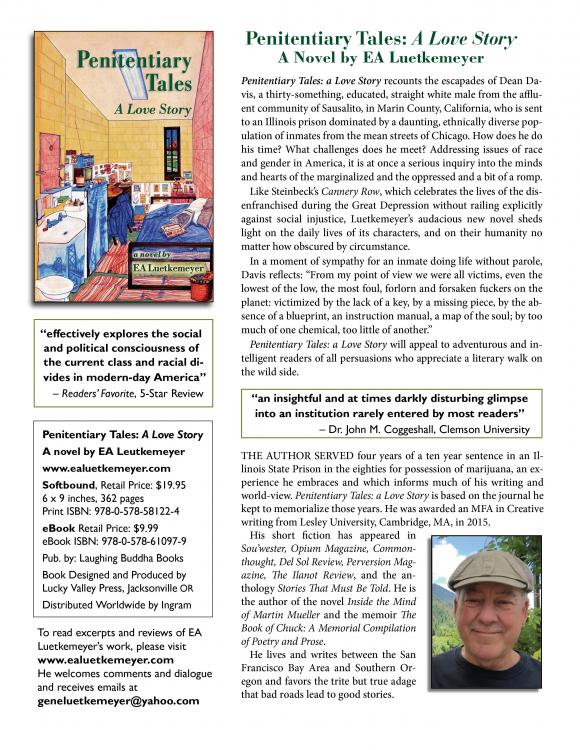
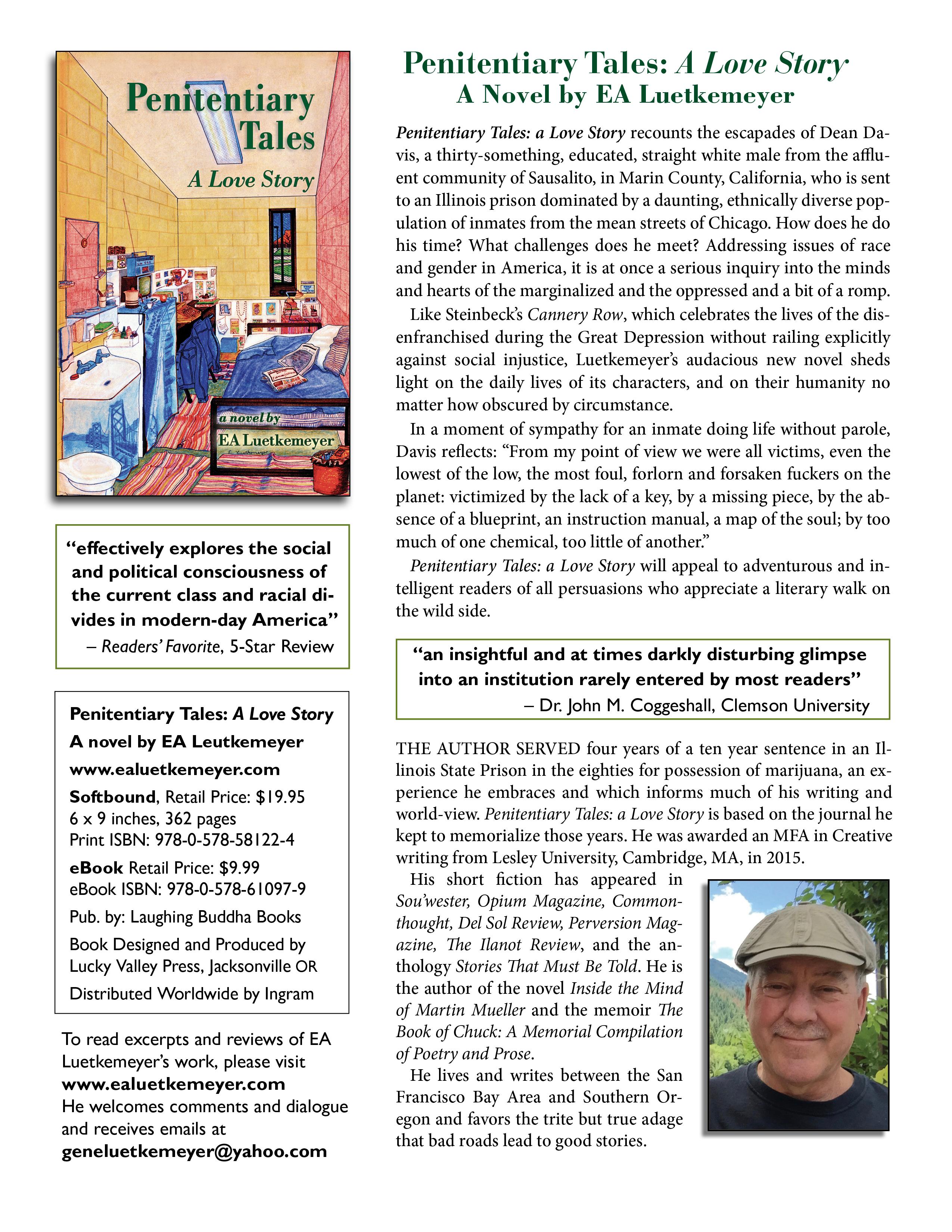
1 pointThank you for considering my request for a review. I am a white writer whose recently released novel is peopled with characters from the African American community. Reviewed favorably by numerous white critics, it lacks the balanced point of view that only a critical assessment by a literate African American community can give. Therefore my appeal to you. Called “an insightful and at times darkly disturbing glimpse into an institution rarely entered by most readers” (Dr. John M. Coggeshall, Clemson University) Penitentiary Tales: a Love Story recounts the escapades of Dean Davis, a thirty-something, educated, straight white male from the affluent community of Sausalito, in Marin County, California, who is sent to an Illinois prison dominated by a daunting, ethnically diverse population of inmates from the mean streets of Chicago. How does he do his time? What challenges does he meet? Addressing issues of race and gender in America, it is at once a serious inquiry into the minds and hearts of the marginalized and the oppressed and a bit of a romp. Like Steinbeck’s Cannery Row, which celebrates the lives of the disenfranchised during the Great Depression without railing explicitly against social injustice, my novel sheds light on the daily lives of its characters, and on their humanity no matter how obscured by circumstance. In a moment of sympathy for an inmate doing life without parole, protagonist Davis reflects: “From my point of view we were all victims, even the lowest of the low, the most foul, forlorn and forsaken fuckers on the planet: victimized by the lack of a key, by a missing piece, by the absence of a blueprint, an instruction manual, a map of the soul; by too much of one chemical, too little of another.” Penitentiary Tales: a Love Story will appeal to readers of all persuasions who are concerned with the class and racial disparities prevalent in America today, and who appreciate a literary walk on the wild side. I served four years of a ten year sentence in an Illinois State Prison in the eighties for possession of marijuana, an experience I cherish for its revelations and which informs much of my writing and world view, especially regarding matters of race and gender. Penitentiary Tales: a Love Story is based on the journal I kept to memorialize those years. Be forewarned that the language is explicit and the scenes sometimes graphic. You will hear what I heard and see what I saw…and perhaps feel what I felt. A native of Chicago, I was awarded an MFA in Creative writing from Lesley University, Cambridge, MA, in 2015. I now live and write between the San Francisco Bay Area and Southern Oregon. For previous reviews and excerpts of Penitentiary Tales: a Love Story, please visit my website, www.ealuetkemeyer.com. Feel free to contact me directly at geneluetkemeyer@yahoo.com. I will mail a signed print copy of Penitentiary Tales: a Love Story to the first five readers to respond, or will forward a digital pdf to all responders. Thank you again for considering my request.
 1 point
 -
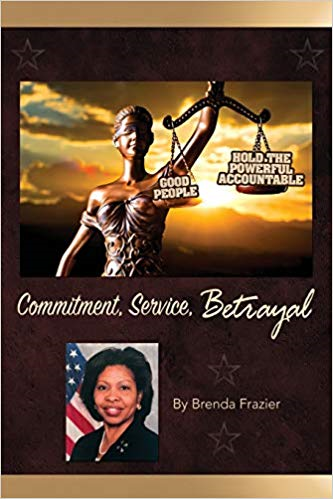
1 pointFOR IMMEDIATE RELEASE Contact: Brenda Toomer-Frazier,(803) 360-0449 or email-btfrazier54@gmail.com THE BETRAYAL OF A PUBLIC SERVANT Columbia, S.C. ---August 10, 2019 --- When a Police officer takes a sworn oath to serve and protect their community, there is a reverence in knowing that part of fulfilling that oath may mean making the ultimate sacrifice. This reality formulates a bond of honor among law enforcement officers from the highest to the lowest in rank. In her book, Commitment, Service and Betrayal, Police Officer Brenda Frazier illustrates how the unforgiving cold steel blade of injustice severed the chord of commonality between she and her police department. Commitment, Service and Betrayal is a read that captures the subtle undercurrent of sexism and racism that occurred in a South Carolina police department forensics lab. Brenda Frazier walks you through her first-hand account of how the venom of the modern-day Jim Crow south still exists even though their actions have moved from the public square to behind closed doors. The Jim Crow South’s painful remnants still prevailed in the treatment she received as a female black chemist in their crime lab. Despite her exemplary track record of commitment and service, the very system she was sworn to honor and respect, betrayed her when she needed it most. This part autobiographical sketch reads like a Life Time Hollywood movie filled with lies, deception, corruption, familial pain, death and betrayal. This is not a script from someone’s imagination but the true story of a woman who worked hard to pursue her dreams and despite the sabotage that existed in all areas of her life, she held on to her God-given drive to survive and prosper. “As a professional and law enforcement officer, I quickly realized, at the end of the day, I was only viewed as a black woman in this toxic work environment”, says Frazier. “I am of the mindset that it is better to go where you are celebrated than where you are tolerated. My hope is that someone who reads my book can draw strength and encouragement to move past adversity.” Frazier is now retired and moving on to the next chapter in life’s journey. Commitment, Service and Betrayal is published by True Perspective Publishing House and is 184 pages and retails for $19.99 and is available on Amazon, Barnes and Noble and wherever books are sold.
 1 point
 -
Relationship is new. Basically I'm committed to one person now we will see how it goes 🙂1 point
-
1 pointSaint Louis, Dec 16, 2019 (Issuewire.com) - Eating the Forbidden Fruit is a gritty fiction novel loosely based on true events in author Roland Sato Page life. The newcomer author delivers a personal journey into his rise and demise as a St. Louis City Police Officer. He takes the readers on a roller coaster ride of good old family memories to the nightmarish reality of being a police officer indicted on federal drug charges. During his trial, he wrote memoirs as a testimonial of redemption. Roland's case stems from the conflict of his childhood affiliation and his oath to uphold the law. What is certain one can't run from sin for karma is much faster. The author actually wrote the novel years ago however after battling Lupus he lost his motivation to complete it. Promising his mother, Fumi Karasawa, who recently passed that he would finish what he started. Roland opened his computer to complete telling his story. He also would like to encourage others with determination they too can reestablish position as a productive citizen. Roland was a popular tattoo artist in the St. Louis area however once diagnosed with Lupus he lost his hand and eye coordination bringing the body art career to a halt. No other choice he had to reinvent himself transforming visual art into literary art. Writing is quite therapeutic for the newly ordained writer. The silver lining is his family support kept him going. "With tragedy comes blessings". If you are anticipating the release of "Eating The Forbidden Fruit" then your wait won't belong. Be on the lookout for the fictional novel in March 30 2020 on all major book outlets.
.JPG.01cc1a9414a134465ce47c6990f497e8.JPG)

 1 point
 -
1 pointAAAAHHHHH! I LOVE CHERYL CROW! No you didn't!!! LOL. Man! That was so good! Such a release! Man! Thank you @Kareem @Maurice Thank you for posting. WHEW! WHEW! I LOVE THE BEATLES. Man! I could listend to 'Hey Jude' over and over and over... This has made my day!!! Lol! I ain't listening to no mo!--for now because I won't stop. I love CHIC and KC & the Sunshine Band. Man!1 point
-
1 pointThis song and Baez's sound reminds me of Sheryl Crow, who I really like. I'll listen to more of Joan Baez based on your recommendation. There were a lot of folksy ladies like this in the early 1990s along with Sheryl Crow. The 10,000 Maniacs (Natalie Merchant) are also high on my early 90s favorites. Truth be told, one of my first girlfriends when I was very young was a white chick who played the violin. So 10,000 Maniacs kind of reminds me of that! But I've always loved the sound of violins and other string instruments (cello, viola, etc.). Nile Rodgers in the late 1970s used them all to perfection in his music, and it's always cute white chicks playing those violins and violas! Again there will never be another 70s or 80s. The talent to compose and perform the music, the love, the respect between black and white...all that cannot exist today...sadly. We tried so hard in the USA to fix racism in the 70s and 80s. The powers-that-be just didn't want that to happen. In sum...1 point

.thumb.JPG.fdd7e0134da4dede0adf1418f4feed10.JPG)