The BCALA Literary Award–Winning Books
Back to Main Awards Page
Established in 1994 at the Second National Conference of African American Librarians, the Black Caucus of the American Library Association (BCALA) Literary Awards honor outstanding fiction and nonfiction by African American authors. Presented during the National Conference of African American Librarians, the awards recognize literary excellence with cash prizes for winners and Honor Book citations for other distinguished titles.
9 Books Honored in 2013
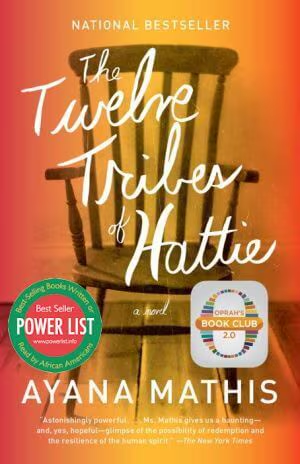
by Ayana Mathis
Buy from AALBC
Add to Cart — $16.95More Book Details
Fiction, Paperback, 320 pages
Publisher: Penguin Random House
ISBN: 9780307949707
 Bookshop
The arrival of a major new voice in contemporary fiction.
A debut of extraordinary distinction: Ayana Mathis tells the story of the children of the Great Migration through the trials of one unforgettable family.
My newest Book Club pick, The Twelve Tribes of Hattie by first-time novelist Ayana Mathis gives me that same feeling of connection. It spoke so deeply to me about what is unique and personal to the many generations of our Tribe. New voices, like Ayanas, are painting a rich and multilayered tapestry to bring the emotional center of the Great Migration to life. The Great Migration is a pivotal time in American history that affected our grandparents, our parents, our aunts and uncles, and now ultimately continues to impact all of us on the other side of it. Youll find the characters in The Twelve Tribes of Hattie are so familiar, its like going to a family reunion. For any book club, you hope to engage and connect with a story so that you feel expanded, inspired, enriched—like youve been somewhere special, that you otherwise wouldnt have gone. This is that kind of novel for every reader. For those of us who share the African American experience, and for all of us who share the human experience, I think it is a journey not to be missed.
I am honored to introduce you to Ayana Mathis and The Twelve Tribes of Hattie. I believe you will love it as much as I do.Oprah Winfrey
About the Book
In 1923, fifteen-year-old Hattie Shepherd flees Georgia and settles in Philadelphia, hoping for a chance at a better life. Instead, she marries a man who will bring her nothing but disappointment and watches helplessly as her firstborn twins succumb to an illness a few pennies could have prevented. Hattie gives birth to nine more children whom she raises with grit and mettle and not an ounce of the tenderness they crave. She vows to prepare them for the calamitous difficulty they are sure to face in their later lives, to meet a world that will not love them, a world that will not be kind. Captured here in twelve luminous narrative threads, their lives tell the story of a mothers monumental courage and the journey of a nation.
Beautiful and devastating, Ayana Mathiss The Twelve Tribes of Hattie is wondrous from first to last—glorious, harrowing, unexpectedly uplifting, and blazing with life. An emotionally transfixing page-turner, a searing portrait of striving in the face of insurmountable adversity, an indelible encounter with the resilience of the human spirit and the driving force of the American dream.
Buy from AALBC
Add to Cart — $16.00More Book Details
Fiction, Paperback, 432 pages
Publisher: Agate Publishing
ISBN: 9781932841640
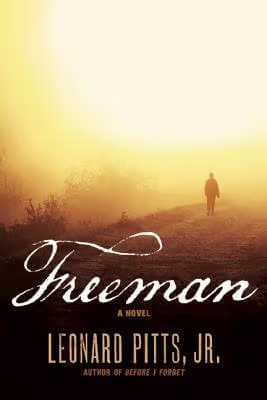
Freeman, the new novel by Leonard Pitts, Jr., takes place in the first few months following the Confederate surrender and the assassination of Abraham Lincoln. Upon learning of Lees surrender, Sama runaway slave who once worked for the Union Armydecides to leave his safe haven in Philadelphia and set out on foot to return to the war-torn South. What compels him on this almost-suicidal course is the desire to find his wife, the mother of his only child, whom he and their son left behind 15 years earlier on the Mississippi farm to which they all "belonged."
At the same time, Sams wife, Tilda, is being forced to walk at gunpoint with her owner and two of his other slaves from the charred remains of his Mississippi farm into Arkansas, in search of an undefined place that would still respect his entitlements as slave-owner and Confederate officer.
The books third main character, Prudence, is a fearless, headstrong white woman of means who leaves her Boston home for Buford, Mississippi, to start a school for the former bondsmen, and thus honor her fathers dying wish.
At bottom, Freeman is a love storysweeping, generous, brutal, compassionate, patientabout the feelings people were determined to honor, despite the enormous constraints of the times. It is this aspect of the book that should ensure it a strong, vocal, core audience of African-American women, who will help propel its likely critical acclaim to a wider audience. At the same time, this book addresses several themes that are still hotly debated today, some 145 years after the official end of the Civil War. Like Cold Mountain, Freeman illuminates the times and places it describes from a fresh perspective, with stunning results. It has the potential to become a classic addition to the literature dealing with this period. Few other novels so powerfully capture the pathos and possibility of the era particularly as it reflects the ordeal of the black slaves grappling with the promiseand the terrorof their new status as free men and women.
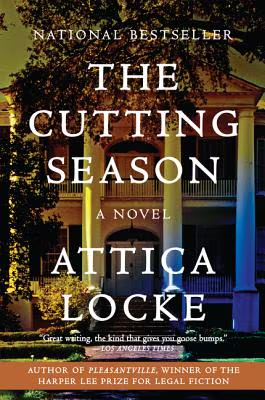
by Attica Locke
Buy from AALBC
Add to Cart — $15.99More Book Details
Fiction, Paperback, 384 pages
Publisher: HarperCollins
ISBN: 9780061802065
From Attica Locke, a writer and producer of FOXs Empire:The Cutting Seasonis a rare murder mystery with heft, a historical novel that thrills, a page-turner that makes you think. Attica Locke is a dazzling writer with a conscience.Dolen Perkins-Valdez,New York Timesbestselling author ofWenchAfter her breathtaking debut novel,Black Water Rising, won acclaim from major publications and respected crime fiction masters like James Ellroy and George Pelecanos, Locke returns withThe Cutting Season, a second novel easily as gripping and powerful as her firsta heart-pounding thriller that interweaves two murder mysteries, one on Belle Vie, a historic landmark in the middle of Lousianas Sugar Cane country, and one involving a slave gone missing more than one hundred years earlier.Black Water Risingwas nominated for aLos Angeles Times Book Prize, an Edgar Award, and an NAACP Image Award, and was short-listed for the Orange Prize in the U.K.

Buy from AALBC
Add to Cart — $39.95More Book Details
Nonfiction, Hardcover, 352 pages
Publisher: University of North Carolina Press
ISBN: 9780807835364
In this first full-length biography of Benjamin Mays (1894-1984), Randal Maurice Jelks chronicles the life of the man Martin Luther King Jr. called his "spiritual and intellectual father." Dean of the Howard University School of Religion, president of Morehouse College, and mentor to influential black leaders, Mays had a profound impact on the education of the leadership of the black church and of a generation of activists, policymakers, and educators. Jelks argues that Mayss ability to connect the message of Christianity with the responsibility to challenge injustice prepared the black church for its pivotal role in the civil rights movement.
From Mayss humble origins in Epworth, South Carolina, through his doctoral education, his work with institutions such as the National Urban League, the NAACP, and the national YMCA movement, and his significant career in academia, Jelks creates a rich portrait of the man, the teacher, and the scholar. Benjamin Elijah Mays, Schoolmaster of the Movement is a powerful portrayal of one mans faith, thought, and mentorship in bringing American apartheid to an end.

by Andrew P. Jackson, Jefferson C. Julius, Jr., and Akilah S. Nosakhere
Buy from AALBC
Add to Cart — $118.00More Book Details
Nonfiction, Hardcover, 300 pages
Publisher: Rowman & Littlefield
ISBN: 9780810882454
The 1970 and 1994 editions of The Black Librarian in America by E.J. Josey singled out racism as an important issue to be addressed within the library profession. Although much has changed since then, this latest collection of 48 essays by Black librarians and library supporters again identifies racism as one of many challenges of the new century.
Essays are written by library educators, library graduate students, retired librarians, public library trustees, veteran librarians, and new librarians fresh out of school with great ideas and wholesome energies. They cover such topics as poorly equipped school libraries and the need to preserve the school library, a call to action to all librarians to make the shift to new and innovative models of public education, the advancement in information technology and library operations, special libraries, recruitment and the Indiana State Library program, racism in the history of library and information science, and challenges that have plagued librarianship for decades.
This collection of poignant essays covers a multiplicity of concerns for the 21st-century Black librarian and embodies compassion and respect for the provision of information, an act that defines librarianship. The essays are personable, inspiring, and thought provoking for all library professionals, regardless of race, class, or gender.
Buy from AALBC
Add to Cart — $24.95More Book Details
Nonfiction, Paperback, 256 pages
Publisher: Rutgers University Press
ISBN: 9780813551678
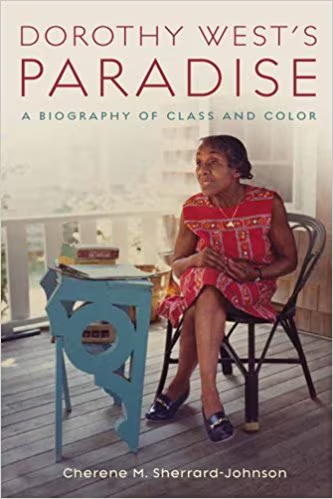
Dorothy West is best known as one of the youngest writers involved in the Harlem Renaissance. Subsequently, her work is read as a product of the urban aesthetics of this artistic movement. But West was also intimately rooted in a very different milieuOak Bluffs, an exclusive retreat for African Americans on Marthas Vineyard. She played an integral role in the development and preservation of that community. In the years between publishing her two novels, 1948s The Living is Easy and the 1995 bestseller The Wedding, she worked as a columnist for the Vineyard Gazette.Dorothy Wests Paradise captures the scope of the authors long life and career, reading it alongside the unique cultural geography of Oak Bluffs and its history as an elite African American enclavea place that West envisioned both as a separatist refuge and as a space for interracial contact. An essential book for both fans of Wests fiction and students of race, class, and American womens lives, Dorothy Wests Paradise offers an intimate biography of an important author and a privileged glimpse into the society that shaped her work.
Buy from AALBC
Add to Cart — $25.00More Book Details
Nonfiction, Hardcover, 352 pages
Publisher: Simon & Schuster, Inc.
ISBN: 9780743296830
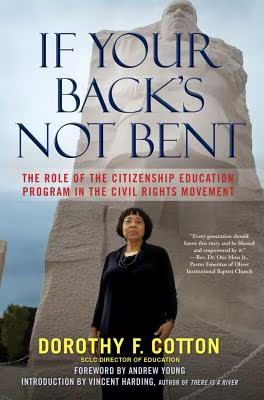
The only female in Martin Luther King, Jr.s inner circle of leadership, for the first time, offers her account of the Civil Rights Movement and what it means to us now.
Nobody can ride your back if your backs not bent, Dr. Martin Luther King Jr. said at the end of a Citizenship Education Program (CEP), an adult grassroots training program directed by Dorothy Cotton. This program, called the best-kept secret of the twentieth centurys civil rights movement, was critical in preparing legions of disenfranchised people across the South to work with existing systems of local government to gain access to services and resources they were entitled to as citizens. They learned to demonstrate peacefully against injustice, even when they were met with violence and hatred. The CEP was born out of the work of the Tennessee Highlander Folk School and was fully developed and expanded by the Southern Christian Leadership Conference led by Dr. King until that fateful day in Memphis in April 1968. Cotton was checked into the Lorraine Motel at that time as well, but shed left to do the work of the CEP before the assassins bullet was fired.
If Your Backs Not Bent recounts the accomplishments and the drama of this training that was largely ignored by the media, which had focused its attention on marches and demonstrations. This book describes who participated and how they were transformedmen and women alikefrom victims to active citizens, and how they transformed their communities and ultimately the country into a place of greater freedom and justice for all. Cotton, the only woman in Dr. Kings inner circle of leadership, for the first time offers her account of the movement, correcting the historical impression that we only marched and sang. She shows how the CEP was key to the movements success, and how the lessons of the program can serve our democracy now. People, and therefore systems, can indeed change if your backs not bent.
by bell hooks
Buy from AALBC
Add to Cart — $19.95More Book Details
Poetry, Paperback, 88 pages
Publisher: University Press of Kentucky
ISBN: 9780813136691
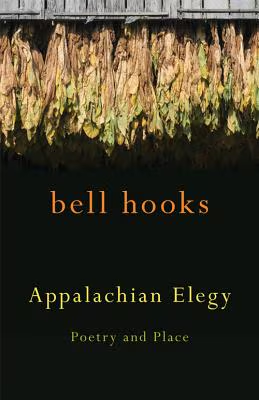
Author, activist, feminist, teacher, and artist bell hooks is celebrated as one of the nations leading intellectuals. Born in Hopkinsville, Kentucky, hooks drew her unique pseudonym from the name of her grandmother, an intelligent and strong-willed African American woman who inspired her to stand up against a dominating and repressive society. Her poetry, novels, memoirs, and childrens books reflect her Appalachian upbringing and feature her struggles with racially integrated schools and unwelcome authority figures. One of Utne Readers "100 Visionaries Who Can Change Your Life," hooks has won wide acclaim from critics and readers alike.
In Appalachian Elegy, bell hooks continues her work as an imagist of lifes harsh realities in a collection of poems inspired by her childhood in the isolated hills and hidden hollows of Kentucky. At once meditative, confessional, and political, this poignant volume draws the reader deep into the experience of living in Appalachia. Touching on such topics as the marginalization of its people and the environmental degradation it has suffered over the years, hookss poetry quietly elegizes the slow loss of an identity while also celebrating that which is constant, firmly rooted in a place that is no longer whole.
Buy from AALBC
Add to Cart — $15.95More Book Details
Poetry, Paperback, 88 pages
Publisher: University of Pittsburgh Press
ISBN: 9780822962236
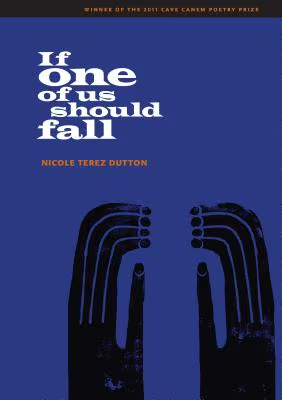
Winner of the Cave Canem Poetry Prize
Nicole Terez Duttons fierce and formidable debut throbs with restless beauty and a lyrical undercurrent that is both empowered and unpredictable. Every poem is unsettling in that delicious way that changes and challenges the reader. There is nothing here that does not hurtle forward.
Patricia Smith
Reader Comments (0)
Log In to Join the Conversation
Commenting is reserved for registered AALBC members to maintain high-quality discussions.
No comments yet. Be the first to share your thoughts!
Advertisement