National Book Award: Winners, Finalists, and Longlisted Titles
← Back to Main Awards Page
The mission of the National Book Foundation is to celebrate the best of American literature, to expand its audience, and to enhance the cultural value of great writing in America. National Book Awards are given in five categories: Fiction, Nonfiction, Poetry, Translated Literature, and Young People’s Literature.
Here we highlight the winners of African descent. The first African-American writer to win a National Book Award was Ralph Ellison, in 1953, for Invisible Man.
4 Books Honored by the National Book Foundation in 1972
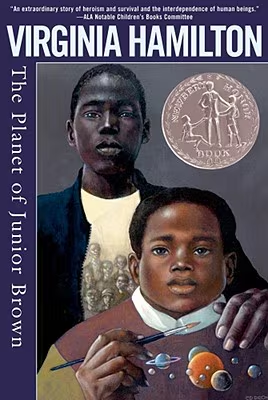
The Planet Of Junior Brown (2006)
Buy from AALBC
Add to Cart — $8.99More Book Details
Fiction, Paperback, 224 pages
Age Range: Young Adult
Publisher: Simon & Schuster, Inc.
ISBN: 9781416914105
 Bookshop
This is a reprint of the original 1971 edition.
Junior Brown, an overprotected three-hundred pound musical prodigy who s prone to having fantasies, and Buddy Clark, a loner who lives by his wits because he has no family whatsoever, have been on the hook from their eighth-grade classroom all semester.
Most of the time they have been in the school building in a secret cellar room behind a false wall, where Mr. Pool, the janitor, has made a model of the solar system. They have been pressing their luck for months and then they are caught. As society in the form of a zealous assistant principal closes in on them, Junior s fantasies become more desperate, and Buddy draws on all his resources to ensure his friend s well-being.
- 1972 1973 Mark Twain Awards - nomination
- 1971 Horn Book fanfare book
- 1972 Lewis Carroll Shelf Award - winner
- 1972 Newbery Medal - honor
- 1997 A film, adapted from the novel, was released
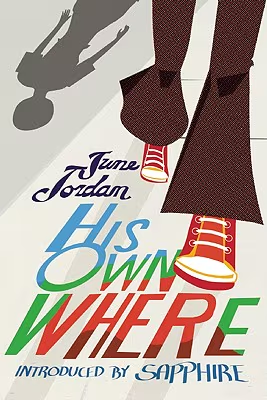
His Own Where
by June Jordan
Buy from AALBC
Add to Cart — $11.95More Book Details
Fiction, Paperback, 112 pages
Age Range: Middle Grade
Publisher: The Feminist Press
ISBN: 9781558616585
This June Jordan treasure is a rare piece of fiction from one of America s most vital poets and political essayists a tender story of young love in the face of generational opposition, a modern-day Romeo and Juliet that sings and sways. Walter Mosley"There must be bridges if we are to reach our young. His Own Where promises to be one." New York Times Book Review (1971)Nominated for a National Book Award in 1971, His Own Where is the story of Buddy, a fifteen-year-old boy whose world is spinning out of control. He meets Angela, whose angry parents accuse her of being "wild." When life falls apart for Buddy and his father, and when Angela is attacked at home, they take action to create their own way of staying alive in Brooklyn. In the process, the two find refuge in one another and learn that love is real and necessary. His Own Where was one of The New York Times Most Outstanding Books and was on the American Library Association s list of Best Books in 1971.June Jordan was a poet, essayist, journalist, dramatist, activist, and educator known for challenging oppression through her inspirational words and actions. She was the founder of Poetry for the People at the University of California, Berkeley, where she taught for many years. The author of over twenty books, her poetry is collected in Directed by Desire; her selected essays in Some of Us Did Not Die. Sapphire is the author of American Dreams, Black Wings & Blind Angels, and Push, which has been made into a motion picture called Precious.
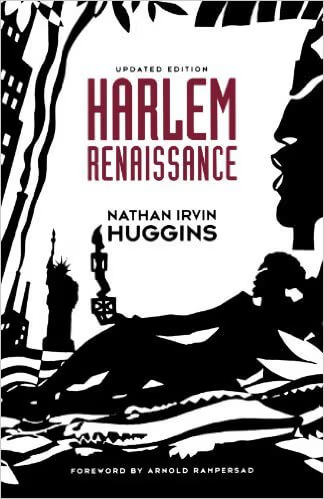
Harlem Renaissance
Buy from AALBC
Add to Cart — $19.95More Book Details
Nonfiction, Paperback, 390 pages
Publisher: Oxford University Press
ISBN: 9780195063363
A finalist for the 1972 National Book Award, hailed by The New York Times Book Review as "brilliant" and "provocative," Nathan Huggins Harlem Renaissance is a milestone in the study of African-American life and culture.
A superb portrait of one of the signal episodes in African-American and American history, this volume offers a brilliant account of the creative explosion in Harlem during these pivotal years. Blending the fields of history, literature, music, psychology, and folklore, Huggins illuminates the thought and writing of such key figures as Alain Locke, James Weldon Johnson, and W.E.B. DuBois and provides sharp-eyed analyses of the poetry of Claude McKay, Countee Cullen, and Langston Hughes. But the main objective for Huggins, throughout the book, is always to achieve a better understanding of America as a whole. As Huggins himself noted, he didn t want Harlem in the 1920s to be the focus of the book so much as a lens through which readers might see how this one moment in time sheds light on the American character and culture, not just in Harlem but across the nation. He strives throughout to link the work of poets and novelists not only to artists working in other genres and media but also to economic, historical, and cultural forces in the culture at large.
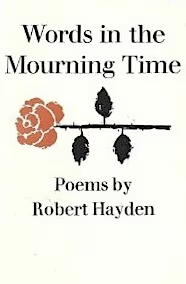
Words in the Mourning Time: Poems
Buy from AALBC
Unavailable from AALBCMore Book Details
Poetry, Hardcover
Publisher: October House
ISBN: 9780807901618
Reader Comments (0)
Log In to Join the Conversation
Commenting is reserved for registered AALBC members to maintain high-quality discussions.
No comments yet. Be the first to share your thoughts!
Advertisement