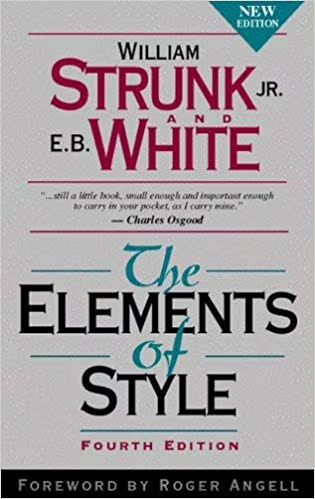
The Elements of Style
Buy from AALBC
Add to Cart — $14.99 Bookshop
Description of The Elements of Style
A full summary of The Elements of Style, 4th Edition, by William Strunk Jr. and E. B. White, reveals why this "little book" remains the definitive guide for writers. Originally written by Strunk in 1918 and later expanded by his student White, the book is a masterclass in brevity, clarity, and precision.
The 4th Edition includes a Foreword by Roger Angell and an Afterword by Charles Osgood, while retaining the core principles that have guided millions of writers. The text is organized into five primary sections:
--- ### I. Elementary Rules of UsageThis section outlines the basic mechanics of grammar and punctuation that form the foundation of clear writing. Key rules include:
- Form the possessive singular of nouns by adding ’s: Regardless of the final consonant (e.g., Charles’s friend).
- Use the serial comma: In a series of three or more terms, use a comma after each term except the last (e.g., red, white, and blue).
- Enclose parenthetic expressions between commas: Ensuring that interruptions in a sentence are clearly marked.
- Do not join independent clauses with a comma: Use a semicolon or a period instead to avoid "comma splices."
Moving beyond grammar, this section focuses on the structure and vigor of writing. The most famous directive in the book appears here:
"Vigorous writing is concise. A sentence should contain no unnecessary words, a paragraph no unnecessary sentences..."
- Make the paragraph the unit of composition: One paragraph to each topic.
- Use the active voice: It is more direct and vigorous than the passive voice.
- Put statements in positive form: Avoid hesitant or noncommittal language.
- Omit needless words: Every word in a sentence must tell.
This chapter addresses technicalities such as the use of exclamation marks (use them sparingly), hyphens, headings, and the proper way to format quotations and titles.
### IV. Words and Expressions Commonly MisusedA curated list of pitfalls for writers, distinguishing between commonly confused words such as affect vs. effect, imply vs. infer, and that vs. which. It also cautions against overused "buzzwords" and colloquialisms that weaken formal prose.
### V. An Approach to StyleWritten by White, this final chapter shifts from rules to the "philosophy" of writing. It offers 21 "Reminders" for writers, including:
- Place yourself in the background: Write in a way that draws attention to the sense and substance of the writing rather than the author’s mood.
- Revise and rewrite: White emphasizes that writing is a process of refinement.
- Do not overwrite: Rich, ornate prose often obscures meaning.
- Be clear: Clarity is the writer’s primary responsibility to the reader.
The 4th Edition also features a modernized glossary and index, and it updates the language to be more inclusive, such as reconsidering the use of the generic "he." Overall, the book serves as both a reference for specific questions and a manifesto for the power of plain English.