Hurston/Wright Legacy Award Nominees and Winning Books
← Back to Main Awards Page
Introduced in 2001 The Hurston/Wright Legacy Award was the first national award presented to Black writers by a national organization of Black writers. In tribute to Zora Neale Hurston, the Foundation has renamed the awards for each category for Fiction, Nonfiction, Debut Fiction, and Poetry – The Zora. These awards are presented at the annual The Hurston/Wright Legacy Awards.
Each October, the award winners are celebrated during the Hurston/Wright Legacy Awards that draws hundreds of literary stars, readers, representatives of the publishing industry, the arts, media, politics, and academia. Learn more at the Hurston/Wright Foundation’s website.
21 Books Honored by the Hurston/Wright Foundation in 2022
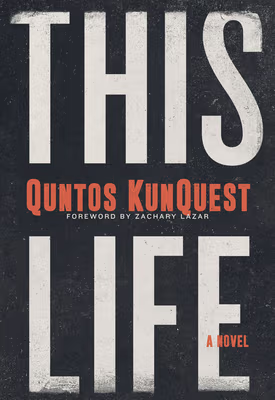
This Life
Buy from AALBC
Add to Cart — $18.00More Book Details
Fiction, Paperback, 250 pages
Publisher: Agate Publishing, Inc
ISBN: 9781572842823
 Bookshop
This Life is the debut novel by Quntos KunQuest, a longtime inmate at Angola, the infamous Louisiana State Penitentiary. This marks the appearance of a bold, distinctive new voice, one deeply inflected by hiphop, that delves into the meaning of a life spent behind bars, the human bonds formed therein, and the poetry that even those in the most dire places can create.
Lil Chris is just nineteen when he arrives at Angola as an AU an admitting unit, a fresh fish, a new vict. He s got a life sentence with no chance of parole, but he s also got a clear mind and sharp awareness one that picks up quickly on the details of the system, his fellow inmates, and what he can do to claim a place at the top. When he meets Rise, a mature inmate who s already spent years in the system, and whose composure and raised consciousness command the respect of the other prisoners, Lil Chris learns to find his way in a system bent on repressing every means he has to express himself.
Lil Chris and Rise channel their questions, frustrations, and pain into rap, and This Life flows with the same cadence that powers their charged verses. It pulses with the heat of impassioned inmates, the oppressive daily routines of the prison yard, and the rap contests that bring the men of the prison together. This Life is told in a voice that only a man who s lived it could have a clipped, urgent, evocative voice that surges with anger, honesty, playfulness, and a deep sense of ugly history. Angola started out as a plantation and as This Life makes clear, black inmates are still in a kind of enslavement there. This Life is an important debut that commands our attention with the vigor, dynamism, and raw, consciousness-expanding energy of this essential new voice.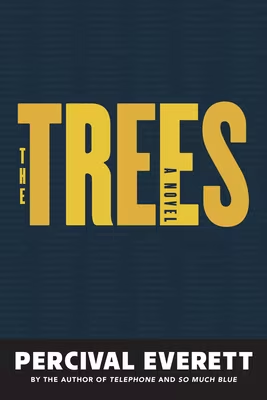
The Trees
Buy from AALBC
Add to Cart — $17.00More Book Details
Fiction, Paperback, 288 pages
Publisher: Graywolf Press
ISBN: 9781644450642
An uncanny literary thriller addressing the painful legacy of lynching in the US, by the author of Telephone
Percival Everett s The Trees is a page-turner that opens with a series of brutal murders in the rural town of Money, Mississippi. When a pair of detectives from the Mississippi Bureau of Investigation arrive, they meet expected resistance from the local sheriff, his deputy, the coroner, and a string of racist White townsfolk. The murders present a puzzle, for at each crime scene there is a second dead body: that of a man who resembles Emmett Till.
The detectives suspect that these are killings of retribution, but soon discover that eerily similar murders are taking place all over the country. Something truly strange is afoot. As the bodies pile up, the MBI detectives seek answers from a local root doctor who has been documenting every lynching in the country for years, uncovering a history that refuses to be buried. In this bold, provocative book, Everett takes direct aim at racism and police violence, and does so in a fast-paced style that ensures the reader can t look away. The Trees is an enormously powerful novel of lasting importance from an author with his finger on America s pulse.
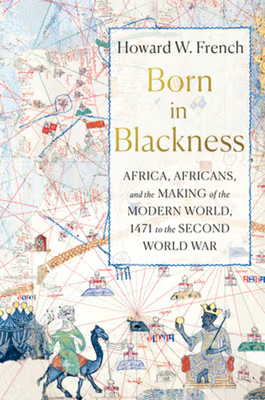
Born in Blackness: Africa, Africans, and the Making of the Modern World, 1471 to the Second World War
Buy from AALBC
Add to Cart — $35.00More Book Details
Nonfiction, Hardcover, 512 pages
Publisher: W. W. Norton & Company
ISBN: 9781631495823
Revealing the central yet intentionally obliterated role of Africa in the creation of modernity, Born in Blackness vitally reframes our understanding of world history.
Traditional accounts of the making of the modern world afford a place of primacy to European history. Some credit the fifteenth-century Age of Discovery and the maritime connection it established between West and East; others the accidental unearthing of the New World. Still others point to the development of the scientific method, or the spread of Judeo-Christian beliefs; and so on, ad infinitum. The history of Africa, by contrast, has long been relegated to the remote outskirts of our global story. What if, instead, we put Africa and Africans at the very center of our thinking about the origins of modernity?
In a sweeping narrative spanning more than six centuries, Howard W. French does just that, for Born in Blackness vitally reframes the story of medieval and emerging Africa, demonstrating how the economic ascendancy of Europe, the anchoring of democracy in the West, and the fulfillment of so-called Enlightenment ideals all grew out of Europe s dehumanizing engagement with the dark continent. In fact, French reveals, the first impetus for the Age of Discovery was not as we are so often told, even today Europe s yearning for ties with Asia, but rather its centuries-old desire to forge a trade in gold with legendarily rich Black societies sequestered away in the heart of West Africa.
Creating a historical narrative that begins with the commencement of commercial relations between Portugal and Africa in the fifteenth century and ends with the onset of World War II, Born in Blackness interweaves precise historical detail with poignant, personal reportage. In so doing, it dramatically retrieves the lives of major African historical figures, from the unimaginably rich medieval emperors who traded with the Near East and beyond, to the Kongo sovereigns who heroically battled seventeenth-century European powers, to the ex-slaves who liberated Haitians from bondage and profoundly altered the course of American history.
While French cogently demonstrates the centrality of Africa to the rise of the modern world, Born in Blackness becomes, at the same time, a far more significant narrative, one that reveals a long-concealed history of trivialization and, more often, elision in depictions of African history throughout the last five hundred years. As French shows, the achievements of sovereign African nations and their now-far-flung peoples have time and again been etiolated and deliberately erased from modern history. As the West ascended, their stories siloed and piecemeal were swept into secluded corners, thus setting the stage for the hagiographic rise of the West theories that have endured to this day.
Capacious and compelling (Laurent Dubois), Born in Blackness is epic history on the grand scale. In the lofty tradition of bold, revisionist narratives, it reframes the story of gold and tobacco, sugar and cotton and of the greatest commodity of them all, the twelve million people who were brought in chains from Africa to the New World, whose reclaimed lives shed a harsh light on our present world.
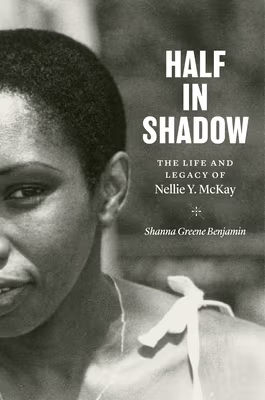
Half in Shadow: The Life and Legacy of Nellie Y. McKay
Buy from AALBC
Add to Cart — $26.95More Book Details
Nonfiction, Paperback, 280 pages
Publisher: University of North Carolina Press
ISBN: 9781469662534
Nellie Y. McKay (1930-2006) was a pivotal figure in contemporary American letters. The author of several books, McKay is best known for coediting the canon-making Norton Anthology of African American Literature with Henry Louis Gates Jr., which helped secure a place for the scholarly study of Black writing that had been ignored by white academia.
However, there is more to McKay s life and legacy than her literary scholarship. After her passing, new details about McKay s life emerged, surprising everyone who knew her. Why did McKay choose to hide so many details of her past? Shanna Greene Benjamin examines McKay s path through the professoriate to learn about the strategies, sacrifices, and successes of contemporary Black women in the American academy.
Benjamin shows that McKay s secrecy was a necessary tactic that a Black, working-class woman had to employ to succeed in the white-dominated space of the American English department. Using extensive archives and personal correspondence, Benjamin brings together McKay s private life and public work to expand how we think about Black literary history and the place of Black women in American culture.
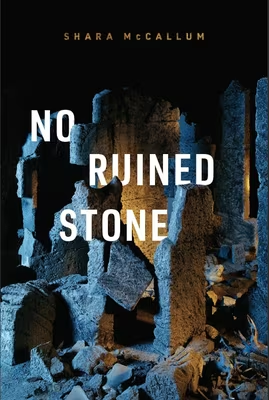
No Ruined Stone
Buy from AALBC
Add to Cart — $18.95More Book Details
Poetry, Paperback, 100 pages
Publisher: Alice James Books
ISBN: 9781948579193
No Ruined Stone is a verse sequence rooted in the life of 18th-century Scottish poet Robert Burns. In 1786, Burns arranged to migrate to Jamaica to work on a slave plantation, a plan he ultimately abandoned. Voiced by a fictive Burns and his fictional granddaughter, a mulatta passing for white, the book asks: what would have happened had he gone?
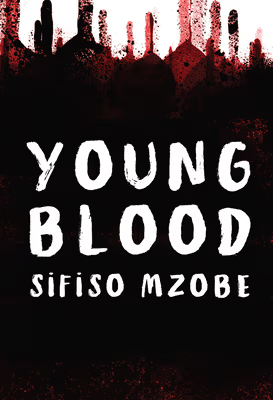
Young Blood
by Sifiso Mzobe
Buy from AALBC
Add to Cart — $16.95More Book Details
Fiction, Paperback, 320 pages
Publisher: Catalyst Press
ISBN: 9781946395481
2022 Shortlist, Hurston/Wright Legacy AwardWinner, Wole Soyinka Prize for Literature in AfricaWinner, 2011 Herman Charles Bosman AwardWinner, Sunday Times Fiction PrizeWinner, The Sunday Times Literary Award.
Sipho, a 17-year-old from the Umlazi township, drops out of high school and joins a car hijacking syndicate to make a name for himself and escape his family s low-income life. Along with hijacking partners Musa and Vusi, Sipho learns the tricks of the dangerous trade and pushes deeper into the underbelly of Umlazi under the guidance of gang leader Sibani, while partying heavily and juggling different women nightly alongside his longtime girlfriend Nana.
Candid and unapologetic, Young Blood is the story of the intricate balance of circumstance and choice, swift gain and incredible loss, as Sipho finds out how far he can push his luck before the damage is irrevocable - and the consequences deadly. Both a red-hot crime novel of car heists, sex, and rival gangs and a coming of age story of a teenager navigating the costs of the fast life, Young Blood reveals the devastating violence and raw beauty of life in South Africa s townships.
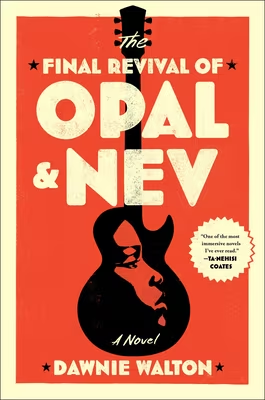
The Final Revival of Opal & Nev
Buy from AALBC
Add to Cart — $27.00More Book Details
Fiction, Hardcover, 368 pages
Publisher: Simon & Schuster, Inc.
ISBN: 9781982140168
An electrifying novel about the meteoric rise of an iconic 1970s rock duo, their sensational breakup, and the dark secrets unearthed when they try to reunite for one last tour. Opal is a fiercely independent young woman pushing against the grain in her style and attitude, Afro-punk before that term existed. Coming of age in Detroit, she can t imagine settling for a 9-to-5 job despite her unusual looks, Opal believes she can be a star. So when the aspiring British singer/songwriter Neville Charles discovers her at a bar s amateur night, she takes him up on his offer to make rock music together for the fledgling Rivington Records. In early seventies New York City, just as she s finding her niche as part of a flamboyant and funky creative scene, a rival band signed to her label brandishes a Confederate flag at a promotional concert. Opal s bold protest and the violence that ensues set off a chain of events that will not only change the lives of those she loves, but also be a deadly reminder that repercussions are always harsher for women, especially black women, who dare to speak their truth. Decades later, as Opal considers a 2016 reunion with Nev, music journalist S. Sunny Shelton seizes the chance to curate an oral history about her idols. Sunny thought she knew most of the stories leading up to the cult duo s most politicized chapter. But as her interviews dig deeper, a nasty new allegation from an unexpected source threatens to blow up everything. Provocative and chilling, The Final Revival of Opal & Nev features a backup chorus of unforgettable voices, a heroine the likes of which we ve not seen in storytelling, and a daring structure, and introduces a bold new voice in contemporary fiction.
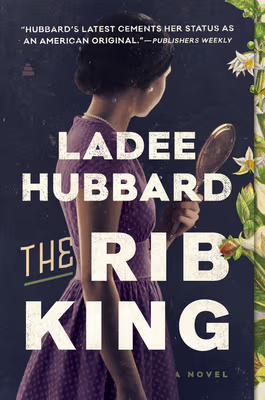
The Rib King
Buy from AALBC
Add to Cart — $16.99More Book Details
Fiction, Paperback, 336 pages
Publisher: HarperCollins
ISBN: 9780062979070
Thrillist - 30 Books We Can t Wait to Read in 2021
Book Riot - Our Most Anticipated Releases of 2021
Real Simple - The Best New Books to Read in 2021
Chicago Review of Books - 12 Must-Read Books of January
Book Riot - January 2021 Horoscopes and Book Recommendations
Glamour 7 of the Best New Books in January
Vulture - 46 Books We Can t Wait to Read in 2021
Lit Hub - Lit Hub s Most Anticipated Books of 2021
GMA.com - 16 January reads for the new year
Harper s Bazaar - 24 Books You Need to Read in 2021 -
The Millions - Most Anticipated: The Great First-Half 2021 Book Preview
Popsugar - From Bravery to Outlawed - These Are the Best Books of January 2021
Ms. Magazine - January 2021 Reads for the Rest of Us
Bustle - The Best New Books, Week of January 18th
Vulture - 27 Notable New Releases Over the Next Two Weeks
Lit Hub - 14 new books to fuel your reading resolutions
"Ultimately the reason to read The Rib King is not its timeliness or its insight into politics or Black culture, but because it accomplishes what the best fiction sets out to do: It drops you into a world you could not otherwise visit and makes you care deeply about what happens there." BookPage (starred review)
The acclaimed author of The Talented Ribkins deconstructs painful African American stereotypes and offers a fresh and searing critique on race, class, privilege, ambition, exploitation, and the seeds of rage in America in this intricately woven and masterfully executed historical novel, set in early the twentieth century that centers around the black servants of a down-on-its heels upper-class white family.
For fifteen years August Sitwell has worked for the Barclays, a well-to-do white family who plucked him from an orphan asylum and gave him a job. The groundskeeper is part of the household s all-black staff, along with "Miss Mamie," the talented cook, pretty new maid Jennie Williams, and three young kitchen apprentices the latest orphan boys Mr. Barclay has taken in to civilize boys like August.
But the Barclays fortunes have fallen, and their money is almost gone. When a prospective business associate proposes selling Miss Mamie s delicious rib sauce to local markets under the brand name "The Rib King" using a caricature of a wildly grinning August on the label Mr. Barclay, desperate for cash, agrees. Yet neither Miss Mamie nor August will see a dime. Humiliated, August grows increasingly distraught, his anger building to a rage that explodes in shocking tragedy.
Elegantly written and exhaustively researched, The Rib King is an unsparing examination of America s fascination with black iconography and exploitation that redefines African American stereotypes in literature. In this powerful, disturbing, and timely novel, Ladee Hubbard reveals who people actually are, and most importantly, who and what they are not.
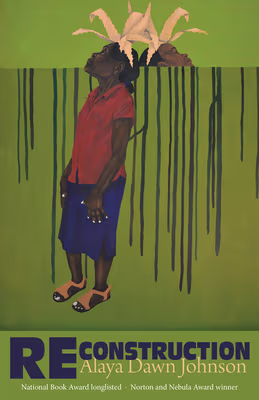
Reconstruction: Stories
Buy from AALBC
Add to Cart — $17.00More Book Details
Fiction, Paperback, 256 pages
Publisher: Small Beer Press
ISBN: 9781618731777
In Reconstruction Award-winning writer and musician Johnson digs into the lives of those trodden underfoot by the powers that be: from the lives of vampires and those caught in their circle in Hawai i to a taxonomy of anger put together by Union soldiers in the American Civil War, these stories will grab you and not let you go.
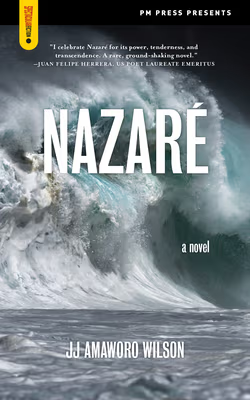
Nazaré
Buy from AALBC
Add to Cart — $24.95Nazaré tells the story of a peasants revolt in the polyglot city of Balaal. The story begins with a miracle. A homeless boy sees a whale washed up on the beach. He alerts the local fishermen, and soon the whole town is trying and failing to push it back into the ocean. With just the boy left to accompany the whale now in its dying throes, a freak wave pulls the creature back into the sea. This is an omen. Change is coming.
The boy and the washerwoman who adopts him cobble together a ramshackle army of fishermen, shopkeepers, lapsed nuns, anarchist bats, and an itinerant camel. They attempt to end the reign of the dictator who rules over Balaal. Their attempt involves pitched battles, farcical trials, rooftop escapes, and sun-parched wanderings in the wilderness. Looming over the disparate cast of characters is the legend of the giant wave Nazaré that will one day annihilate everyone and everything in the city.
Nazaré is an adventure and a parable that pits the oppressed against the oppressor. The work has been likened to that of Gabriel Garc a M rquez and Mario Vargas Llosa in its use of language, its inventiveness, its humor, and its examination of issues of justice.
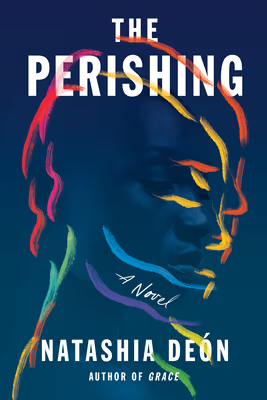
The Perishing
Buy from AALBC
Add to Cart — $26.00More Book Details
Fiction, Hardcover, 320 pages
Publisher: Counterpoint
ISBN: 9781640093027
A Black immortal in 1930 s Los Angeles must recover the memory of her past in order to discover who she truly is in this extraordinarily affecting novel for readers of N. K. Jemisin and Octavia E. Butler.
Lou, a young Black woman, wakes up in an alley in 1930s Los Angeles with no memory of how she got there or where she s from. Taken in by a caring foster family, Lou dedicates herself to her education while trying to put her mysterious origins behind her. She ll go on to become the first Black female journalist at the Los Angeles Times, but Lou s extraordinary life is about to take an even more remarkable turn. When she befriends a firefighter at a downtown boxing gym, Lou is shocked to realize that though she has no memory of meeting him, she s been drawing his face for years.
Increasingly certain that their paths previously crossed and beset by unexplainable flashes from different eras haunting her dreams Lou begins to believe she may be an immortal sent here for a very important reason, one that only others like her can explain. Setting out to investigate the mystery of her existence, Lou must make sense of the jumble of lifetimes calling to her, just as new forces threaten the existence of those around her.
Immersed in the rich historical tapestry of Los Angeles Prohibition, the creation of Route 66, and the collapse of the St. Francis Dam The Perishing is a stunning examination of love and justice through the eyes of one miraculous woman whose fate seems linked to the city she comes to call home.
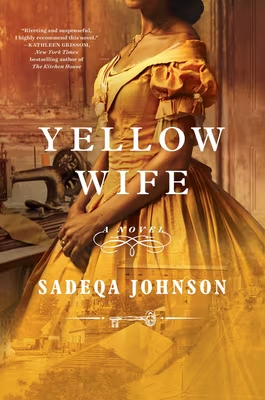
Yellow Wife
Buy from AALBC
Add to Cart — $26.00More Book Details
Fiction, Hardcover, 288 pages
Publisher: Simon & Schuster, Inc.
ISBN: 9781982149109
"Wholly engrossing, exquisitely researched, and so timely. Sadeqa Johnson brings a fresh telling to a story we think we already know, making it beautifully relatable and human. Riveting and suspenseful, I highly recommend this novel." Kathleen Grissom New York Times bestselling author of The Kitchen House This harrowing story follows an enslaved woman forced to barter love and freedom while living in the most infamous slave jail in Virginia. Born on a plantation in Charles City Virginia, Pheby Delores Brown has lived a privileged life. Shielded by her mother s position as the plantation s medicine woman, and cherished by the Master s sister, she is set apart from the others on the plantation, belonging to neither world. Freedom on her eighteenth birthday has been promised to her, but instead of the idyllic life she imagined with her true love, Essex Henry, Pheby is forced to leave the only home she has ever known and unexpectedly finds herself thrust into the bowels of slavery at the infamous "Devil s Half-Acre," a jail where the enslaved are broken, tortured, and sold every day in Richmond, Virginia. There Pheby is exposed not just to her Jailor s cruelty but also to his contradictions. To survive Pheby will have to outwit him but soon faces the ultimate sacrifice.
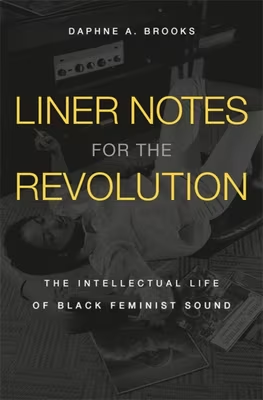
Liner Notes for the Revolution: The Intellectual Life of Black Feminist Sound
Buy from AALBC
Add to Cart — $39.95More Book Details
Nonfiction, Hardcover, 608 pages
Publisher: Harvard University Press
ISBN: 9780674052819
An award-winning Black feminist music critic takes us on an epic journey through radical sound from Bessie Smith to Beyoncé.
Daphne A. Brooks explores more than a century of music archives to examine the critics, collectors, and listeners who have determined perceptions of Black women on stage and in the recording studio. How is it possible, she asks, that iconic artists such as Aretha Franklin and Beyonc exist simultaneously at the center and on the fringe of the culture industry?
Liner Notes for the Revolution offers a startling new perspective on these acclaimed figures a perspective informed by the overlooked contributions of other Black women concerned with the work of their musical peers. Zora Neale Hurston appears as a sound archivist and a performer, Lorraine Hansberry as a queer Black feminist critic of modern culture, and Pauline Hopkins as America s first Black female cultural commentator. Brooks tackles the complicated racial politics of blues music recording, song collecting, and rock and roll criticism. She makes lyrical forays into the blues pioneers Bessie Smith and Mamie Smith, as well as fans who became critics, like the record-label entrepreneur and writer Rosetta Reitz. In the twenty-first century, pop superstar Janelle Monae s liner notes are recognized for their innovations, while celebrated singers Cecile McLorin Salvant, Rhiannon Giddens, and Valerie June take their place as cultural historians.
With an innovative perspective on the story of Black women in popular music and who should rightly tell it Liner Notes for the Revolution pioneers a long overdue recognition and celebration of Black women musicians as radical intellectuals.
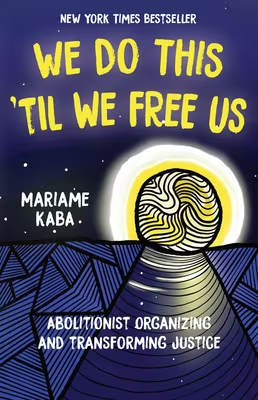
We Do This ’Til We Free Us: Abolitionist Organizing and Transforming Justice
by Mariame Kaba
Buy from AALBC
Add to Cart — $16.95More Book Details
Nonfiction, Paperback, 240 pages
Publisher: Haymarket Books
ISBN: 9781642595253
Organizing is both science and art. It is thinking through a vision, a strategy, and then figuring out who your targets are, always being concerned about power, always being concerned about how you re going to actually build power in order to be able to push your issues, in order to be able to get the target to actually move in the way that you want to.
What if social transformation and liberation isn t about waiting for someone else to come along and save us? What if ordinary people have the power to collectively free ourselves? In this timely collection of essays and interviews, Mariame Kaba reflects on the deep work of abolition and transformative political struggle.
With chapters on seeking justice beyond the punishment system, transforming how we deal with harm and accountability, and finding hope in collective struggle for abolition, Kaba s work is deeply rooted in the relentless belief that we can fundamentally change the world. As Kaba writes, Nothing that we do that is worthwhile is done alone.
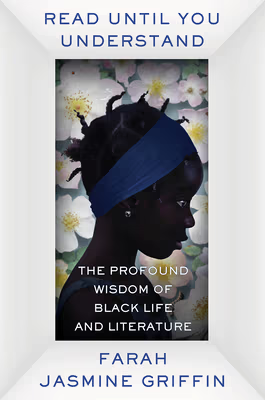
Read Until You Understand: The Profound Wisdom of Black Life and Literature
Buy from AALBC
Add to Cart — $26.95More Book Details
Nonfiction, Hardcover, 272 pages
Publisher: W. W. Norton & Company, Inc.
ISBN: 9780393651904
Farah Jasmine Griffin has taken to her heart the phrase read until you understand, a line her father, who died when she was nine, wrote in a note to her. She has made it central to this book about love of the majestic power of words and love of the magnificence of Black life.
Griffin has spent years rooted in the culture of Black genius and the legacy of books that her father left her. A beloved professor, she has devoted herself to passing these works and their wisdom on to generations of students.
Here, she shares a lifetime of discoveries: the ideas that inspired the stunning oratory of Frederick Douglass and Malcolm X, the soulful music of Marvin Gaye and Stevie Wonder, the daring literature of Phillis Wheatley and Toni Morrison, the inventive artistry of Romare Bearden, and many more. Exploring these works through such themes as justice, rage, self-determination, beauty, joy, and mercy allows her to move from her aunt s love of yellow roses to Gil Scott-Heron s Winter in America.
Griffin entwines memoir, history, and art while she keeps her finger on the pulse of the present, asking us to grapple with the continuing struggle for Black freedom and the ongoing project that is American democracy. She challenges us to reckon with our commitment to all the nation s inhabitants and our responsibilities to all humanity.
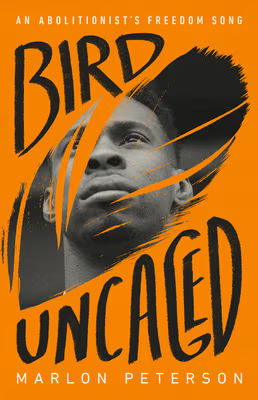
Bird Uncaged: An Abolitionist’s Freedom Song
Buy from AALBC
Add to Cart — $28.00More Book Details
Nonfiction, Hardcover, 224 pages
Publisher: Hachette Book Group
ISBN: 9781645036517
From a leading prison abolitionist, a moving memoir about coming of age in Brooklyn and surviving incarceration and a call to break free from all the cages that confine us. Marlon Peterson grew up in 1980s Crown Heights, raised by Trinidadian immigrants. Amid the routine violence that shaped his neighborhood, Marlon became a high-achieving and devout child, the specter of the American dream opening up before him. But in the aftermath of immense trauma, he participated in a robbery that resulted in two murders. At nineteen, Peterson was charged and later convicted. He served ten long years in prison. While incarcerated, Peterson immersed himself in anti-violence activism, education, and prison abolition work. In Bird Uncaged, Peterson challenges the typical "redemption" narrative and our assumptions about justice. With vulnerability and insight, he uncovers the many cages from the daily violence and trauma of poverty, to policing, to enforced masculinity, and the brutality of incarceration created and maintained by American society. Bird Uncaged is a twenty-first-century abolitionist memoir, and a powerful debut that demands a shift from punishment to healing, an end to prisons, and a new vision of justice.
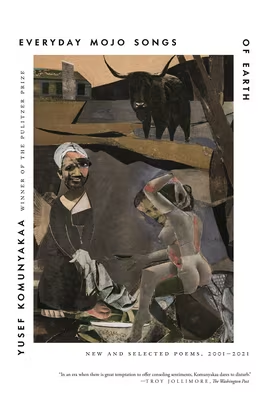
Everyday Mojo Songs of Earth: New and Selected Poems, 2001-2021
Buy from AALBC
Add to Cart — $20.00More Book Details
Poetry, Paperback, 288 pages
Publisher: Macmillan Publishers
ISBN: 9780374604851
New and selected poems from the great Pulitzer Prize-winning poet, Yusef Komunyakaa
These songs run along dirt roads
& highways, crisscross lonely seas
& scale mountains, traverse skies
& underworlds of neon honkytonk,
Wherever blues dare to travel.
Everyday Mojo Songs of Earth brings together selected poems from the past twenty years of Yusef Komunyakaa s work, as well as new poems from the Pulitzer Prize winner. His masterful, concise verse conjures arresting images of peace and war, the natural power of the earth and of love, his childhood in the American South and his service in Vietnam, the ugly violence of racism in America, and the meaning of power and morality.
The new poems in this collection add a new refrain to the jazz-inflected rhythms of one of our most significant and individual voices (David Wojahn, Poetry). Komunyakaa writes of a young man fashioning a slingshot, workers who honor the Earth by opening shine / inside the soil, and the sounds of a saxophone filling a dim lounge in New Jersey. As April Bernard wrote in The New York Times Book Review, He refuses to be trivial; and he even dares beauty.
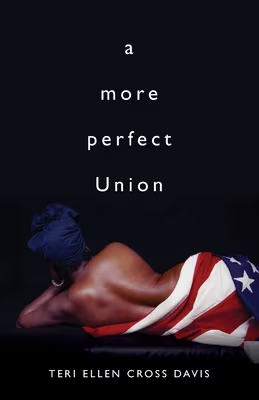
A More Perfect Union
Buy from AALBC
Add to Cart — $14.95More Book Details
Poetry, Paperback, 74 pages
Publisher: Ohio University Press
ISBN: 9780814257784
In the tender, sensual, and bracing poems of a more perfect Union, Teri Ellen Cross Davis reclaims the experience of living and mothering while Black in contemporary America, centering Black women s pleasure by wresting it away from the relentless commodification of the White gaze. Cross Davis deploys stunning emotional range to uplift the mundane, interrogate the status quo, and ultimately create her own goddesses. Parenting, lust, household chores all are fair game for Cross Davis s gimlet eye. Whether honoring her grief for Prince s passing while examining his role in midwifing her sexual awakening or contemplating travel and the gamble of being Black across this wide world, these poems tirelessly seek a path out of the labyrinth to hope.
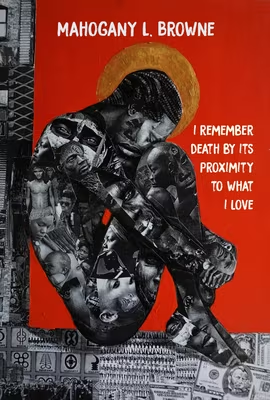
I Remember Death by Its Proximity to What I Love
Buy from AALBC
Add to Cart — $16.00More Book Details
Poetry, Paperback, 100 pages
Publisher: Haymarket Books
ISBN: 9781642595703
Mahogany L. Browne s evocative book-length poem explores the impacts of the prison system on both the incarcerated and the loved ones left behind.
I Remember Death by Its Proximity to What I Love is an expansive poetic meditation on who we think is bound by incarceration. The answer: all of us. Weaving personal narrative, case studies, and inventive form, Browne invokes the grief, pain, and resilience in the violent wake of the prison system. This poem is dirge work but allows us to revel in the intricacies of our human condition. Written by a beloved and prolific writer, organizer, and educator, this work serves as a practice of self-reflection and accountability. Browne steps into the lineage of Sonia Sanchez s Does Your House Have Lions? with the precision of a master wordsmith and the empathy of an attentive storyteller.
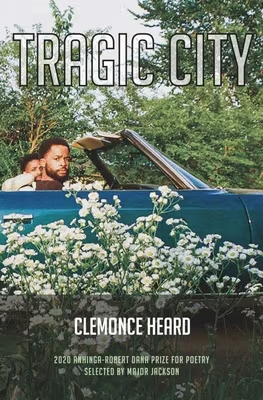
Tragic City
Buy from AALBC
Add to Cart — $22.00More Book Details
Poetry, Paperback, 128 pages
Publisher: Anhinga Press
ISBN: 9781934695715
Heard s sojourn in Tulsa and the history of the Tulsa Race Massacre comes to a head in these poems that investigate the incident s resounding trauma with lyric and historic precision. The absence of reckoning a century after the 1921 Tulsa Race Massacre is soldered together by a series of poems based on Heard s time living on the fringes of the city s art district and what was once Greenwood, Tulsa s thriving Black neighborhood. Heard blends survivor testimonies, myths, and present intelligence with his own lived experience and a farrago of forms to feel his way to a more intuitive truth of what isn t documented.
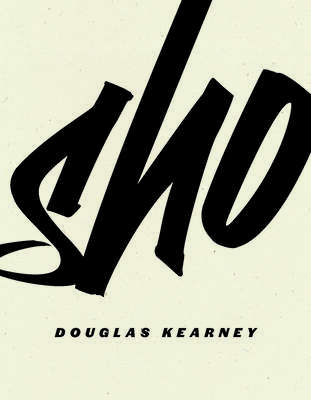
Sho
Buy from AALBC
Add to Cart — $18.00More Book Details
Poetry, Paperback, 104 pages
Publisher: Wave Books
ISBN: 9781950268153
Eschewing series and performative typography, Douglas Kearney s Sho aims to hit crooked licks with straight-seeming sticks. Navigating the complex penetrability of language, these poems are sonic in their espousal of Black vernacular traditions, while examining histories, pop culture, myth, and folklore. Both dazzling and devastating, Sho is a genius work of literary precision, wordplay, farce, and critical irony. In his stove-like imagination, Kearney has concocted poems that destabilize the spectacle, leaving looky-loos with an important uncertainty about the intersection between violence and entertainment.
Reader Comments (0)
Log In to Join the Conversation
Commenting is reserved for registered AALBC members to maintain high-quality discussions.
No comments yet. Be the first to share your thoughts!
Advertisement