National Book Award: Winners, Finalists, and Longlisted Titles
← Back to Main Awards Page
The mission of the National Book Foundation is to celebrate the best of American literature, to expand its audience, and to enhance the cultural value of great writing in America. National Book Awards are given in five categories: Fiction, Nonfiction, Poetry, Translated Literature, and Young People’s Literature.
Here we highlight the winners of African descent. The first African-American writer to win a National Book Award was Ralph Ellison, in 1953, for Invisible Man.
17 Books Honored by the National Book Foundation in 2021
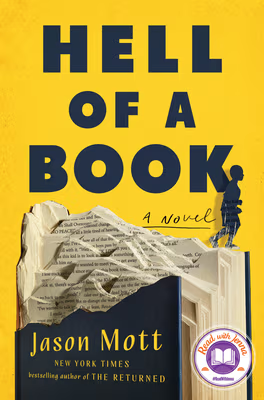
Hell of a Book
by Jason Mott
Buy from AALBC
Add to Cart — $27.00More Book Details
Fiction, Hardcover, 336 pages
Publisher: Penguin Random House
ISBN: 9780593330968
 Bookshop
An astounding work of fiction from a New York Times bestselling author, always deeply honest, at times electrically funny, that goes to the heart of racism, police violence, and the hidden costs exacted upon Black Americans, and America as a whole In Hell of a Book, an African-American author sets out on a cross-country book tour to promote his bestselling novel. That storyline drives Jason Mott s novel and is the scaffolding of something much larger and more urgent: since his novel also tells the story of Soot, a young Black boy living in a rural town in the recent past, and The Kid, a possibly imaginary child who appears to the author on his tour. Throughout, these characters stories build and build and as they converge, they astonish. For while this heartbreaking and magical book entertains and is at once about family, love of parents and children, art, and money, there always is the tragic story of a police shooting playing over and over on the news. Who has been killed? Who is The Kid? Will the author finish his book tour, and what kind of world will he leave behind? Unforgettably powerful, an electrifying high-wire act, ideal for book clubs, and the book Mott says he has been writing in his head for ten years, Hell of a Book in its final twists truly becomes its title.
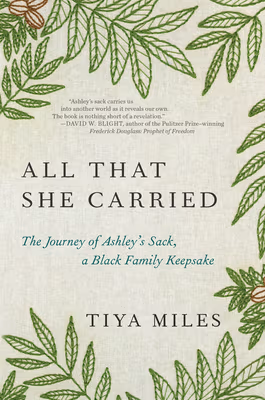
All That She Carried: The Journey of Ashley’s Sack, a Black Family Keepsake
by Tiya Miles
Buy from AALBC
Add to Cart — $28.00More Book Details
Nonfiction, Hardcover, 416 pages
Publisher: Penguin Random House
ISBN: 9781984854995
A renowned historian traces the life of a single object handed down through three generations of Black women to craft an extraordinary testament to people who are left out of the archives.
In 1850s South Carolina, an enslaved woman named Rose faced a crisis, the imminent sale of her daughter Ashley. Thinking quickly, she packed a cotton bag with a few precious items as a token of love and to try to ensure Ashley s survival. Soon after, the nine-year-old girl was separated from her mother and sold.
Decades later, Ashley s granddaughter Ruth embroidered this family history on the bag in spare yet haunting language including Rose s wish that It be filled with my Love always. Ruth s sewn words, the reason we remember Ashley s sack today, evoke a sweeping family story of loss and of love passed down through generations. Now, in this illuminating, deeply moving new book inspired by Rose s gift to Ashley, historian Tiya Miles carefully unearths these women s faint presence in archival records to follow the paths of their lives and the lives of so many women like them to write a singular and revelatory history of the experience of slavery, and the uncertain freedom afterward, in the United States.
The search to uncover this history is part of the story itself. For where the historical record falls short of capturing Rose s, Ashley s, and Ruth s full lives, Miles turns to objects and to art as equally important sources, assembling a chorus of women s and families stories and critiquing the scant archives that for decades have overlooked so many. The contents of Ashley s sack a tattered dress, handfuls of pecans, a braid of hair, my Love always are eloquent evidence of the lives these women lived. As she follows Ashley s journey, Miles metaphorically unpacks the bag, deepening its emotional resonance and exploring the meanings and significance of everything it contained.
All That She Carried is a poignant story of resilience and of love passed down through generations of women against steep odds. It honors the creativity and fierce resourcefulness of people who preserved family ties even when official systems refused to do so, and it serves as a visionary illustration of how to reconstruct and recount their stories today.
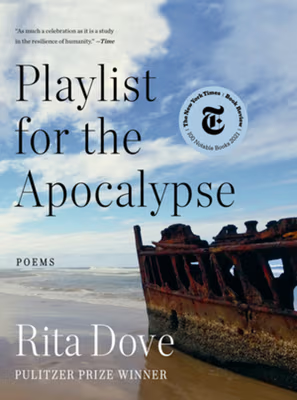
Playlist for the Apocalypse: Poems
by Rita Dove
Buy from AALBC
Add to Cart — $15.95More Book Details
Poetry, Paperback, 128 pages
Publisher: W. W. Norton & Company, Inc.
ISBN: 9781324050438
Finalist for the 2022 Los Angeles Times Book Prize and the 2021 NAACP Image Award for Outstanding Literary Work - Poetry
A piercing, unflinching new volume offers necessary music for our tumultuous present, from perhaps the best public poet we have (Boston Globe).
In her first volume of new poems in twelve years, Rita Dove investigates the vacillating moral compass guiding America s, and the world s, experiments in democracy. Whether depicting the first Jewish ghetto in sixteenth-century Venice or the contemporary efforts of Black Lives Matter, a girls night clubbing in the shadow of World War II or the doomed nobility of Muhammad Ali s conscious objector stance, this extraordinary poet never fails to connect history s grand exploits to the triumphs and tragedies of individual lives.
Meticulously orchestrated and musical in its forms, Playlist for the Apocalypse collects a dazzling array of voices: an elevator operator simmers with resentment, an octogenarian dances an exuberant mambo, a spring cricket philosophizes with mordant humor on hip hop, critics, and Valentine s Day. Calamity turns all too personal in the book s final section, Little Book of Woe, which charts a journey from terror to hope as Dove learns to cope with debilitating chronic illness.
At turns audaciously playful and grave, alternating poignant meditations on mortality and acerbic observations of injustice, Playlist for the Apocalypse takes us from the smallest moments of redemption to catastrophic failures of the human soul. Listen up, the poet says, speaking truth to power; what you ll hear in return is a lifetime of song.
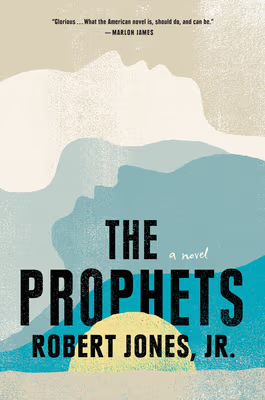
The Prophets
Buy from AALBC
Add to Cart — $27.00More Book Details
Fiction, Hardcover, 400 pages
Publisher: Penguin Random House
ISBN: 9780593085684
- #1 Indie Next Pick
- The New York Times Book Review s Books to Watch for in January
- The Washington Post s 10 Books to Read in January
- TIME s 10 New Books You Should Read in January
- O, the Oprah Magazine s 32 LGBTQ Books That Will Change the Literary Landscape in 2021
- Good Morning America s Best Books to Read this January
- CNN s Best Books of January
- Harper s Bazaar s Winter s Best New Releases
- BuzzFeed s Most Anticipated Historical Fiction of 2021
- PopSugar s Best Books of January
- Lit Hub s Most Anticipated Books of 2021
- Electric Literature s Most Anticipated Debuts of 2021
- The Millions Most Anticipated Books of 2021
- Debutiful s Best Debuts of January
- Lambda Literary s Most Anticipated LGBTQ Books of January
- LGBTQ Read s Most Anticipated LGBTQIAP Fiction of 2021 Picks
- Kirkus Reviews Most Anticipated Books of the Fall
Instant New York Times Bestseller
May this book cast its spell on all of us, restore to us some memory of our most warrior and softest selves. The New York Times Book Review
A new kind of epic A grand achievement While The Prophets dreamy realism recalls the work of Toni Morrison its penetrating focus on social dynamics stands out more singularly. Entertainment Weekly
A singular and stunning debut novel about the forbidden union between two enslaved young men on a Deep South plantation, the refuge they find in each other, and a betrayal that threatens their existence.
Isaiah was Samuel s and Samuel was Isaiah s. That was the way it was since the beginning, and the way it was to be until the end. In the barn they tended to the animals, but also to each other, transforming the hollowed-out shed into a place of human refuge, a source of intimacy and hope in a world ruled by vicious masters. But when an older man a fellow slave seeks to gain favor by preaching the master s gospel on the plantation, the enslaved begin to turn on their own. Isaiah and Samuel s love, which was once so simple, is seen as sinful and a clear danger to the plantation s harmony.
With a lyricism reminiscent of Toni Morrison, Robert Jones, Jr., fiercely summons the voices of slaver and enslaved alike, from Isaiah and Samuel to the calculating slave master to the long line of women that surround them, women who have carried the soul of the plantation on their shoulders. As tensions build and the weight of centuries of ancestors and future generations to come culminates in a climactic reckoning, The Prophets masterfully reveals the pain and suffering of inheritance, but is also shot through with hope, beauty, and truth, portraying the enormous, heroic power of love.
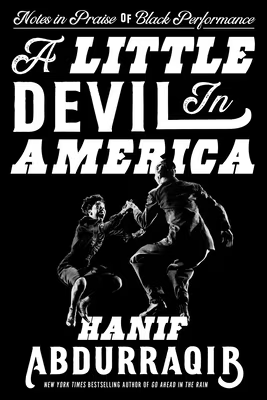
A Little Devil in America: Notes in Praise of Black Performance
Buy from AALBC
Add to Cart — $27.00More Book Details
Nonfiction, Hardcover, 272 pages
Publisher: Penguin Random House
ISBN: 9781984801197
A stirring meditation on Black performance in America from the New York Times bestselling author of Go Ahead in the Rain
Whether heralding unsung entertainers or reexamining legends, Hanif Abdurraqib weaves together gorgeous essays that reveal the resilience, heartbreak, and joy within Black performance. I read this book breathlessly. Brit Bennett, author of The Vanishing Half
At the March on Washington in 1963, Josephine Baker was fifty-seven years old, well beyond her most prolific days. But in her speech she was in a mood to consider her life, her legacy, her departure from the country she was now triumphantly returning to. I was a devil in other countries, and I was a little devil in America, too, she told the crowd. Inspired by these few words, Hanif Abdurraqib has written a profound and lasting reflection on how Black performance is inextricably woven into the fabric of American culture. Each moment in every performance he examines whether it s the twenty-seven seconds in Gimme Shelter in which Merry Clayton wails the words rape, murder, a schoolyard fistfight, a dance marathon, or the instant in a game of spades right after the cards are dealt has layers of resonance in Black and white cultures, the politics of American empire, and Abdurraqib s own personal history of love, grief, and performance.
Abdurraqib writes prose brimming with jubilation and pain, infused with the lyricism and rhythm of the musicians he loves. With care and generosity, he explains the poignancy of performances big and small, each one feeling intensely familiar and vital, both timeless and desperately urgent. Filled with sharp insight, humor, and heart, A Little Devil in America exalts the Black performance that unfolds in specific moments in time and space from midcentury Paris to the moon, and back down again to a cramped living room in Columbus, Ohio.
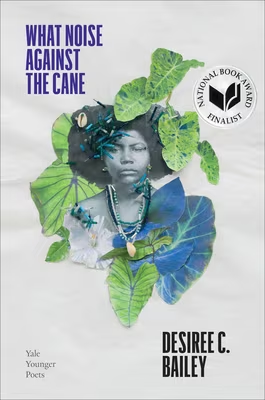
What Noise Against the Cane
Buy from AALBC
Add to Cart — $20.00More Book Details
Poetry, Paperback, 96 pages
Publisher: Yale University Press
ISBN: 9780300256536
Finalist for the 2021 National Book Award for Poetry, this Yale Series of Younger Poets volume (#115) is a lyrical and polyvocal exploration of what it means to fight for yourself
Bailey invites us to see what twenty-first-century life is like for a young woman of the Black diaspora in the long wake of a history of slavery, brutality, and struggling for freedoms bodily and psychological. Carl Phillips, from the Foreword
Desiree C. Bailey sings true in her debut. Wherever this voice goes a Caribbean sun travels with it transfiguring what a maroon might overhear a call awaiting response. Yusef Komunyakaa
The 115th volume of the Yale Series of Younger Poets, What Noise Against the Cane is a lyric quest for belonging and freedom, weaving political resistance, Caribbean folklore, immigration, and the realities of Black life in America. Desiree C. Bailey begins by reworking the epic in an oceanic narrative of bondage and liberation in the midst of the Haitian Revolution. The poems move into the contemporary Black diaspora, probing the mythologies of home, belief, nation, and womanhood. Series judge Carl Phillips observes that Bailey s poems argue for hope and faith equally . These are powerful poems, indeed, and they make a persuasive argument for the transformative powers of steady defiance.
Sho
Buy from AALBC
Add to Cart — $18.00More Book Details
Poetry, Paperback, 104 pages
Publisher: Wave Books
ISBN: 9781950268153
Eschewing series and performative typography, Douglas Kearney s Sho aims to hit crooked licks with straight-seeming sticks. Navigating the complex penetrability of language, these poems are sonic in their espousal of Black vernacular traditions, while examining histories, pop culture, myth, and folklore. Both dazzling and devastating, Sho is a genius work of literary precision, wordplay, farce, and critical irony. In his stove-like imagination, Kearney has concocted poems that destabilize the spectacle, leaving looky-loos with an important uncertainty about the intersection between violence and entertainment.
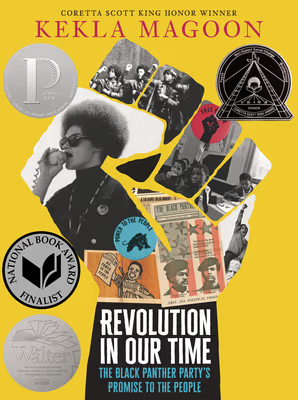
Revolution in Our Time: The Black Panther Party’s Promise to the People
by Kekla Magoon
Buy from AALBC
Add to Cart — $24.99More Book Details
Nonfiction, Hardcover, 400 pages
Age Range: Young Adult
Publisher: Candlewick Press
ISBN: 9781536214185
With passion and precision, Kekla Magoon relays an essential account of the Black Panthers as militant revolutionaries and as human rights advocates working to defend and protect their community.
In this comprehensive, inspiring, and all-too-relevant history of the Black Panther Party, Kekla Magoon introduces readers to the Panthers community activism, grounded in the concept of self-defense, which taught Black Americans how to protect and support themselves in a country that treated them like second-class citizens. For too long the Panthers story has been a footnote to the civil rights movement rather than what it was: a revolutionary socialist movement that drew thousands of members mostly women and became the target of one of the most sustained repression efforts ever made by the U.S. government against its own citizens.
Revolution in Our Time puts the Panthers in the proper context of Black American history, from the first arrival of enslaved people to the Black Lives Matter movement of today. Kekla Magoon s eye-opening work invites a new generation of readers grappling with injustices in the United States to learn from the Panthers history and courage, inspiring them to take their own place in the ongoing fight for justice.
Kekla Magoon is a national treasure, and Revolution in Our Time passionately and meticulously details a critical truth that is both feared and necessary in the classroom.
Rita Williams-Garcia, award-winning author of A Sitting in St. James
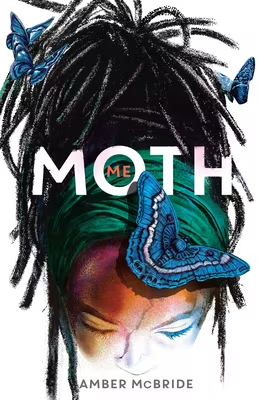
Me (Moth)
Buy from AALBC
Add to Cart — $18.99More Book Details
Fiction, Hardcover, 256 pages
Age Range: Young Adult
Publisher: Macmillan Publishers
ISBN: 9781250780362
A debut YA novel-in-verse by Amber McBride, Me (Moth) is about a teen girl who is grieving the deaths of her family, and a teen boy who crosses her path.
Moth has lost her family in an accident. Though she lives with her aunt, she feels alone and uprooted.
Until she meets Sani, a boy who is also searching for his roots. If he knows more about where he comes from, maybe he ll be able to understand his ongoing depression. And if Moth can help him feel grounded, then perhaps she too will discover the history she carries in her bones.
Moth and Sani take a road trip that has them chasing ghosts and searching for ancestors. The way each moves forward is surprising, powerful, and unforgettable.
Here is an exquisite and uplifting novel about identity, first love, and the ways that our memories and our roots steer us through the universe.
Me (Moth) holds you like a gentle haint, pulling you in and out of song, and dance, and dreams until you are not sure where reality ends and memory begins. Amber McBride in her young adult debut has written a marvelous novel in verse full of ancestor wisdom and love that traverses crossroads that we must navigate to live. Joanne V. Gabbin, Director, Furious Flower Poetry Center
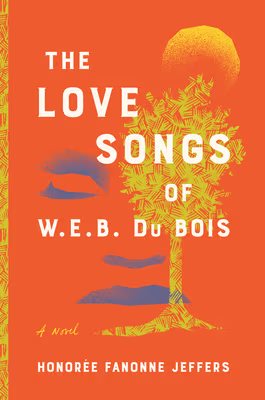
The Love Songs of W.E.B. Du Bois
Buy from AALBC
Add to Cart — $28.99More Book Details
Fiction, Hardcover, 816 pages
Publisher: HarperCollins
ISBN: 9780062942937
I was so enraptured by the story of this modern Black family, and how author Honorée Fanonne Jeffers wove the larger fabric of historical trauma through the family s silence through generations Oprah Winfrey, Announcing The Love Songs of W.E.B. Du Bois as the Next Oprah s Book Club Selection
The Love Songs of W.E.B. Du Bois, the ambitious and uncompromising debut novel from National Book Award-nominated poet Honorée Fanonne Jeffers, takes readers into the intimate lives of Black and Indigenous women who have fought racism and sexism to weave their experiences into America s larger tapestry. Fashioning a microcosm of our fraught national history, Jeffers crafts a complex narrative of forced accommodation, courageous resistance, and resilience, as she deftly chronicles the journey of one American family through centuries from the white appropriation of native lands to the African slave trade, from the Civil War to the Civil Rights Movement and beyond. Jeffers frames her wholly original narrative with Sorrow Songs a term borrowed from W.E.B. Dubois: ancestral memories that unfold as beautifully-rendered, almost mythic tales.
The novel centers on Ailey Pearl Garfield as she pushes against the expectations of her African American middle-class upbringing. On the path to fulfilling her family s wish for her to become a doctor, Ailey attends an historically Black college in Georgia, not far from the rural homestead where her ancestors were once enslaved. Ailey straddles the present and the past as she reconnects with this side of her heritage, whose traditions clash with those of her imperious, light-skinned paternal grandmother, to whom skin tone is paramount. As Ailey struggles to learn who she is and what she wants, she must reckon with the complicated racial history that has shaped her family, uncovering buried truths about her ancestors both invigorating and difficult.
In creating this world, Jeffers has drawn on stories from her own family. Remembering childhood summers spent in Georgia with her grandmother, she recalls, I wasn t a child who played well with others. I preferred to sit still in corners and eavesdrop on elder relatives. I first learned of slavery and lynching, and the difficult history of this country not from books, but from eavesdropping on old, Black folks. After I became a creative writing major, I kept returning to the ancestral land of my mother and grandmother, and I began writing about a southern, Black family that had survived the horrors of historical racism and white supremacy.
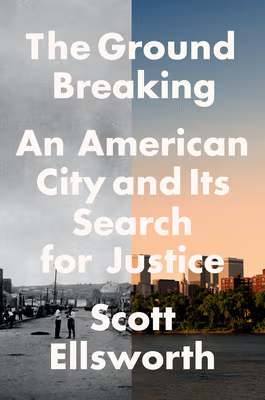
The Ground Breaking: An American City and Its Search for Justice
Buy from AALBC
Add to Cart — $28.00More Book Details
Nonfiction, Hardcover, 336 pages
Publisher: Penguin Random House
ISBN: 9780593182987
And then they were gone.
More than one-thousand homes and businesses. Restaurants and movie theaters, churches and doctors offices, a hospital, a public library, a post office. Looted, burned, and bombed from the air. Over the course of less than twenty-four hours in the spring of 1921, Tulsa s infamous "Black Wall Street" was wiped off the map and erased from the history books. Official records disappeared, researchers were threatened, and the worst single incident of racial violence in American history lay buried for more than fifty years. But there were some secrets that would not die. A riveting and essential new book, The Ground Breaking not only tells the long-suppressed story of the notorious Tulsa Race Massacre. It also unearths the lost history of how the massacre was covered up, and of the courageous individuals who fought to keep the story alive. Most importantly, it recounts the ongoing archaeological and true crime saga of the search for the unmarked graves of the victims of the massacre, and of the fight to win restitution for the survivors and their families. Both a forgotten chronicle from the nation s past, and a story ripped from today s headlines, The Ground Breaking is a page-turning reflection on how we, as Americans, must wrestle with the parts of our history that have been buried for far too long.
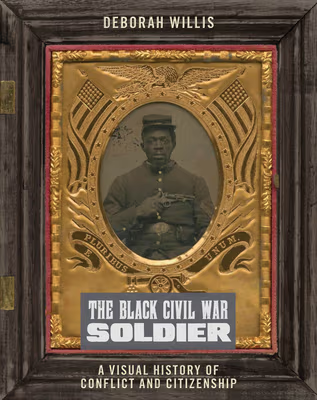
The Black Civil War Soldier: A Visual History of Conflict and Citizenship
Buy from AALBC
Add to Cart — $39.00More Book Details
Nonfiction, Hardcover, 256 pages
Publisher: New York University Press
ISBN: 9781479809004
A stunning collection of stoic portraits and intimate ephemera from the lives of Black Civil War soldiers
Though both the Union and Confederate armies excluded African American men from their initial calls to arms, many of the men who eventually served were black. Simultaneously, photography culture blossomed marking the Civil War as the first conflict to be extensively documented through photographs. In The Black Civil War Soldier, Deb Willis explores the crucial role of photography in (re)telling and shaping African American narratives of the Civil War, pulling from a dynamic visual archive that has largely gone unacknowledged.
With over seventy images, The Black Civil War Soldier contains a huge breadth of primary and archival materials, many of which are rarely reproduced. The photographs are supplemented with handwritten captions, letters, and other personal materials; Willis not only dives into the lives of black Union soldiers, but also includes stories of other African Americans involved with the struggle from left-behind family members to female spies. Willis thus compiles a captivating memoir of photographs and words and examines them together to address themes of love and longing; responsibility and fear; commitment and patriotism; and most predominantly African American resilience.
The Black Civil War Soldier offers a kaleidoscopic yet intimate portrait of the African American experience, from the beginning of the Civil War to 1900. Through her multimedia analysis, Willis acutely pinpoints the importance of African American communities in the development and prosecution of the war. The book shows how photography helped construct a national vision of blackness, war, and bondage, while unearthing the hidden histories of these black Civil War soldiers. In combating the erasure of this often overlooked history, Willis asks how these images might offer a more nuanced memory of African-American participation in the Civil War, and in doing so, points to individual and collective struggles for citizenship and remembrance.
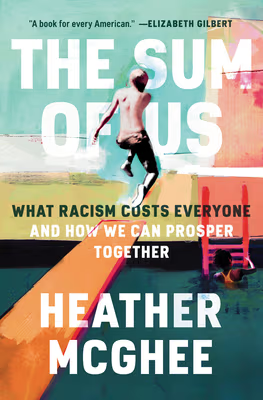
The Sum of Us: What Racism Costs Everyone and How We Can Prosper Together
Buy from AALBC
Add to Cart — $28.00More Book Details
Nonfiction, Hardcover, 448 pages
Publisher: Penguin Random House
ISBN: 9780525509561
Heather McGhee s specialty is the American economy and the mystery of why it so often fails the American public. From the financial crisis to rising student debt to collapsing public infrastructure, she found a common root problem: racism. But not just in the most obvious indignities for people of color. Racism has costs for white people, too. It is the common denominator of our most vexing public problems, the core dysfunction of our democracy and constitutive of the spiritual and moral crises that grip us all. But how did this happen? And is there a way out?
McGhee embarks on a deeply personal journey across the country from Maine to Mississippi to California, tallying what we lose when we buy into the zero-sum paradigm the idea that progress for some of us must come at the expense of others. Along the way, she meets white people who confide in her about losing their homes, their dreams, and their shot at better jobs to the toxic mix of American racism and greed. This is the story of how public goods in this country from parks and pools to functioning schools have become private luxuries; of how unions collapsed, wages stagnated, and inequality increased; and of how this country, unique among the world s advanced economies, has thwarted universal healthcare.
But in unlikely places of worship and work, McGhee finds proof of what she calls the Solidarity Dividend: gains that come when people come together across race, to accomplish what we simply can t do on our own.
The Sum of Us is a brilliant analysis of how we arrived here: divided and self-destructing, materially rich but spiritually starved and vastly unequal. McGhee marshals economic and sociological research to paint an irrefutable story of racism s costs, but at the heart of the book are the humble stories of people yearning to be part of a better America, including white supremacy s collateral victims: white people themselves. With startling empathy, this heartfelt message from a Black woman to a multiracial America leaves us with a new vision for a future in which we finally realize that life can be more than a zero-sum game.
How the Word Is Passed: A Reckoning with the History of Slavery Across America
by Clint Smith
Buy from AALBC
Add to Cart — $29.00More Book Details
Nonfiction, Hardcover, 352 pages
Publisher: Hachette Book Group
ISBN: 9780316492935
"We need this book." Ibram X. Kendi, #1 New York Times bestselling author of How to be an Anti-Racist
The Atlantic staff writer and poet Clint Smith s revealing, contemporary portrait of America as a slave owning nation Beginning in his hometown of New Orleans, Clint Smith leads the reader on an unforgettable tour of monuments and landmarks those that are honest about the past and those that are not that offer an intergenerational story of how slavery has been central in shaping our nation s collective history, and ourselves. It is the story of the Monticello Plantation in Virginia, the estate where Thomas Jefferson wrote letters espousing the urgent need for liberty while enslaving more than four hundred people. It is the story of the Whitney Plantation, one of the only former plantations devoted to preserving the experience of the enslaved people whose lives and work sustained it. It is the story of Angola, a former plantation-turned-maximum-security prison in Louisiana that is filled with Black men who work across the 18,000-acre land for virtually no pay. And it is the story of Blandford Cemetery, the final resting place of tens of thousands of Confederate soldiers. A deeply researched and transporting exploration of the legacy of slavery and its imprint on centuries of American history, How the Word Is Passed illustrates how some of our country s most essential stories are hidden in plain view whether in places we might drive by on our way to work, holidays such as Juneteenth, or entire neighborhoods like downtown Manhattan, where the brutal history of the trade in enslaved men, women, and children has been deeply imprinted. Informed by scholarship and brought to life by the story of people living today, Smith s debut work of nonfiction is a landmark of reflection and insight that offers a new understanding of the hopeful role that memory and history can play in making sense of our country and how it has come to be.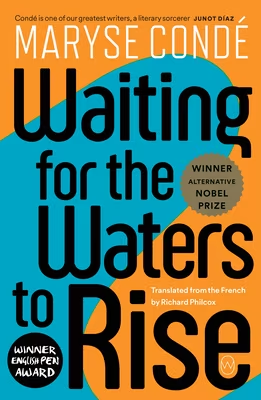
Waiting for the Waters to Rise
by Maryse Conde
Buy from AALBC
Add to Cart — $16.99More Book Details
Fiction, Paperback, 368 pages
Publisher: World Editions
ISBN: 9781642860733
Richard Philcox (Translator)
Babakar is a doctor living alone, with only the memories of his childhood in Mali. In his dreams, he receives visits from his blue-eyed mother and his ex-lover Azelia, both now gone, as are the hopes and aspirations he s carried with him since his arrival in Guadeloupe. Until, one day, the child Ana s comes into his life, forcing him to abandon his solitude. Ana s s Haitian mother died in childbirth, leaving her daughter destitute now Babakar is all she has, and he wants to offer this little girl a future. Together they fly to Haiti, a beautiful, mysterious island plagued by violence, government corruption, and rebellion. Once there, Babakar and his two friends, the Haitian Movar and the Palestinian Fouad, three different identities looking for a more compassionate world, begin a desperate search for Ana s s family.
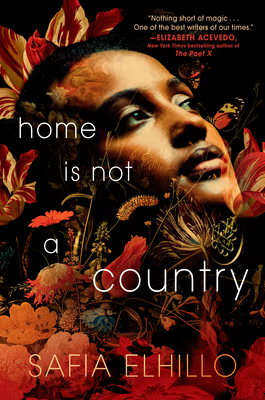
Home Is Not a Country
Buy from AALBC
Add to Cart — $17.99More Book Details
Fiction, Hardcover, 224 pages
Age Range: Young Adult
Publisher: Penguin Random House
ISBN: 9780593177051
Nothing short of magic. Elizabeth Acevedo, New York Times bestselling author of The Poet X
From the acclaimed poet featured on Forbes Africa s 30 Under 30 list, this powerful novel-in-verse captures one girl, caught between cultures, on an unexpected journey to face the ephemeral girl she might have been. Woven through with moments of lyrical beauty, this is a tender meditation on family, belonging, and home.
my mother meant to name me for her favorite flower
its sweetness garlands made for pretty girls
i imagine her yasmeen bright & alive
& i ache to have been born her instead
Nima wishes she were someone else. She doesn t feel understood by her mother, who grew up in a different land. She doesn t feel accepted in her suburban town; yet somehow, she isn t different enough to belong elsewhere. Her best friend, Haitham, is the only person with whom she can truly be herself. Until she can t, and suddenly her only refuge is gone.
As the ground is pulled out from under her, Nima must grapple with the phantom of a life not chosen the name her parents meant to give her at birth Yasmeen. But that other name, that other girl, might be more real than Nima knows. And the life Nima wishes were someone else s is one she will need to fight for with a fierceness she never knew she possessed.
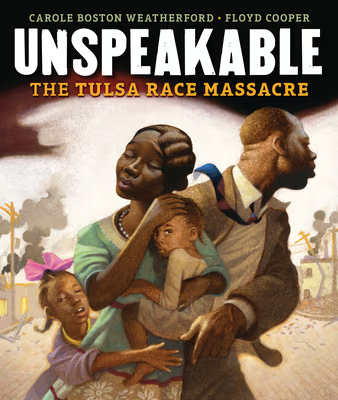
Unspeakable: The Tulsa Race Massacre
by Carole Boston Weatherford, Illustrated by Floyd Cooper
Buy from AALBC
Add to Cart — $17.99More Book Details
Nonfiction, Hardcover, 32 pages
Age Range: Picture Book
Publisher: Lerner Publishing Group
ISBN: 9781541581203
Celebrated author Carole Boston Weatherford and illustrator Floyd Cooper provide a powerful look at the 1921 Tulsa race massacre, one of the worst incidents of racial violence in our nation s history.
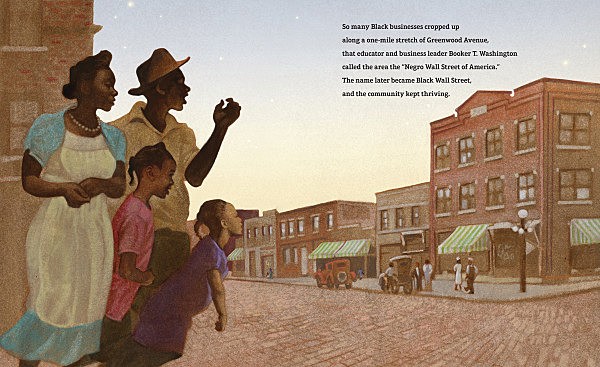
Celebrated author Carole Boston Weatherford and illustrator Floyd Cooper provide a powerful look at the Tulsa Race Massacre, one of the worst incidents of racial violence in our nation s history. The book traces the history of African Americans in Tulsa s Greenwood district and chronicles the devastation that occurred in 1921 when a white mob attacked the Black community.
News of what happened was largely suppressed, and no official investigation occurred for seventy-five years. This picture book sensitively introduces young readers to this tragedy and concludes with a call for a better future.
Reader Comments (0)
Log In to Join the Conversation
Commenting is reserved for registered AALBC members to maintain high-quality discussions.
No comments yet. Be the first to share your thoughts!
Advertisement