

Leaderboard
-
Troy
Administrators6Points14,765Posts -

Delano
Members5Points6,052Posts -
.jpg.473e1f1051552796800f1e62b10321ca.jpg)
Cynique
Moderators3Points5,744Posts -
Mel Hopkins
Members2Points2,198Posts

.thumb.jpg.3bf9f25532a7944736ddb02aa1b64269.jpg)

Popular Content
Showing content with the highest reputation on 02/06/2018 in Posts
-
@zaji, I looked for your piece it seems quite substantive.
 3 points
 -
@Troy thank you for posting! @zaji you have a new follower on wordpress.2 points
-
I've always felt that slave descendants in America created their own unique culture. For the diaspora to reach waaay back to our African origins and cobble together a generic culture gleaned from a continent made up of many different countries is almost a cry of desperation. Instead of clinging to the past, pride should be taken in how over 4 centuries we, as human beings, have scratched out our own niche in this country. ( The process of making kinky hair manageable by straightening it, for instance, is a part of our culture that should not be disparaged by those seeking to shame a custom which originated with blacks, - which made Madame C J Walker a millionaire, - and which spawned a traditional black beautician industry.) Our music, our cuisines, our colorful slang, our style and swag have created a black mystique envied and emulated by the dominant white culture. All of this transcends our pigment. I have also contended that the black experience differs from person-to-person, depending greatly on where you were born and raised. i, myself, am an 84-year-old mid-westerner who grew up a small town. I always attended integrated schools, including college, have never had a black teacher, and have never had a white person call me a "nigger to my face. And something i often marvel over is how during 1953 down in Montgomery, Alabama, when Rosa Parks finally balked at sitting in the back of the bus, I and a handful of other black coeds, resided in an integrated housing unit on the campus of the University of Illinois, a dormitory where white maids cleaned our rooms, and a white wait-staff served us our meals in the dining room. During this same period, when Emmit Till was lynched for allegedly ogling a white woman during his visit to Mississippi, one of my black dorm mates from Chicago was engaged to a white guy. Even my father as a farm boy growing up in Kansas during the early 1900s, attended an integrated one- room school house and swam in the same swimming hole with white kids during a time when lynching was common. I'm sure the kind of life i've led is similar to others who grew up away from the Jim Crow south. We blacks are as much different as we are alike. As in other cultures, a class division does exist within the African American community where the values and lifestyles of inner city blacks differ from those of upwardly mobile ones. ( Unfortunately, the caste system based on color persists across the board.) Considering their different circumstances and how varied blacks are in appearance, our diversity is stifled when branded by a white invention known as "race". This is where the familiar claim of blacks not being a monolith kicks in. It is also the point where i will fall back on my favorite axiom: "it is, what it is". To me this is the bottom line! The concept of race enables the discrimination which nullifies the idea of our being one entity made up of a single human species. So categorizing people by "race" does, indeed, benefit whites more than it does blacks because it allows the power structure to elevate to a superior status, the race designated as white. (i got the impression is that this is where Leone is coming from.) Also, I'm not convinced that race and culture are interchangeable. IMO, culture is a "way-of-life", not a "how-we-look". BTW, zaji, you are a very skilled writer. It's a pleasure to read your well-articulated views. Don't be a stranger.2 points
-
I don't want to have anyone define me.2 points
-
My neighborhood the kids were mostly black. I told my mother we lived in a chocolate city. She said the majority of people were white although the kids were majority black. From second grade through high school the kids were mostly white. Growing up my parents exposed us to culture and art . We saw Alvin Ailey and the Negro ensemble company. I have had drinks dinners and conversations with racists. Which on hindsight is interesting. Because I didn't fit the stereotype of an urban youth or an Oreo. There are different expressions of racism. From the KKK liberals conservatives media and culture. I just like challenging Blacks and Whites. Blacker than thou Black is what Black does. I don't want anyone to define me.2 points
-
Man I'm going to make sure Leonce sees these comments, they are just so thoughtful and profound. I may quote from these comments in my next letter. It would be nice if others shared as well. @Mel Hopkins, though we converged at Brooklyn Tech our paths there were entirely different. I grew up in segregated East Harlem where you where either Black or Puerto Rican. I did not know any white people my age until I got to Tech. Even then the only ones I really got to know were on the teams I competed on. To this day NY City Public schools are very segregated by both "race" and class. @zaji, what you wrote is probably better articulates what @Pioneer1 has been trying to communicate regarding race. Pioneer does what Zaji wrote reflect what you believe. I "saw" race.., and that is largely my biggest problem. I thought all Black people lived in the 'hood and were poor. This is all I saw growing up and this was reinforced by the images I saw on TV. The Blaxploitation films were filmed in my neighborhood, The Projects the TV Show Good Times depicted could have very easily been the one I grew up in. The Cosby Show which later might have changed my perspective, but I'm sure I would have assumed that is was far fetched; Doctors don't marry lawyers and live in big houses in NYC. In fact the one of the first Brownstones, like the one the Huxtables lived in, that I'd ever been in, that was not cut up into apartments, was the one I owned. The life my kids was provided would have been completely alien to the one I lived even though they lived walking distance from where I was raised. What what I was seeing was not race, but largely culture and often the two are confused. Most people would see Zaji, Mel, and myself as just "Black" people largely indistinguishable from each other. The reality is that culturally we are different. One good thing about the artificial construct of race is that it has brought us together2 points
-
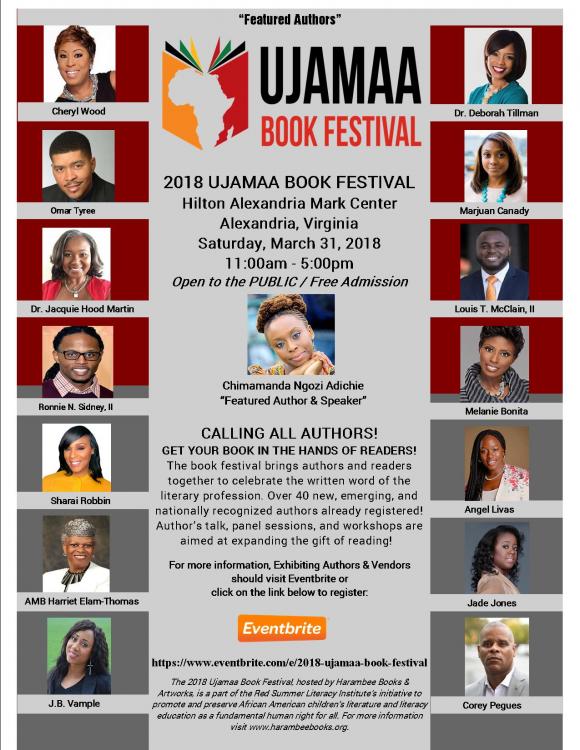
Harambee Books & Artworks will host over forty local and national bestselling authors on March 31, 2018 for one day of writers' workshops, booksignings, Children's Corner, music and theater during their 2018 UJAMAA BOOK FESTIVAL! CALLING ALL AUTHORS TO THE DMV! GET YOUR BOOK IN THE HANDS OF AVID READERS! The event attracts a wide array of authors, publishers, book clubs, libraries and individual readers from the Northeast U.S. and nationwide. The 2018 UJAMAA BOOK FESTIVAL is scheduled for March 31, 2018 at the Hilton Alexandria Mark Center Hotel, Alexandria, Virginia and is hosted by Harambee Books & Artworks, one of the leading black-owned bookstores promoting African-American literature. 2018 UJAMAA BOOK FESTIVAL Hilton Alexandria Mark Center Hotel, Alexandria, Virginia Hosted by: Harambee Books & Artworks Date: Saturday, March 31, 2018 Time: 11:00am - 5:00pm Open to the PUBLIC / Free Admission This annual event will feature the following: · Author exhibits · Corporate/publisher booths · Featured author discussions and signings · Children's Corner · Workshops and seminars · Live entertainment · Panel discussion on writing tips · And more.... The 2018 Ujamaa Book Festival brings over forty authors and fifteen-hundred readers authors together to celebrate the written word of the literary profession. Over 40 new, emerging, and nationally recognized authors already registered. Author's talk, panel discussions and workshops are aimed at expanding the knowledge of the discerning reader and fledgling author. We invite you to be a part of this exciting event. ***For more information, Exhibiting Authors & Vendors should visit the following for more details: https://harambeebooks.org or https://www.eventbrite.com/e/2018-ujamaa-book-festival-march-31st-alexandria-va-tickets-39947418805 “This is an excellent opportunity for our features new, emerging, and nationally recognized authors to not only showcase their work, but also meet literary professionals from a variety of backgrounds,” Meet Harambee Books & Artworks, an independent black-owned bookstore based in Old Town of Alexandria VA, serving the Washington DC metropolitan region, with a wide selection of best-selling books, exclusive artworks, and fashionable apparels. We also provide educational resources, reading programs, and community-based events to improve literacy skills and foster parental engagement. Harambee Books & Artworks was conceived to achieve our mission of literacy education as a fundamental human right for all. Call or come by Harambee Books & Artworks; (703) 299-2591, or info@harambeebooks.org, https://harambeebooks.org, we look forward to hearing from you.
 1 point
 -
1 point@DelBelow are 3 different definitions of paradox. A paradox is a seemingly absurd or contradictory statement or proposition which when investigated may prove to be well founded or true. A paradox is a statement that, despite apparently sound reasoning from true premises, leads to a self-contradictory or a logically unacceptable conclusion. A paradox involves contradictory yet interrelated elements that exist simultaneously and persist over time.1 point
-
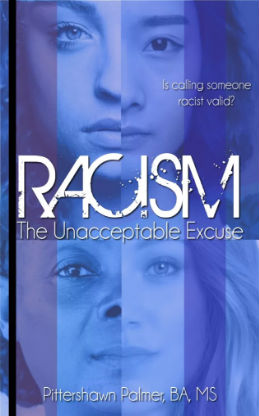
@Troy Indeed. This construct has done something. For me, it hasn't brought us together as much as reminded us of what we were prior to all this mess. The "good" it has done is bittersweet. I recently wrote a piece called, Racism: The Unacceptable Excuse, which speaks to how I feel about the use of even the word racism as a method of dissecting European behaviors.1 point
-
@Mel Hopkins it was probably in my 30's. Troy its a list without the bullet points. There are a few ways I find books. I read about Dorothy Parker because of the Prince track. I read the autobiography of Malcolm X because of the Spike Lee movie. Found a few through The New York Press newspaper. A couple of book clubs. Recommendations from people or celebrities. Anthologies. I would also puvk authors because i felt i should have read them . I was interested in the following topics or genre. Mythology Jungian Psychology Numbers Astrology The Occult. Sone books happened to be in a section when i was looking for something else. A few people gave me books. Sometimes it ess a friend or someone i didn't know well. Lastly by accident.1 point
-
@Delano, man you better familiarize yourself with the use of commas. I was like what does a "Psychic Bartender" do -- have your drink ready when you step to the bar? I don't read as much as a bookseller should, but I probably read more than most webmasters, and certainly most people -- but that is not saying very much. I have been running AALBC.com for over 20 years now. The activity is so completely different in 2018 than it was in 1997, it might as well be two completely different jobs. The only commonality is a love for Black people and desire to ensure our stories are told. In fact the job would be impossible without it. While money is definitely a motavator, I don't know anyone who does this type of work solely for money. Over the years it seems people who work solely for money, whether it is for themselves, or for a corporation usually have no problem exploiting others.1 point
.thumb.jpg.2e983cc4a1fbd50a5324b38ccdf3b1b5.jpg)