


Leaderboard


Popular Content
Showing content with the highest reputation on 11/07/2020 in all areas
-
This song, "The Other Side of Town," by Curtis Mayfield is one of my favorite songs from one of my favorite artists. It came out in 1970, but I was an adult before I first heard it -- if I heard it before them I probably could not appreciate it. It is a very sad song in many was. It reminds my of the lives, and contributions to society, that were lost because people grew up impoverished. It also make me think of the comments @Gibran and @Pioneer1 made in earlier conversation where people do something dumb because some negative remnant of their upbringing presents itself. Know know folks who have completely derailed their lives because -- they let the ghetto comes out of them. I'm not immune to it either, but I've been lucky (relatively speaking).2 points
-
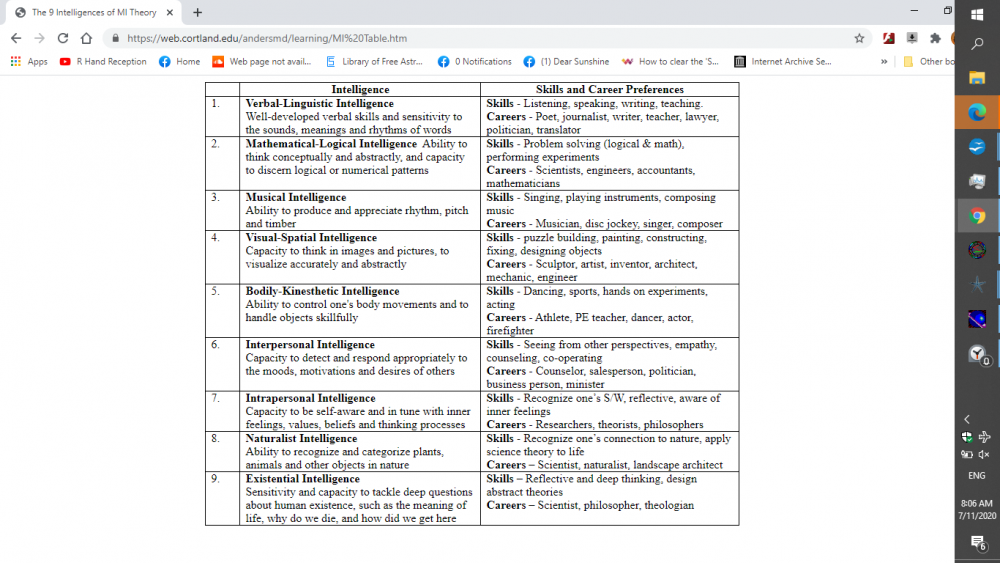
Each is better or more successful at their chosen "objective" You can think about intelligence as skill sets. https://web.cortland.edu/andersmd/learning/MI theory.htm Multiple Intelligences According to MI Theory, identifying each student’s intelligences has strong ramifications in the classroom. If a child's intelligence can be identified, then teachers can accommodate different children more successfully according to their orientation to learning. Teachers in traditional classrooms primarily teach to the verbal/linguistic and mathematical/logical intelligences. The nine intelligences are: § VISUAL/SPATIAL - children who learn best visually and organizing things spatially. They like to see what you are talking about in order to understand. They enjoy charts, graphs, maps, tables, illustrations, art, puzzles, costumes - anything eye catching. § VERBAL/LINGUISTIC - children who demonstrate strength in the language arts: speaking, writing, reading, listening. These students have always been successful in traditional classrooms because their intelligence lends itself to traditional teaching. § MATHEMATICAL/LOGICAL - children who display an aptitude for numbers, reasoning and problem solving. This is the other half of the children who typically do well in traditional classrooms where teaching is logically sequenced and students are asked to conform. § BODILY/KINESTHETIC - children who experience learning best through activity: games, movement, hands-on tasks, building. These children were often labeled "overly active" in traditional classrooms where they were told to sit and be still! § MUSICAL/RHYTHMIC - children who learn well through songs, patterns, rhythms, instruments and musical expression. It is easy to overlook children with this intelligence in traditional education. § INTRAPERSONAL - children who are especially in touch with their own feelings, values and ideas. They may tend to be more reserved, but they are actually quite intuitive about what they learn and how it relates to themselves. § INTERPERSONAL - children who are noticeably people oriented and outgoing, and do their learning cooperatively in groups or with a partner. These children may have typically been identified as "talkative" or " too concerned about being social" in a traditional setting. § NATURALIST - children who love the outdoors, animals, field trips. More than this, though, these students love to pick up on subtle differences in meanings. The traditional classroom has not been accommodating to these children. § EXISTENTIALIST - children who learn in the context of where humankind stands in the "big picture" of existence. They ask "Why are we here?" and "What is our role in the world?" This intelligence is seen in the discipline of philosophy. Since Howard Gardner’s original listing of the intelligences in Frames of Mind (1983) there has been a great deal of discussion as to other possible candidates for inclusion (or candidates for exclusion). Subsequent research and reflection by Howard Gardner and his colleagues has looked to three particular possibilities: a naturalist intelligence, a spiritual intelligence and an existential intelligence. He has concluded that the first of these ‘merits addition to the list of the original seven intelligences’ (Gardner 1999: 52).
 1 point
 -
1 pointlet me drop this right here O black woman, do you know who you are? It is you for whom the birds sing when the dawn opens itself for inspection. It is the glow in your eyes that the stars imitate when they sparkle. It is the color of your flava that makes the rainbow dull in comparison, and it is via your beauty that we can physically witness God’s artistry.• O black woman, do you know who you are? You are the secret that only reveals itself when a man is truly ready to experience the joy of having his dream transformed into reality. You are God’s private blessing to men who know what to do within the point between birth and death. To dwell within the kingdom of YOU is where heaven begins. • O black woman, do you know who you are? You are both the starting point and the finish line for everything I could ever aspire to be. You are a force of nature that has broken my shackles so that I can walk freely. You have erased my doubts so that I can think clearly. You have repaired my broken wings so that I can soar beside you. • O black woman, do you know who you are? You are the magic that awes the universe, the splendor that amazes the earth, and the glory that makes men heart beat with pride when they attempt to possess U. • O black woman, do you know who you are? You are the beautiful gift that God left on the doorstep of my heart. You are that special moment in time when nothing else matters but most importantly, you are YOU! Unmistakably YOU! • O black woman, do you know who you are? You are the sunshine that lights my life from within. You are the fire that warms every fiber of my being and that illuminates my path so that I am never afraid of the darkness. • O black woman, did u know that when I stare in the skies the stars spell your name? I feel your touch in the wind and I see your face in the clouds. And when I stand under the shadow of your smile, I find shelter from the storm. • O black woman, do you know who you are? You are that warm safe place where all roads lead at the end of a day when I have slayed all my dragons and find that all my strength comes from you. You melt on my life and I become complete. • O black woman, do you know who u are? You are chocolate, dipped in mystery, a specially-designed flava whose smile is brighter than the rainbow.1 point
