

richardmurray
-
Posts
4,563 -
Joined
-
Last visited
-
Days Won
125
Content Type
Profiles
Forums
Blogs
Events
Everything posted by richardmurray
-
MY THOUGHTS AS I LISTENED 1:17 the third black disney princess 1:22 Hans Christian Anderson version was so different than this. 2:17 mmessages to children and adults, remember christianity was originally taught through moral tales, not the bible, cause most couldn't read 3:45 good memory research, I never knew Queen latifah played ursula 4:17 why did you like Melissa mccarthy's ursula 4:41 based on inflation , the animated made more 4:58 school time: Cinderella with brandy side whitney : noni rose as tiani in princess and frog; princess of wakanda in the Black Panther series; Halley Bailey as Ariel is fourth 6:26 yeah, the creature in the film lady in the water is more like what anderson or europan historical fiction described mermaids are 8:23 that's right Merida, I will fight for my own hand! 9:05 a lot of urban usa, most of rural usa isn't mixed 9:28 I can see the despisal of the female characters whose only goal is to get a man being slowly murdered off inpsires you:) 10:50 your nice to disney, Disney over the last thirty years, is trying to make more money by placating the modern audience which has non white males with money. Disney would go bak to fantasia's black centaurs if the dollars went that way 11:49 Great point, philosophically having the casting untied to how characters are described is supposed to lead all in the audience to be aracial but it doesn't really work out that way 13:01 and they probably felt they wanted sebastian to be less "caribbean" 14:17 I remember telling people, this movie will make a ton of money. Disney knows how to make money. They comprehend how to be effective commercialist using art, I don't see them as culturally caring as many suggest but... 15:32 meow!:) leo season, have fun IN AMENDMENT Again, I was very fortunate as a black child, not merely to be raised by two black parents of the opposite gender, but also cause both of my parents were knowledgeable of and exposed me to the cultures of the many black tribes in the black village. The one biggest problem, many communities have is their miscomprehension to their internal variance. It isn't that humans in any community don't comprehend the internal variance exist. But I find most people growing up tend to be raised by parents or guardians who criminalize, a negative bias, to be honest, those in their community by one racial standard who don't share something about them on another racial standard. I am of the same phenotypical race as clarence thomas. But we are not of the same philosophical race. But what is the point? The point I don't mind Clarence Thomas being of a different tribe in the village than me. Most black people do. That is the problem. Can you accept that other black tribes to thrive will hinder your own tribe? But what does this have to do with the little mermaid. Two things, each tribe in the black village in the usa has its own heritage<what is carried> or culture < what is grown> , that has similarities, but also variances to the other tribes in the village. Part of that heritage is its fantasy or mythology. Some tribes in the black village embrace white fantasy brewed of the usa, like huckleberry finn or disney products as their own. Some don't. I don't see disney products as black, but that doesn't mean I think all other black people do or most importantly, all other black people should. The problem is, again, too many black people think other black people should be changed. That is the simple truth in the black community. The second is, whenever Black people are present in media, no matter who is financing it, black people have to ask themselves the simple question. Does this represent us? And there lies a huge problem for the black village in the usa, cause the black village in the usa has so many tribes with unjoinable cultures or heritages that dysfunctional argument is all that can come from Black discourse on our identity in media. IT doesn't anyone is wrong or right in the discourse, but the tribes have differences that can not be bridged. And no tribe is strong enough to sway the others, unlike to be fair, the white village in the usa, who has tribes strong enough to move the entire village even if many tribes don't want it . ala the civil rights act. You can see this with the global Chinese community and the commonly called mainland. And this is where Disney's the little mermaid comes front and center. A village that has no central identity, because it doesn't have a dominant tribe in itself, can't make clear delineations to what is acceptable or not, which some tribes in the black village in the usa want as well. But, this means black discourse becomes an automatic negative whenever identity comes into play. So, a white film depicting a black mermaid based on a tale from a white european man to the modern global ticketbuyer who ars a hyper multiracial blend creates... an autonegative discourse in the black community, where no one is wrong, or right, but concurrence of thought between the members of the village is nearly dead. And this discussion by @Pioneer1 in this forum is a prime example White People Who Can Pass For Black, Brown, and Yellow. - Culture, Race & Economy - African American Literature Book Club (aalbc.com) The commentors are literally repeating their points because how one views race doesn't have a bridge to another when it simple doesn't. It becomes either someone just gives in and says they change their position or they say nothing. But everything else is repetition unless a deeper issue is discussed. The deeper issue is black identity in the usa, but as i said, the only way discourse can come to an all agree is if all have the same position. But which black tribe's position will be used? Again, Frederick Douglass was booed by a crowd of all black people speaking his composite nation speech. Douglass is a man that most blacks of wealth, the black one percent, in the modern usa tout as a hero, what does it say that most blacks booed him at the end of his days and most blacks in modernity, the black ninety nine percent, boo the blacks of wealth today? The cohesion in history comes from the same problem. A position on blacks relationship to the usa isn't accepted between the tribes so you get argument and no actions. @Pioneer1 also asked the following Help A Brother Out......My Thinking Patterns and Perspectives of the World - Culture, Race & Economy - African American Literature Book Club (aalbc.com) But it is another prime example of different tribes. The reality is, every black home should had taught what should had been common knowledge. That the black community, a phenotypical race, in the usa began its existence in the usa unlike the whites, with a lack of cohesion that has never gone away. It is that simple. When black militants say: my forebears wanted to kill whites, they are correct, but not all black forebears in the usa wanted to do that or did do that.. When black voters say: my forebears fought to get the vote side whites as equals, they are correct, but not all black forebears in the usa wanted to do that or did do that. So you get people in the Black community as adults wondering why the Black community has such negative discourse, why blacks don't do like they do, when the answer should had been told to them by their parents who knew. And , just in case you may think this is an isolated issue in the black community in the usa, it isn't. I argue it is the usa's great problem. The entire issue with the entertainment industry is the culture of slavery in fiscal capitalism in the usa, which is purer to the usa than unions or individual rights or anything else. Hollywood KAput The only thing that survived the english colonial form of the usa into its independent self from the british empire to modernity is slavery. Yes, slavery still exist in the penal system in the usa today. And yet, while all in the usa know this, the lack of this truth in the homes of people growing up, which all adults know, leads to people's shock that the fiscally wealthy desire or manage fiscal capitalsm in the usa to always be a slavery based way. From Ronald Reagan cutting government programs to give money to the rich , like the taking of native american land to grow plantations. From failed banks being given a welfare check by Bush jr + Obama like when the southern agrarian economy couldn't return to its former profitable self in reconstruction and the government embraced jim crow to get black people into the southern prison systems to revitalize the southern agrarian economy, which happened to gilded wealth accumulation. From the automotive or entertainment industries failures while being supported by the usa government reflects how the enslavers who lost everything were given it all back by the usa government , through the usa's power curtaling the essence of fiscal capitalistic that the usa advertises. But the key is all in the usa know this, but few say it. And some want slavery in a stronger form to make a comeback , ala the robot. The point being the usa's 300 million make up a village with a quite large number of tribes who don't fit together, heritage-wise or culturally or philosophically, but raise their children and suggest in themselves that a unity exist or will exist which of course is a simple lie, but which creates the discourse battles leading to no where. Finally, and away from things, thanks to @harry brown for announcing the anniversary of AALBC. I still have goals I want to see in this ecommunity and hopefully they will happen.
-
 topics Cento poetry series ninth round First Photomanipulation Dates If You Made It This Far: working with pencils, Tony Jaa, NATO, The Man From Earth, Comprehending Race https://rmnewsletter.over-blog.com/2023/06/07/23/2023-rmnewsletter.html
 -
@Troy great as I told @Pioneer1
-
White People Who Can Pass For Black, Brown, and Yellow.
richardmurray replied to Pioneer1's topic in Culture, Race & Economy
All I want to say is many of you confuse words meaning arranging based on some condition: race/order/class/gender/ethnic and many others side a word that means acting favorably or disfavorably based on a condition. The word bias is the word many of you seem unable to use or don't know how to use, while using the following words falsely in the word bias place: race/ethnic/order/class or similar. Race isn't Bias. Applying a phenotypical label, black or white, is just an arrangement. A human being killing another human being cause they don't share the same phenotype is an act of bias. -

Concept: it's not all about tights and capes
Artist: shawn alleyne <<lines>> < Pyroglyphics Studio > OR < https://www.deviantart.com/pyroglyphics1 >
Prior post
https://aalbc.com/tc/profile/6477-richardmurray/?status=2387&type=status
Shawn Alleyne post
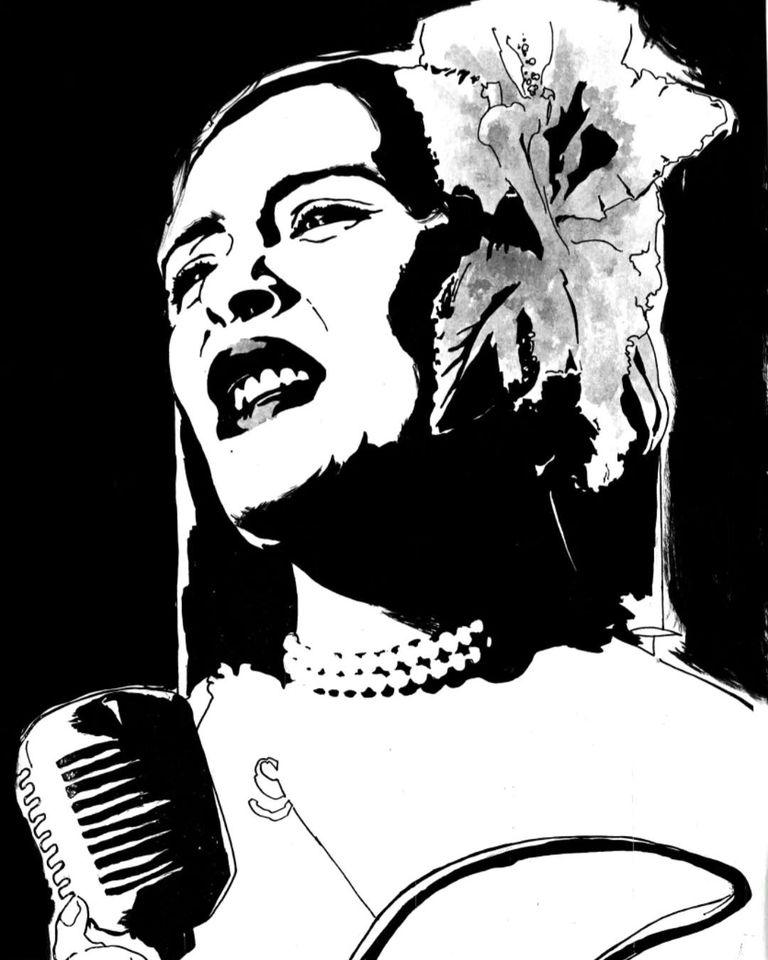
https://aalbc.com/tc/search/?q=shawn&quick=1&type=core_statuses_status&updated_after=any&sortby=newestStrange Fruit < a poem>
Southern trees bear strange fruit,
Blood on the leaves and blood at the root,
Black bodies swinging in the Southern breeze,
Strange fruit hanging from the poplar trees.
Pastoral scene of the gallant South,
The bulging eyes and twisted mouth,
The scent of magnolias, sweet and fresh,
Then the sudden smell of burning flesh.
Here is a fruit for the crows to pluck,
For the rain to gather, for the wind to suck,
For the sun to rot, for the trees to drop,
Here is a strange and bitter crop.lyrics from Abel Meeropol
But no one sings the poem better than the great, legendary, Billie Holiday
with accompanying trumpet from Charlie Shavers -
@Pioneer1 I will speak to your example well, 1 billion from 5 billion is 20% of 5 billion so that is an 80% loss of profit between years, which is a negative... a failure. And the holders will be angry that in 2020 they could split 5 billion among themselves while in 2021 they could only split 1 billion, that is a huge difference in all earnest. In defense of your example, your correct, the firm doesn't have to lay off the common workers but the reality is, the administrative members and board members who are getting cumulatively a billion or more in their collective salaries of fiscal dues are not going to cut their wealth for others. This was and is the whole fiscal capitalist selling point against socialism for near 100 years. In socialism the executives/administratives/ board members are supposed to earn as much as the common laborer in the firm, thus the firms revenue handles healthcare/utilities/transportation external financial forces. But in fiscal capitalism, said group can make a billion or more a year collectively and cut the workers throat to find the financial balance in the firm.
-
Keechant Sewell left the NYPD because she wanted to reprimand a senior official in the NYPD and the mayor opposed her. Adams said he loved Kechant Sewell but when she wanted to reprimand a high ranking official in the NYPD, the mayor opposed her. Yes she was not from the NYPD but a law enforcement agency in long island, but all the nypd people clapping for like friends or appreciative is bullshit, and adams is a liar. I learned this from local nyc news. I apologize I can't find a clip of this online and I didn't tape it nor do I see it coming on again. So for those looking for raw proof, I can't give it. But Inside City Hall 7/22/2023 last segment, the words were spoken by a journalist named Ben. The frontliner of the show clearly knew this but said nothing and cutely moved on from it. Ben didn't name the officer , which is hilarious. IN AMENDMENT The Adams Administration placed many women at the top of organizations that barely have any women in their upper management. It is like when you place a black as president of a white college. It is dysfunctional
-
Title: Cloud Complex
Artist: GDbee < https://gdbee.store/ >
Prior post
https://aalbc.com/tc/profile/6477-richardmurray/?status=2385&type=status
GDBee Post
https://aalbc.com/tc/search/?&q=gdbee&type=core_statuses_status&quick=1&author=richardmurray&search_and_or=or&sortby=newest -
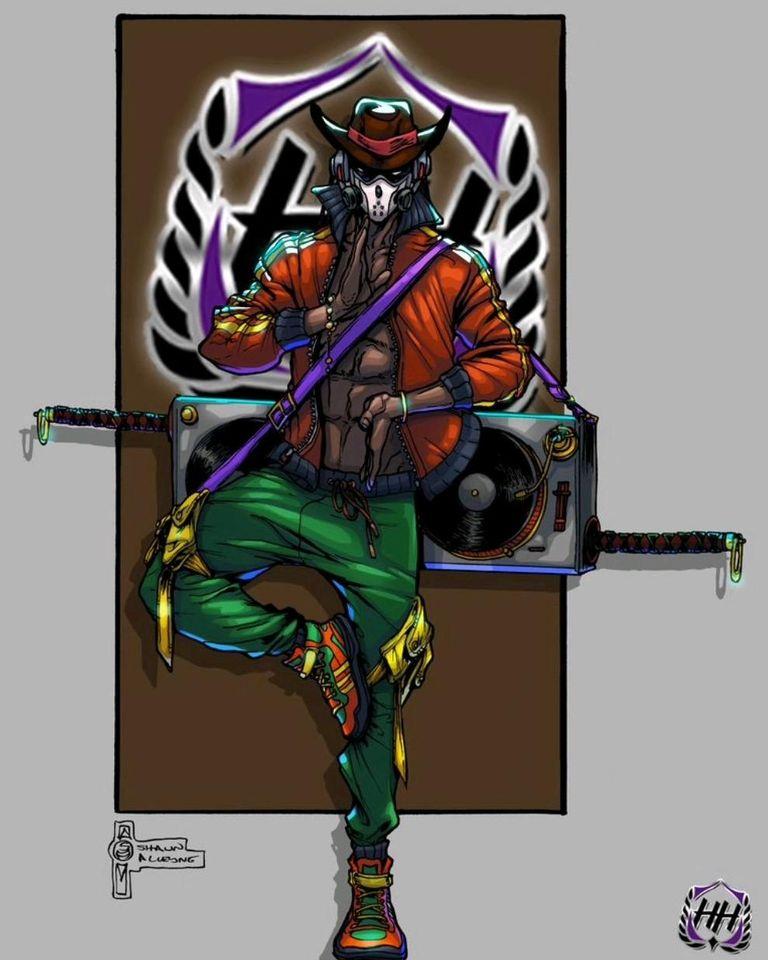
Concept: dj ninja character design for heritagehiphop
Artist: shawn alleyne <<lines>> < Pyroglyphics Studio > OR < https://www.deviantart.com/pyroglyphics1 > thedadodesign <colors>
Prior post
https://aalbc.com/tc/profile/6477-richardmurray/?status=2379&type=status
Shawn Alleyne post
https://aalbc.com/tc/search/?q=shawn&quick=1&type=core_statuses_status&updated_after=any&sortby=newest -
House Unanimously Passes Resolution
richardmurray replied to ProfD's topic in Culture, Race & Economy
@ProfD right but white jews who are a tribe in the white community have money, the wealthiest black tribe is the financial aristocratic community in africa, who don't act as one. but, my point is, no black tribe in the village or the larger black community has enough money, so can't pay for things to go their way. simple, but if the gypsies of europe are white but don't have the money so they are continually persecuted even in europe itself. -
Tell Me: What's Wrong With This Story And Picture?
richardmurray replied to Pioneer1's topic in Culture, Race & Economy
@Troy Why don't you ever say phenotypical race? I notice you never say that. You say race when I say phenotypical race. Melanin has nothing to do with assessing gender race or linguistical race or age race, or geographic race, or cultural race or financial race , but in phenotypical race, melanin is a dictater to the color of skin and sequentially, appearance, which is another word for phenotype. I am not trying to be insulting, but to suggest melanin production can't be used to determine phenotypical race which is appearance is an illogic. You basically said the factor that dictates the color of skin, the epidermis that covers most of the body is not good enough to determine how people look. Can you explain more how people's skin can't be used to determine their difference of appearance? -
@Pioneer1you have your views. If I own a firm, and it has a 90% global market share with total global saturation where the usa automobile industry at one time had and through my management goes to 50% and a total absence in many geographies, I will call it a failure. The whole point of managing a firm is to make money regardless of the environment. I apologize but I treat all races fairly. Financial race is clear cut like all others. If you are a fiscal capitalist the goal is to make profit, if you fail to make profit it is called failure. In the same way, the goal of socialism is the efficient use of resources. If resources are used inefficienctly it is called failure. Ala why I said and say the soviet union or the chinese failed to be effective socialist.
-
I have placed my reply in my email newsletter, 7/30 edition. But I will leave the article for you. It is long so... https://aalbc.com/tc/profile/6477-richardmurray/?status=2386&type=status
-
House Unanimously Passes Resolution
richardmurray replied to ProfD's topic in Culture, Race & Economy
@ProfD I only wish you would had added one point which you didn't. The white jew doesn't get support in the usa for free. Money is behind it. Money is how the white jew gets other whites tribes to support them. It isn't a love affair. Why do black people make it seem like white jews are supported absent money? -
White People Who Can Pass For Black, Brown, and Yellow.
richardmurray replied to Pioneer1's topic in Culture, Race & Economy
I know everything involving the human body relates to dna in the complex cellular system that is in all humans or all other living organisms. I also know that one's appearance or phenotype doesn't determine one's allegiance to any group. But, to me the issue is the war in the black community involving phenotypical race. From the free blacks who fought alongside white people who still supported slavery but wanted freedom from england versus the free blacks who fought alongside white people who still supported slavery but wanted revenge against some whites From Frederick Douglass who was booed by a crowd of black people when he spoke his composite american speech versus Marcus Garvey who was insulted by WEB DUbois seeking Black unity. To Barrack Obama elected primarily because of the black turnout who said he had to be president of all to Nelson Mandela who was willing to award qaddafi of libya for his help to black people in south africa. The Black community in the last 500 years globally has an internal nonviolent battle over its self identity plus its relationship to the white community aside the constructs made by whites. This is complex for the Black community anywhere Pioneer. I will argue, if the tribes in the black community showed the violence to each other that white tribes did and do, this wouldn't be an issue. But the truth is, the black community , rightly or wrongly isn't as internally violent as many whites or blacks think or suggest. So, this complexity brews on. -
in my view, but no need to preach it.
-
Time to Break Up Hollywood
Hollywood is trapped in a death spiral, with streaming giants struggling to profit while smothering the industry itself. Finally the writers stood up. But will it be enough?
MATT STOLLER
MAY 14, 2023Today I’m writing about the biggest Hollywood labor dispute in decades, as screenwriters enter their third week striking against streaming giants like Disney, Netflix, Paramount, Warner Bros, and Comcast. Far from a narrow conflict over money, this fight is existential, a question of whether America can be a place where stars are born and movies are made.
As one striker put it < https://strikegeist.substack.com/p/daily-digest-why-this-strike-feels > , the strike is “about the whole corporate dominance of America.”
(The Ankler’s excellent Strikegeist < https://strikegeist.substack.com/ > newsletter is covering the strike, and I highly recommend it if you are interested in what’s going on day-to-day.)
Of America’s many inventions, reality TV does not rank as highly as, say, the semiconductor, the laser, the polio vaccine, or manned flight. But from Candid Camera in the 1940s to MTV’s The Real World in the early 1990s, the medium of reality TV has been as influential in its own way as rock music and hip hop. But today, it’s Great Britain, not America, creating many of the most popular reality shows
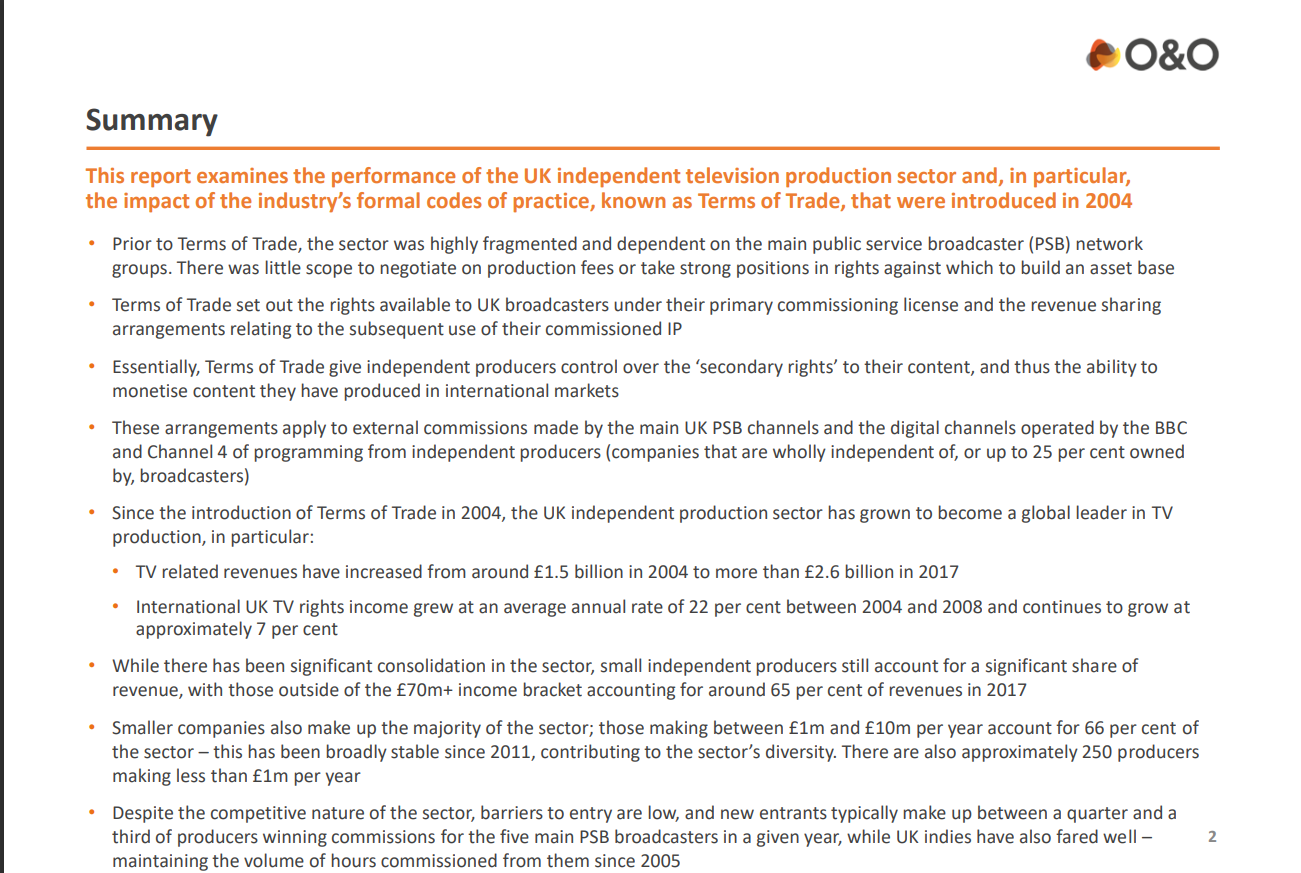
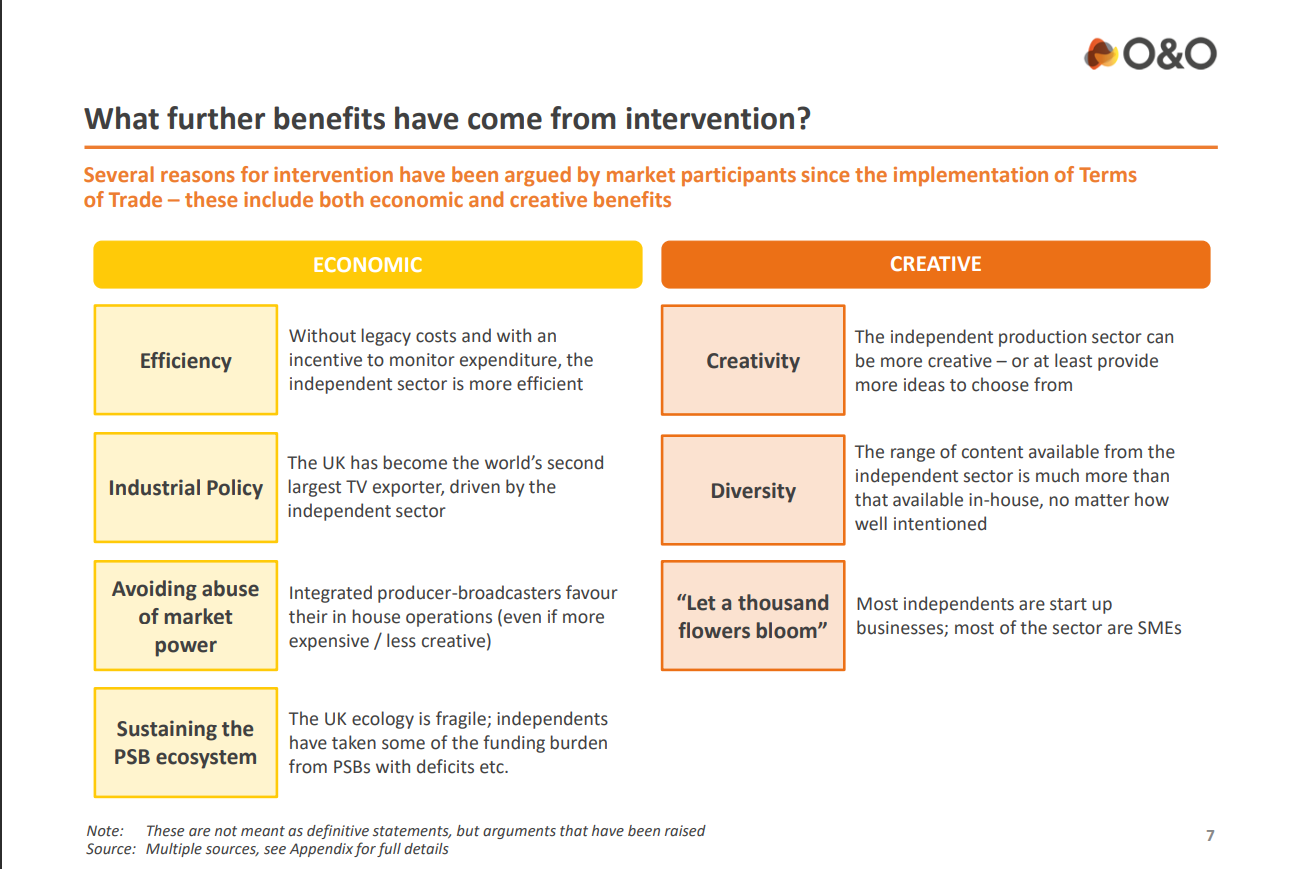
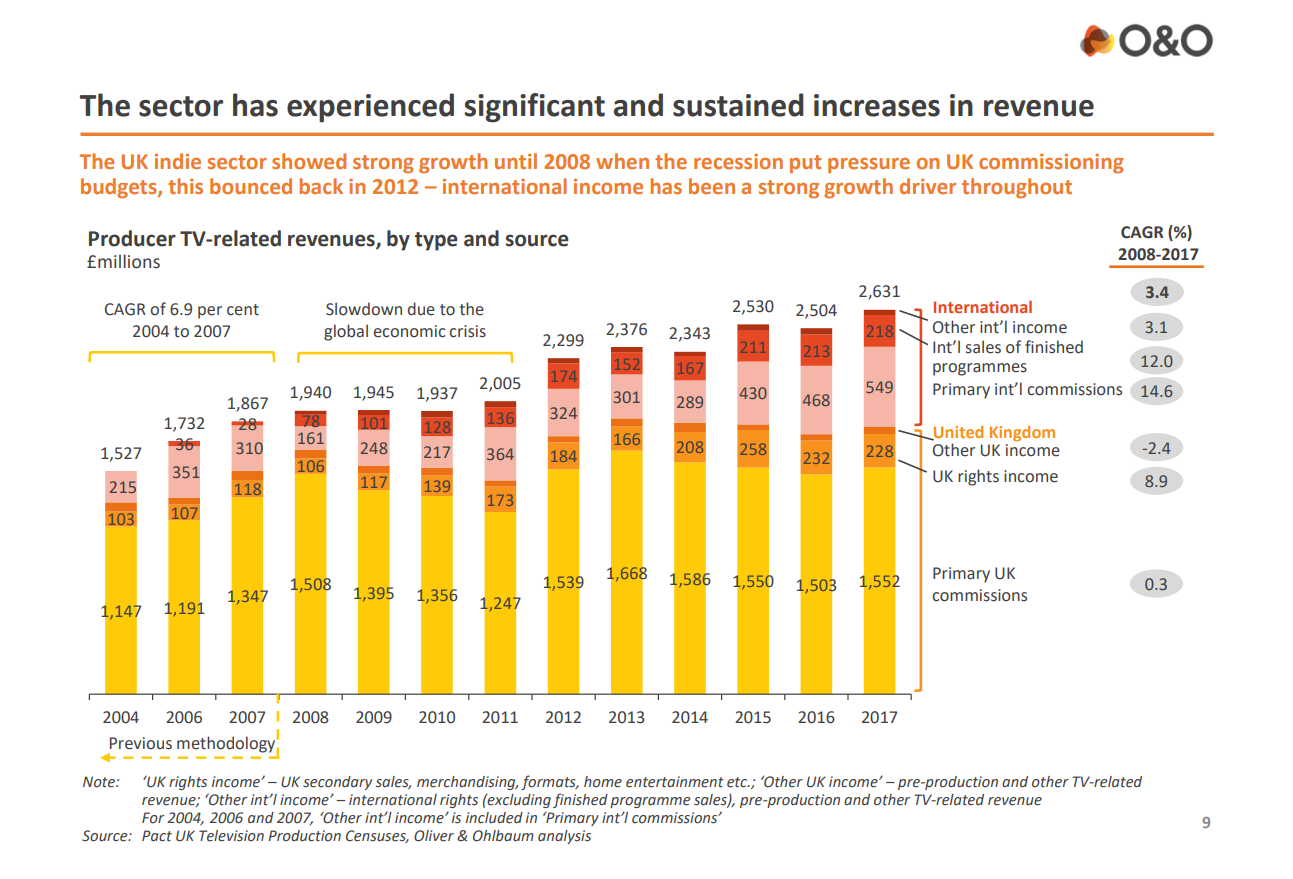
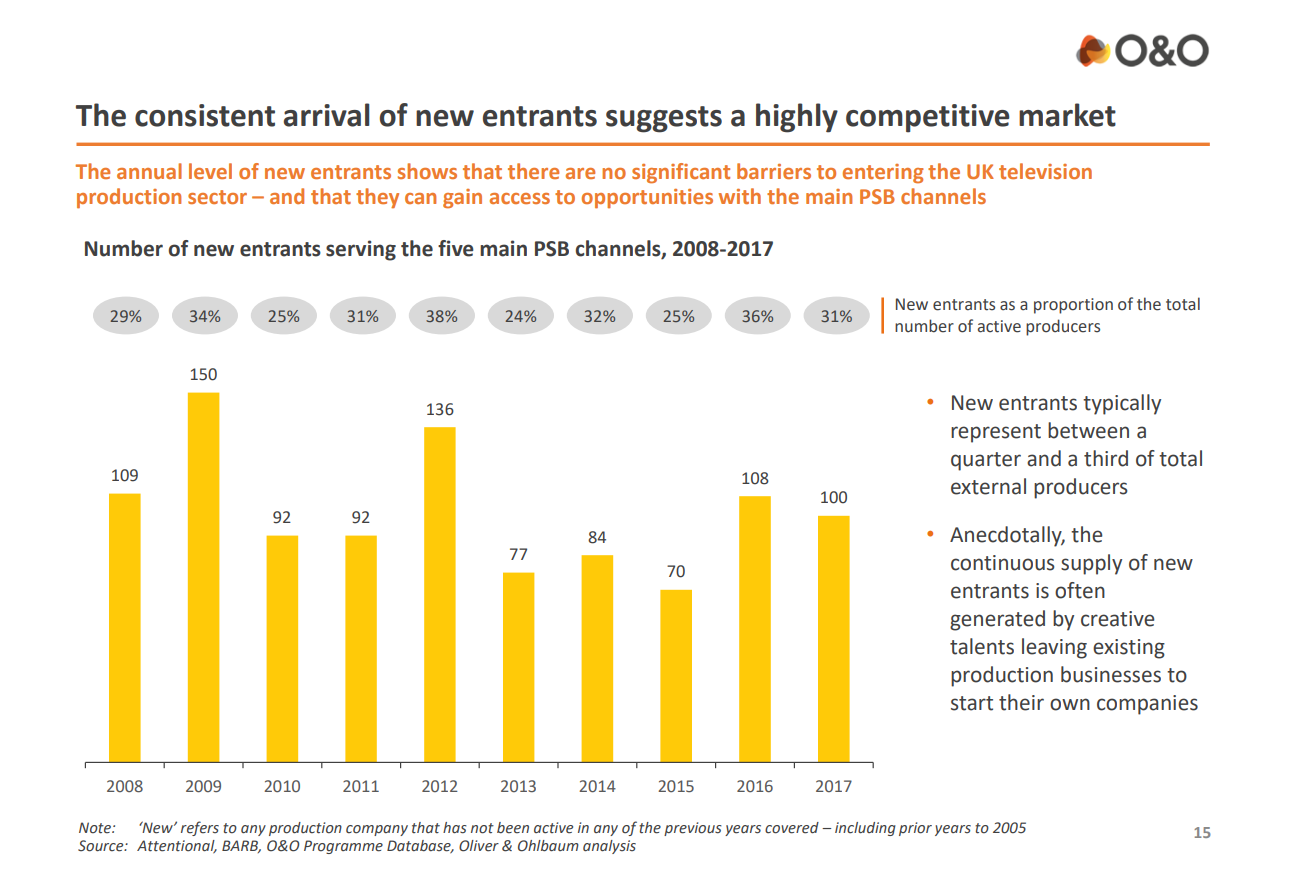
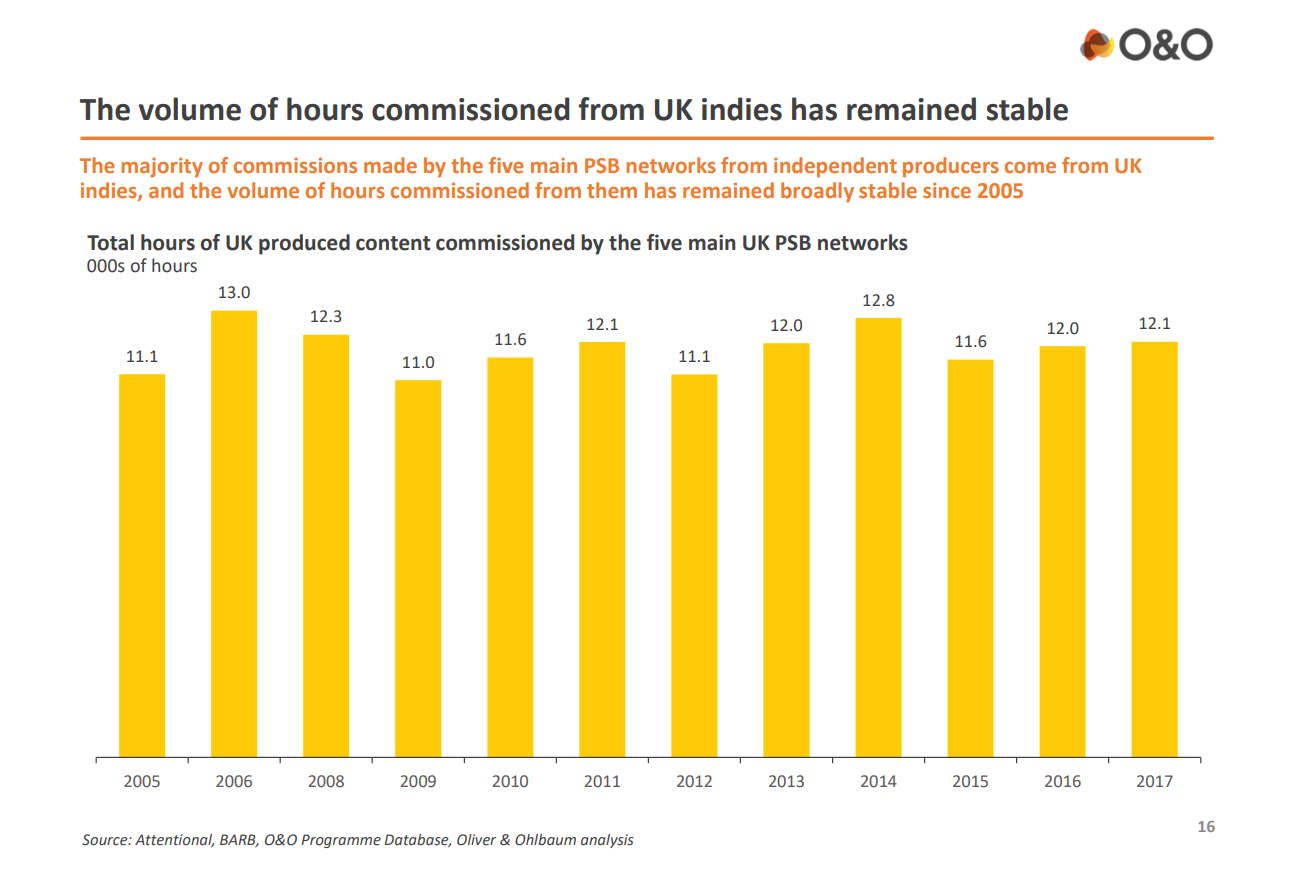
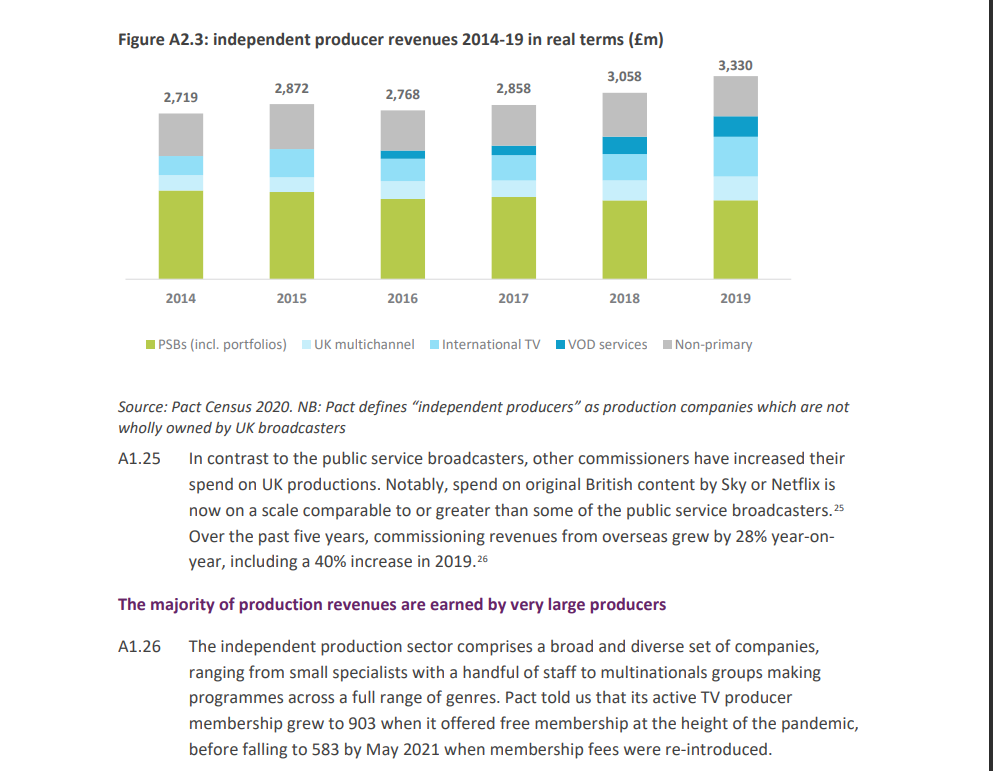
Here are some of the shows that got their start in the U.K., and then were licensed for an American audience: American Idol, America’s Got Talent, X-Factor, Dancing with the Stars, Wife Swap, Undercover Boss, Super Nanny, Who Wants to be a Millionaire. And there are hundreds more. In the U.K, independent producers have increased their TV related revenues from £1.5 billion in 2004 to more than £2.6 billion in 2017.
What happened? Put simply, governments changed laws so that independent producers gained bargaining leverage in the U.K., and lost it in the U.S.
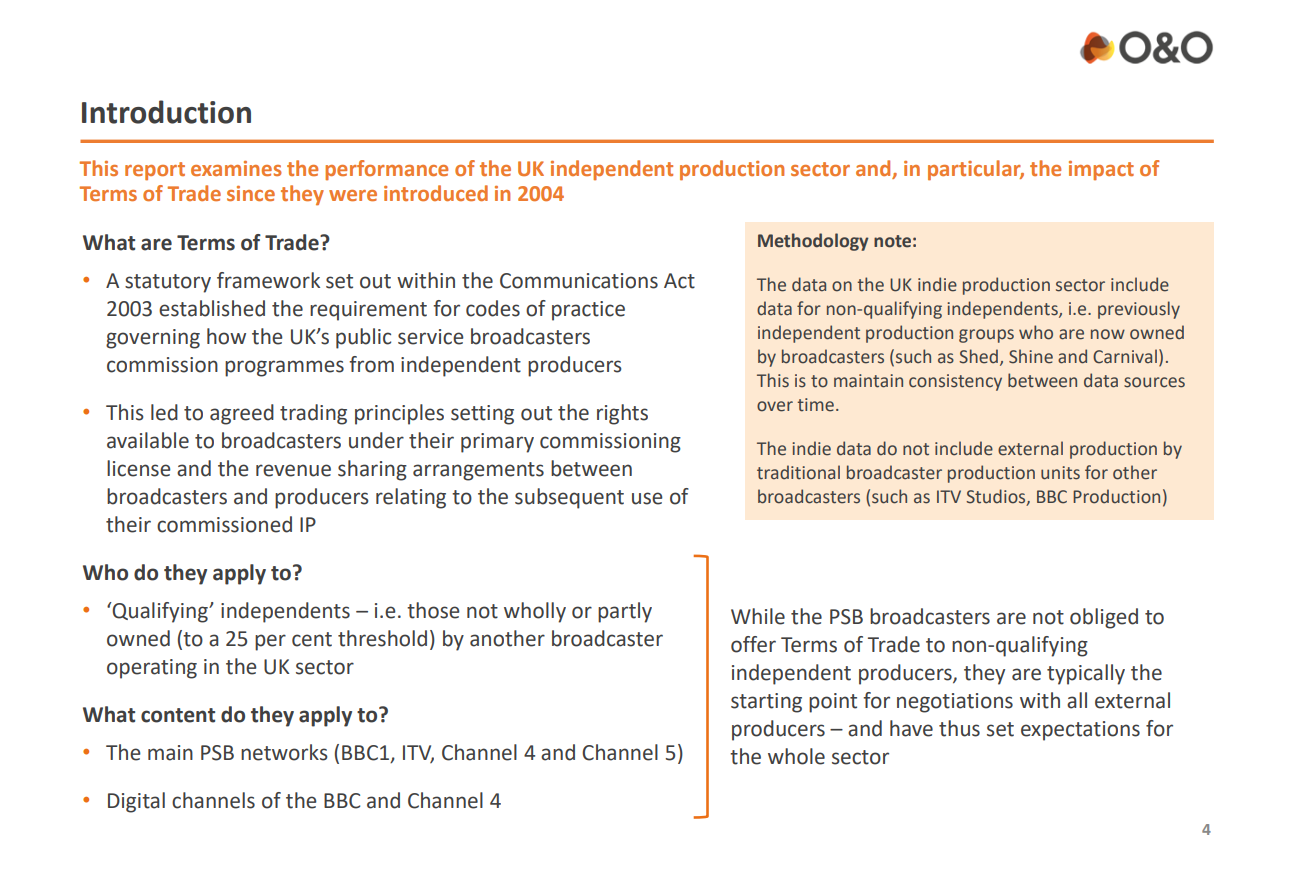
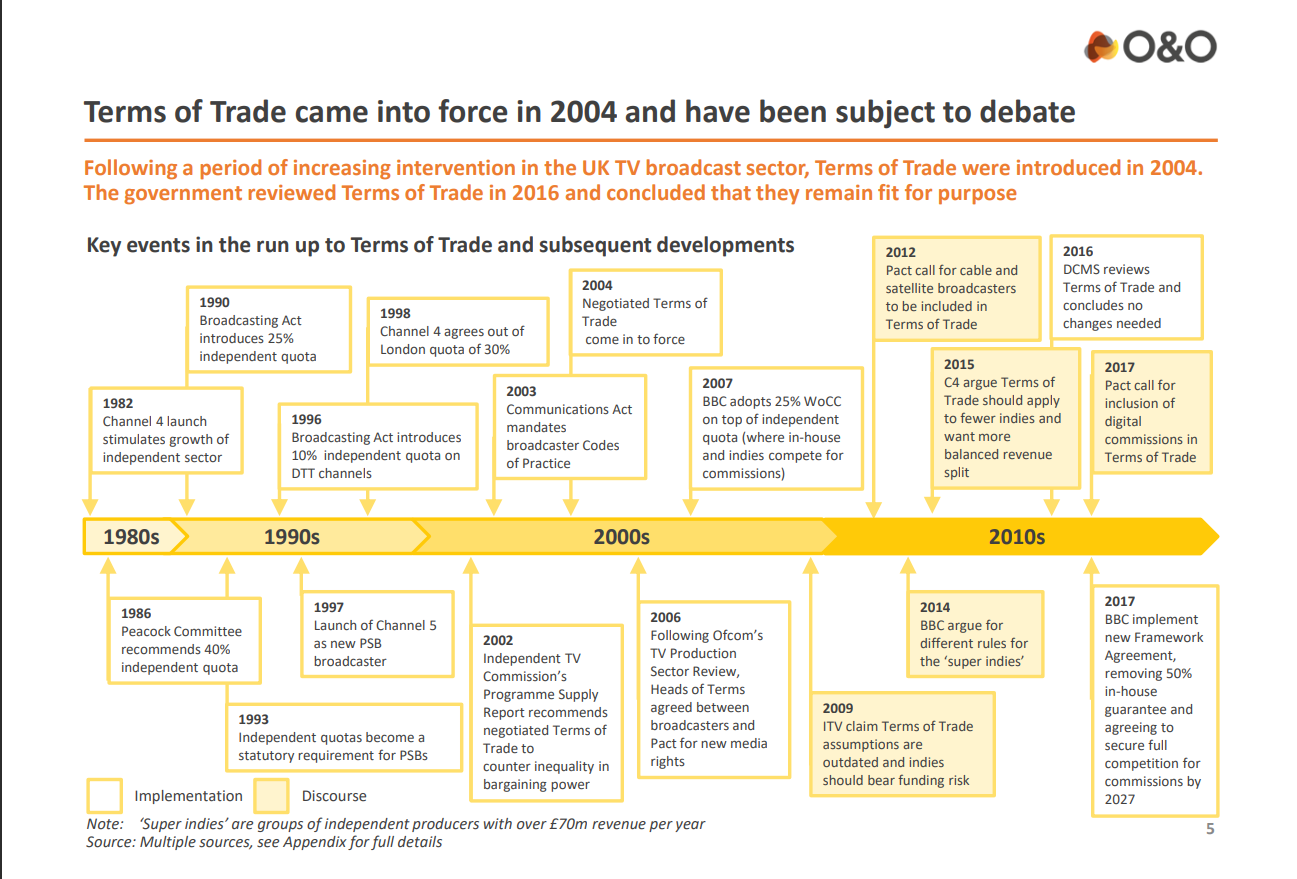
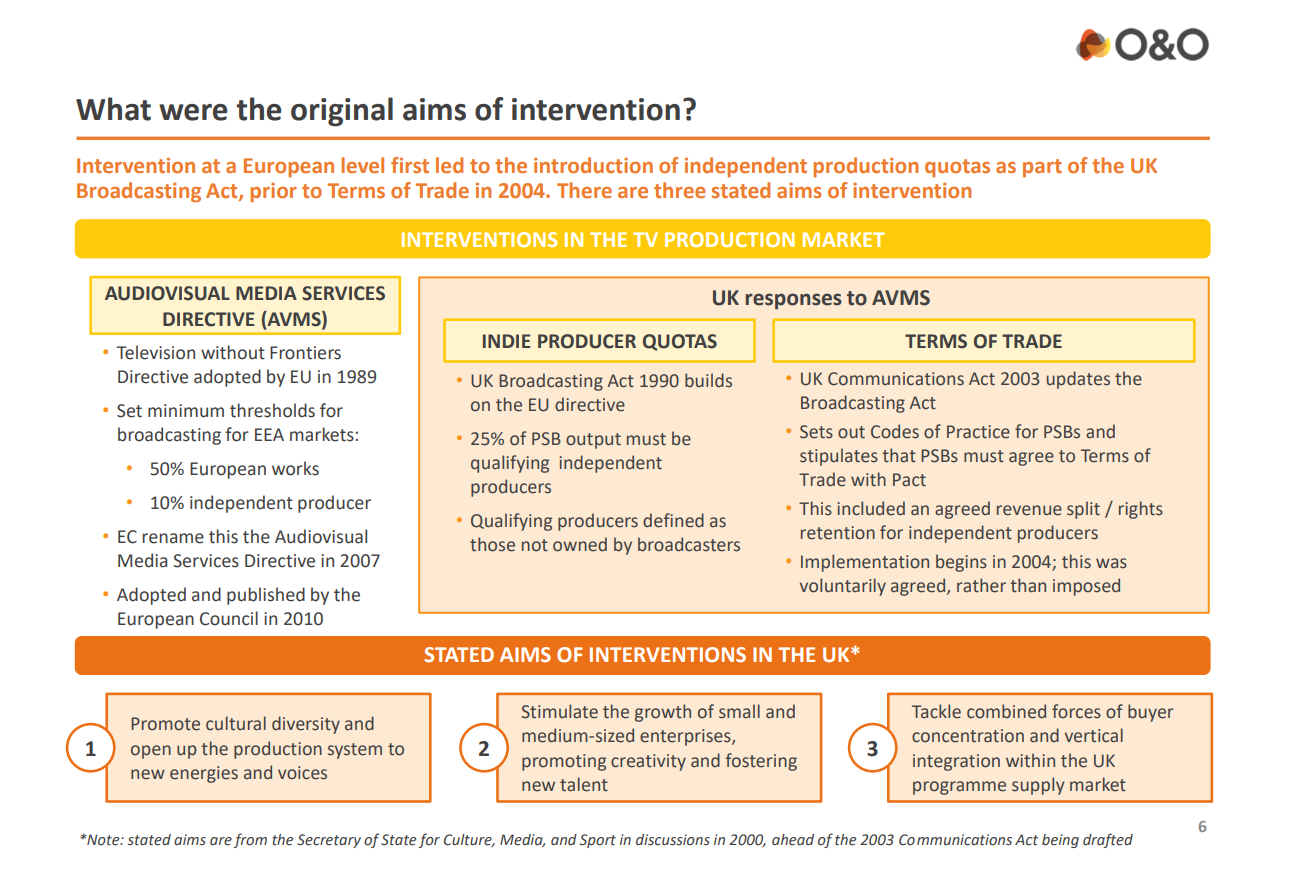
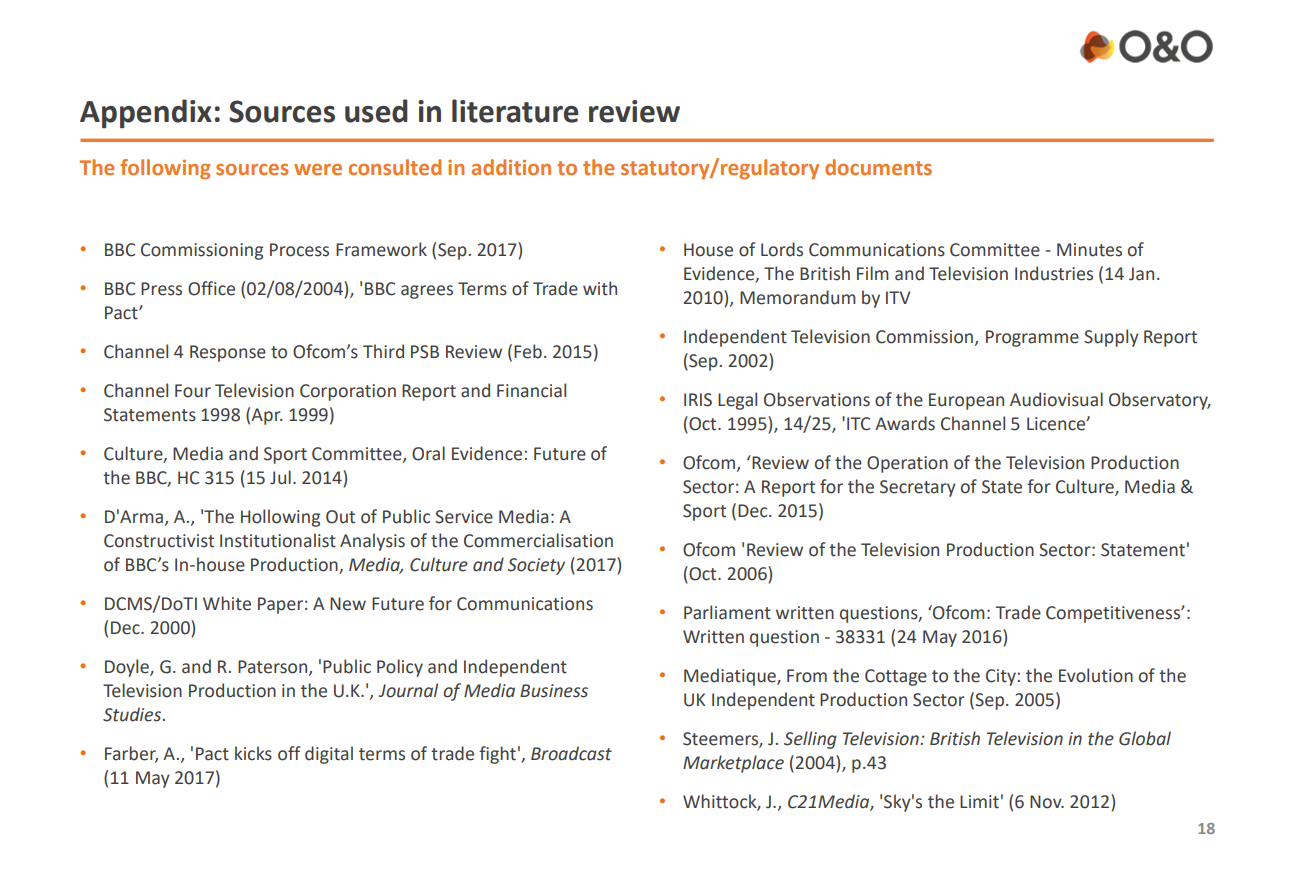
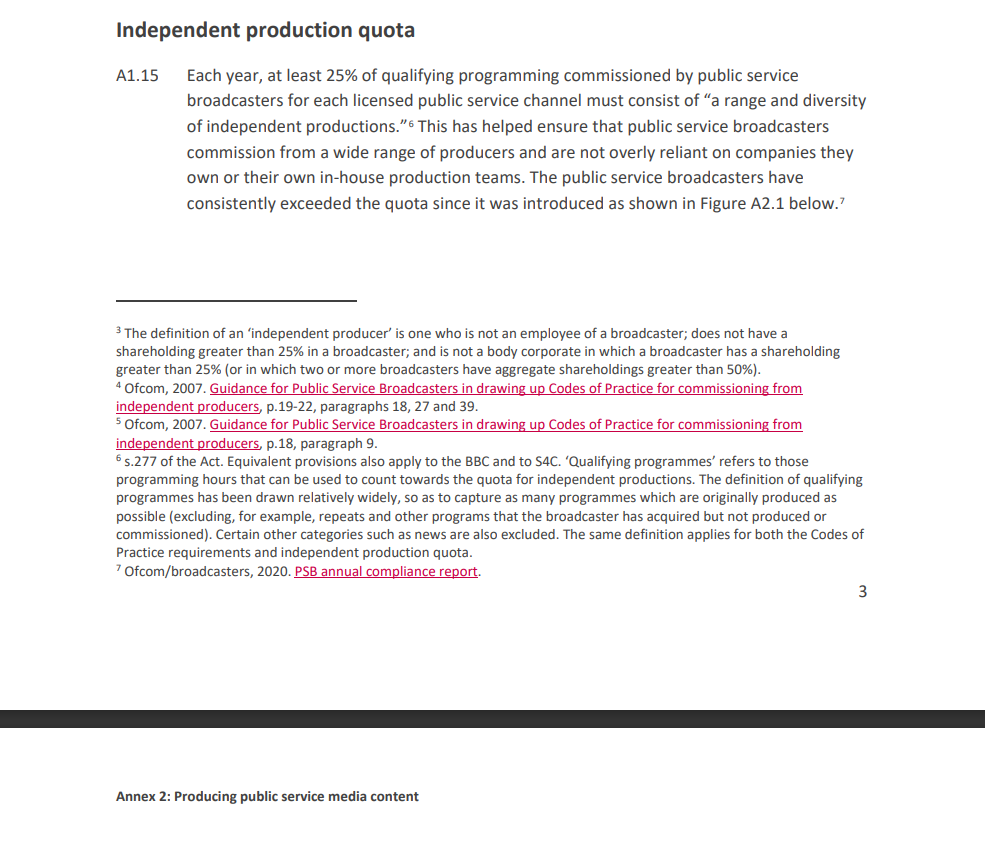
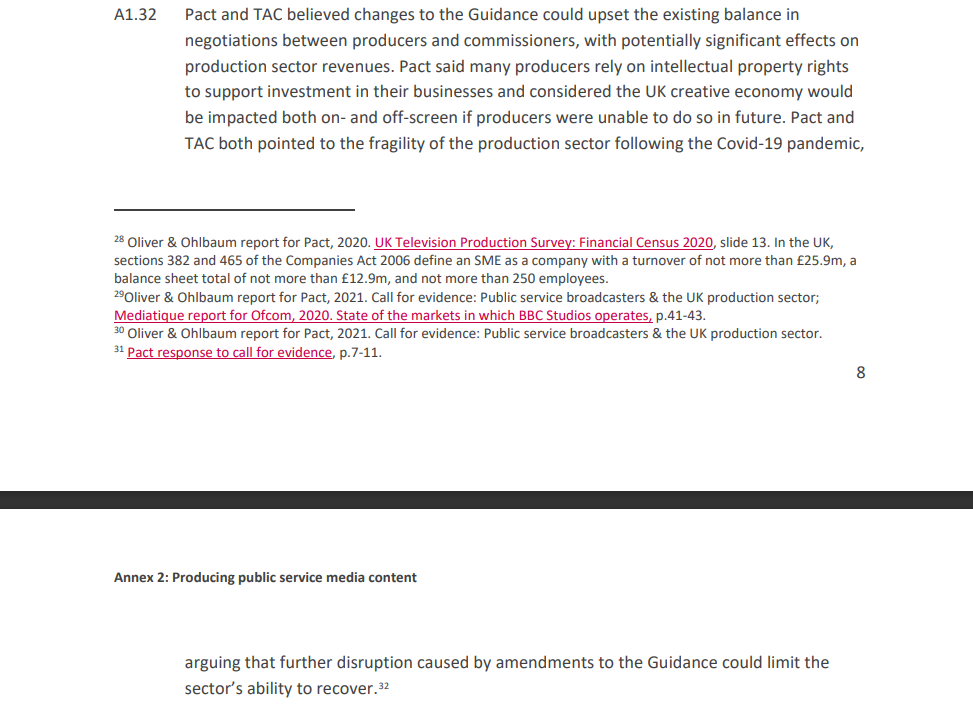
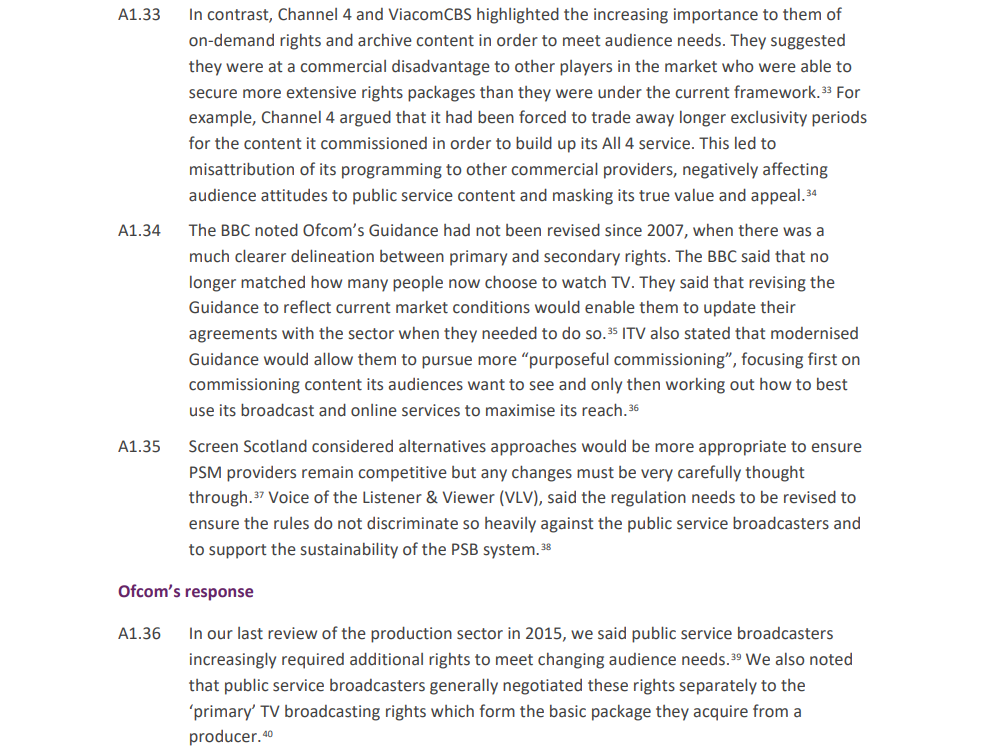
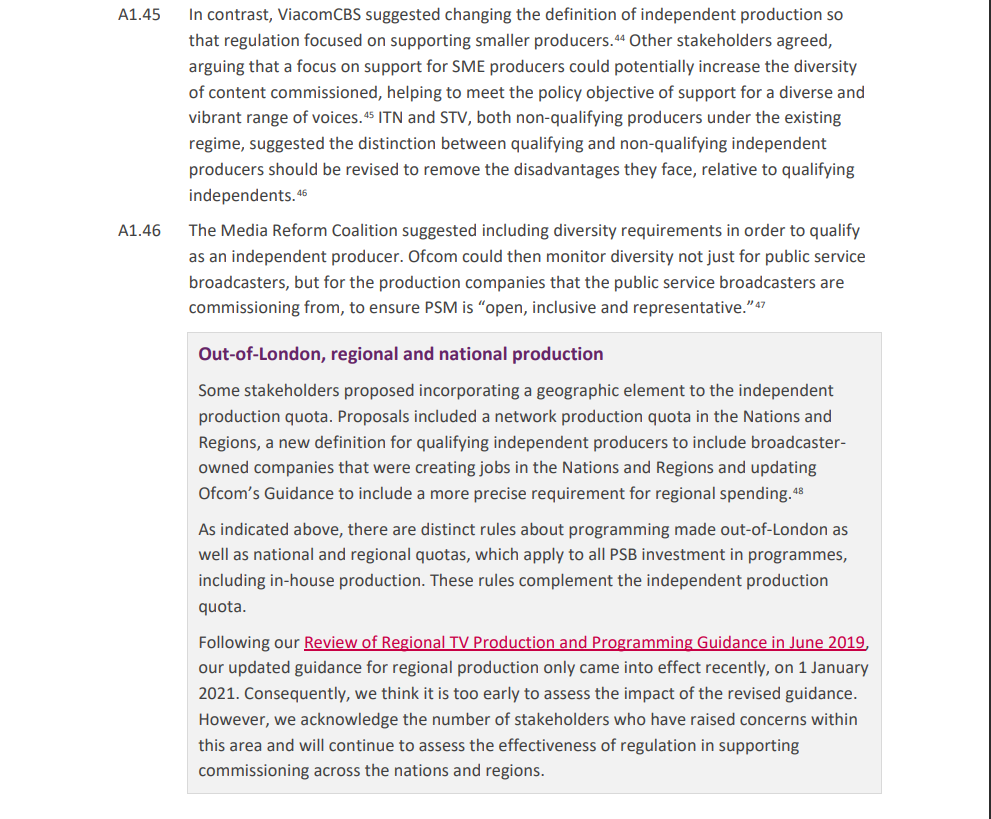
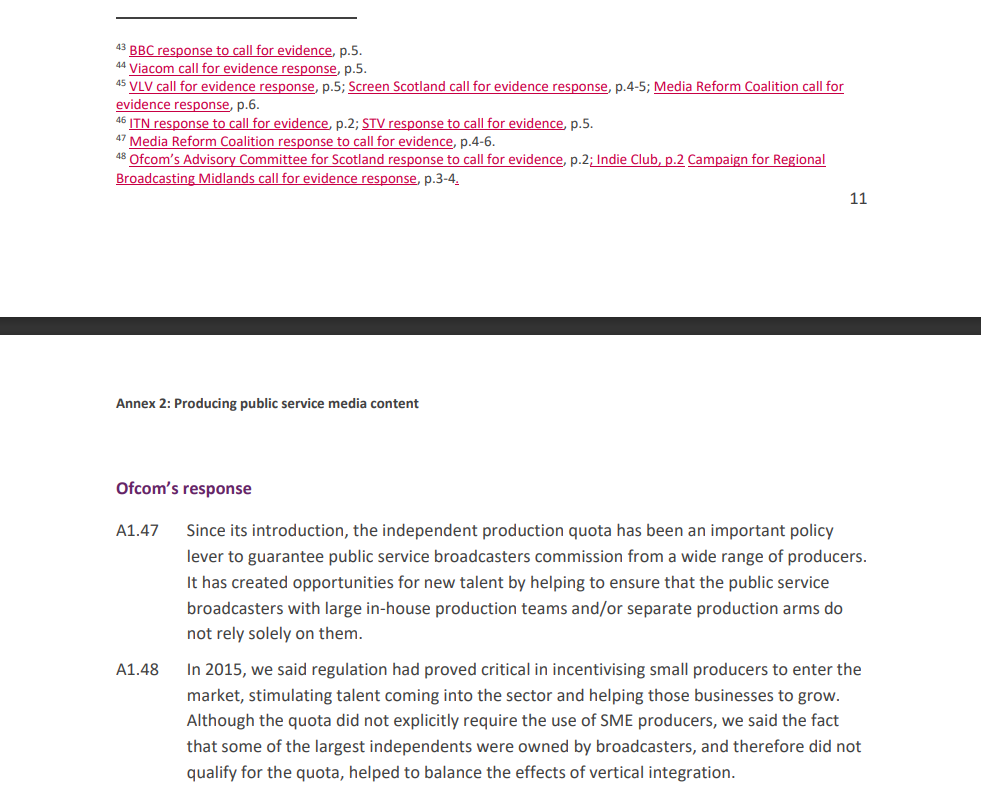
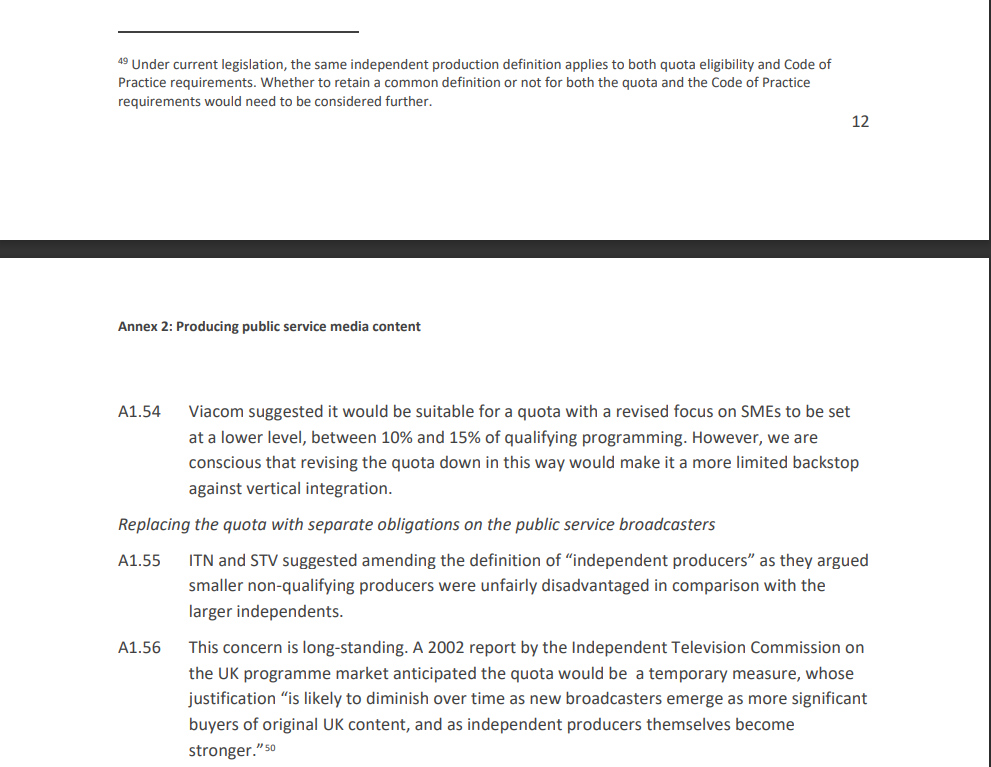
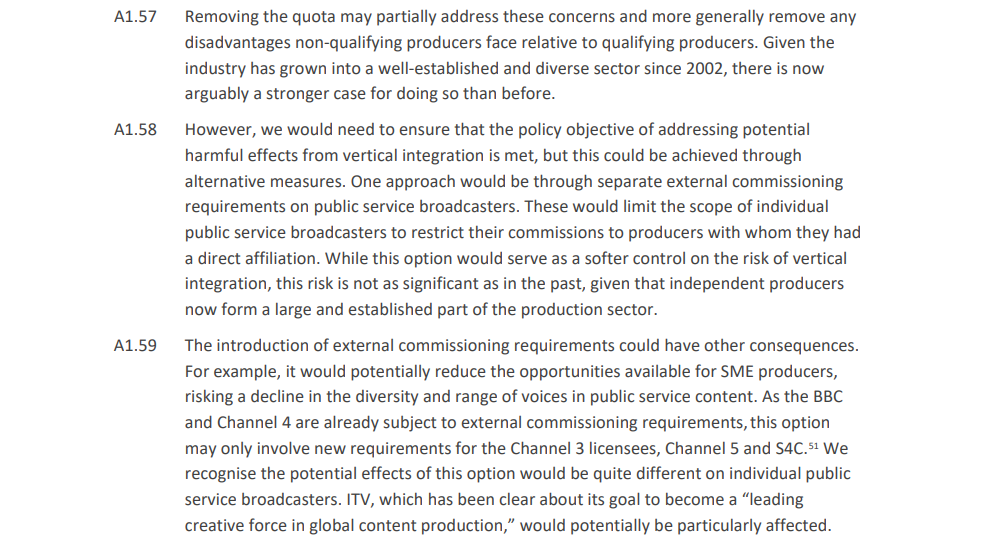
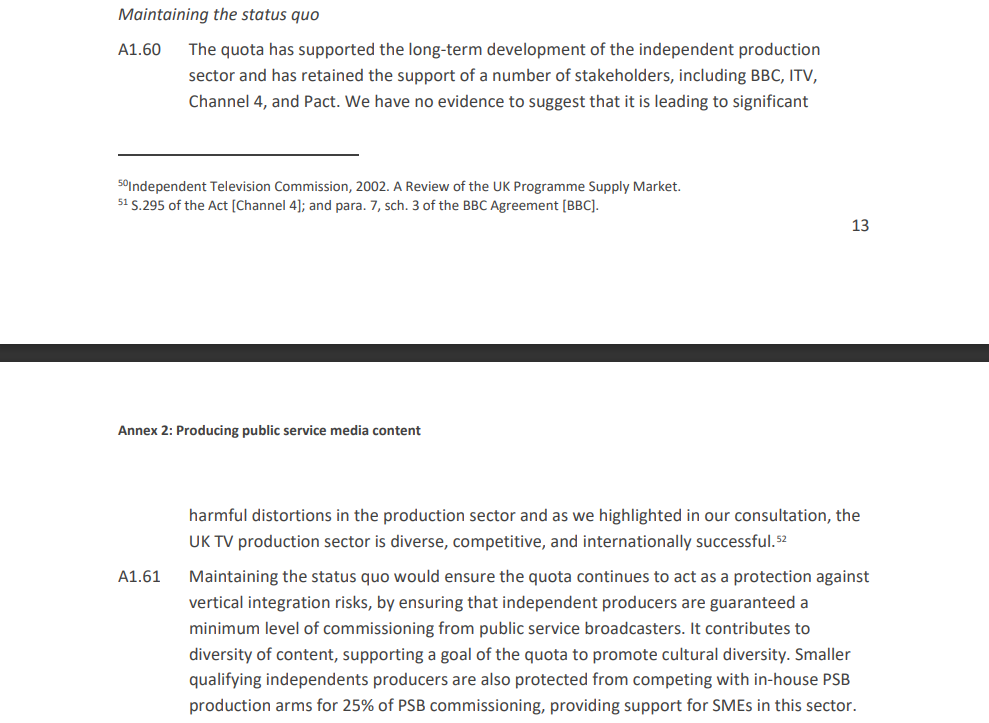
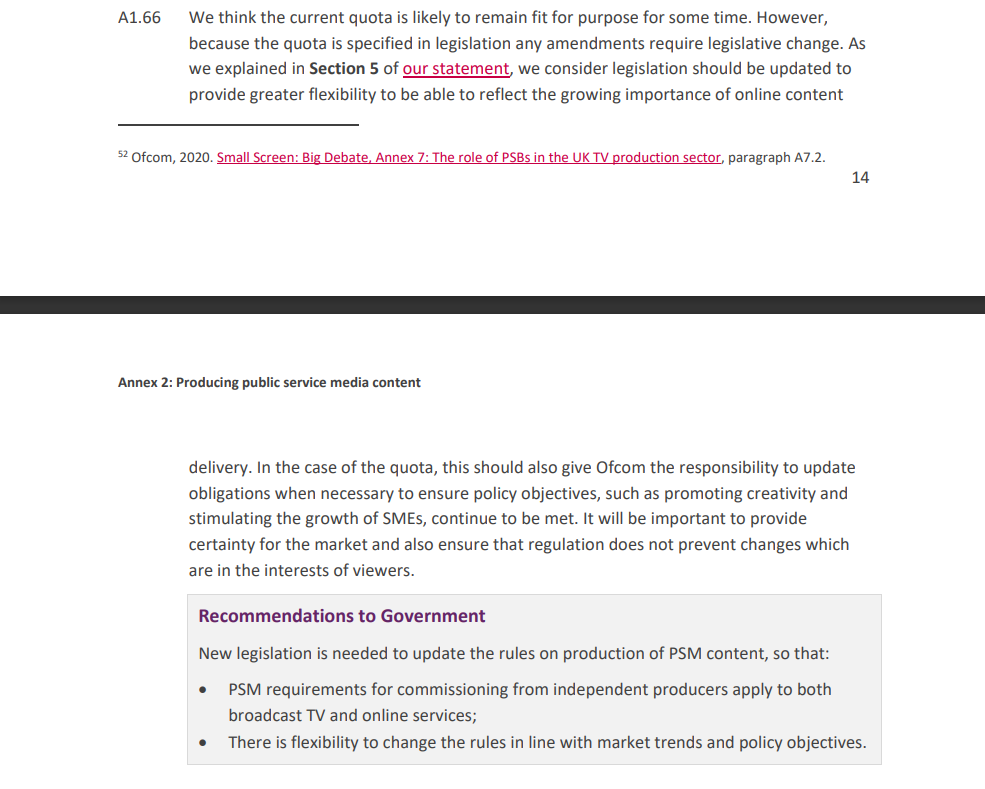
Let’s start with the U.K. In the early 2000s, the British government embarked on a strategy to grow its independent production industry. It facilitated something called the “Terms of Trade,” < https://cmpa.ca/wp-content/uploads/2019/01/Appendix-C-Oliver-Ohlbaum-Associates-2018-The-impact-of-the-UK-te...-1.pdf > a broadcaster code of conduct to remedy the bargaining asymmetry between dominant broadcasters and independent producers. This pact required four big public channels in the UK - BBC1, ITV, Channel 4 and Channel 5 - to commission < https://www.smallscreenbigdebate.co.uk/__data/assets/pdf_file/0024/221955/annex-2-statement-future-of-public-service-media.pdf > 25% of their production from independent producers, and to allow those producers to retain copyrights from their work they could license abroad.
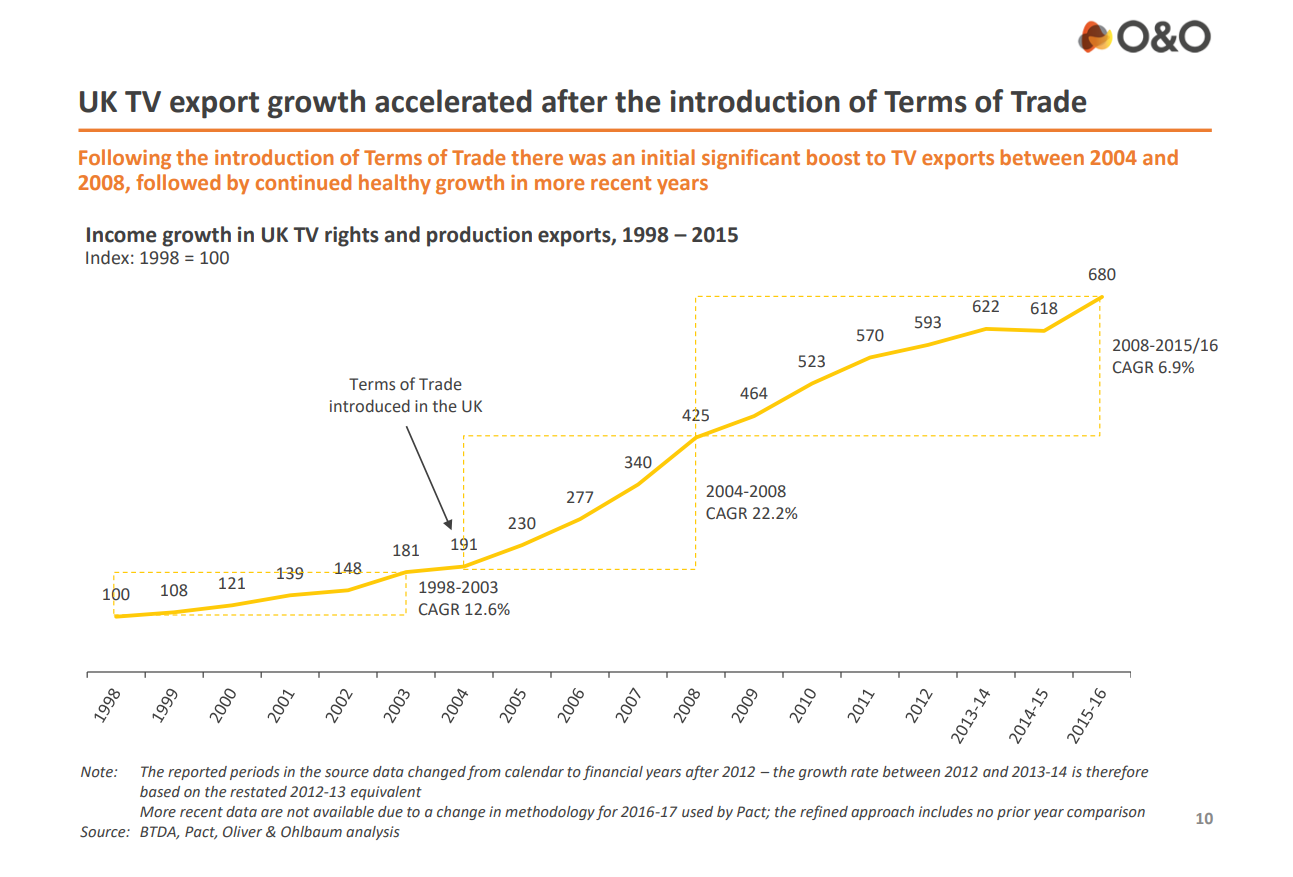
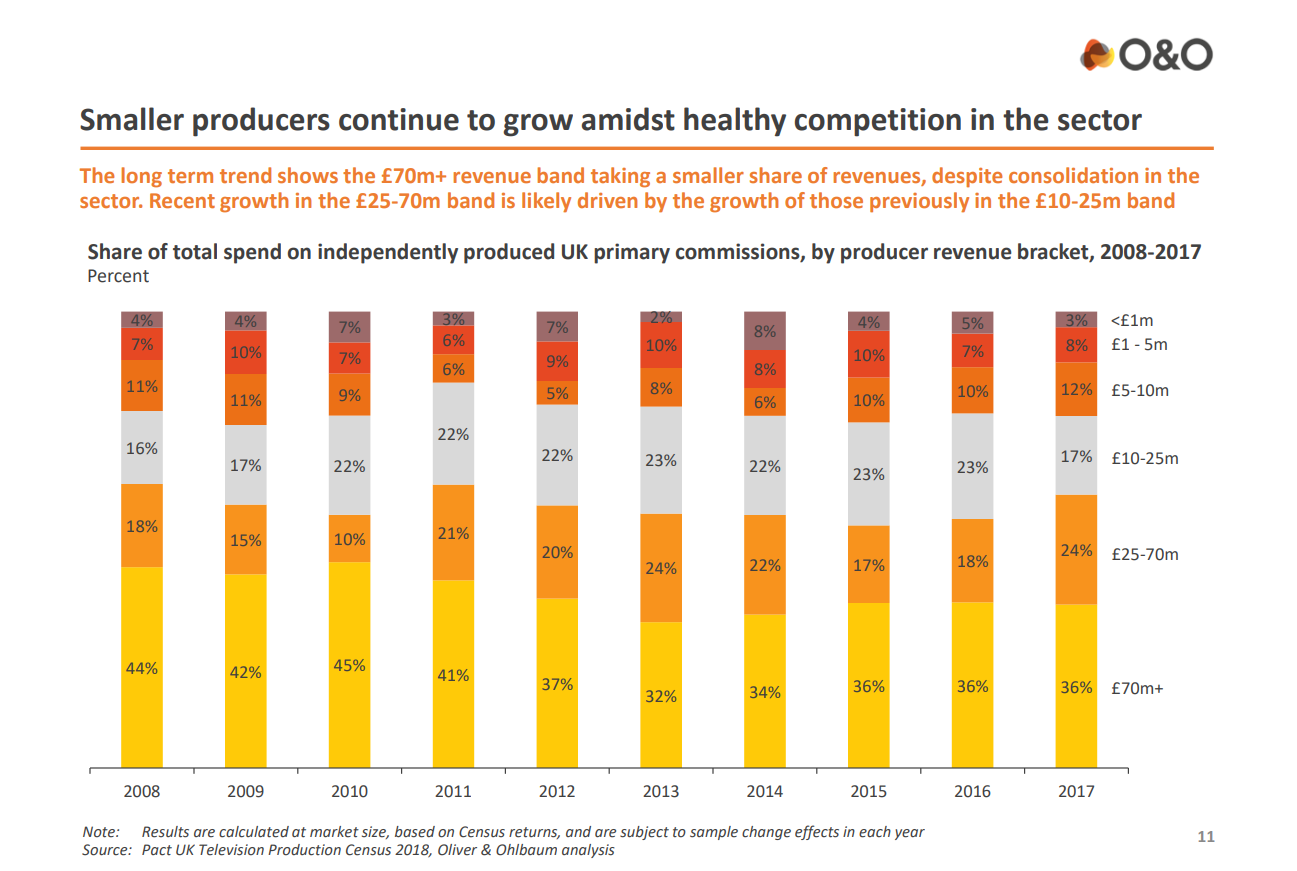
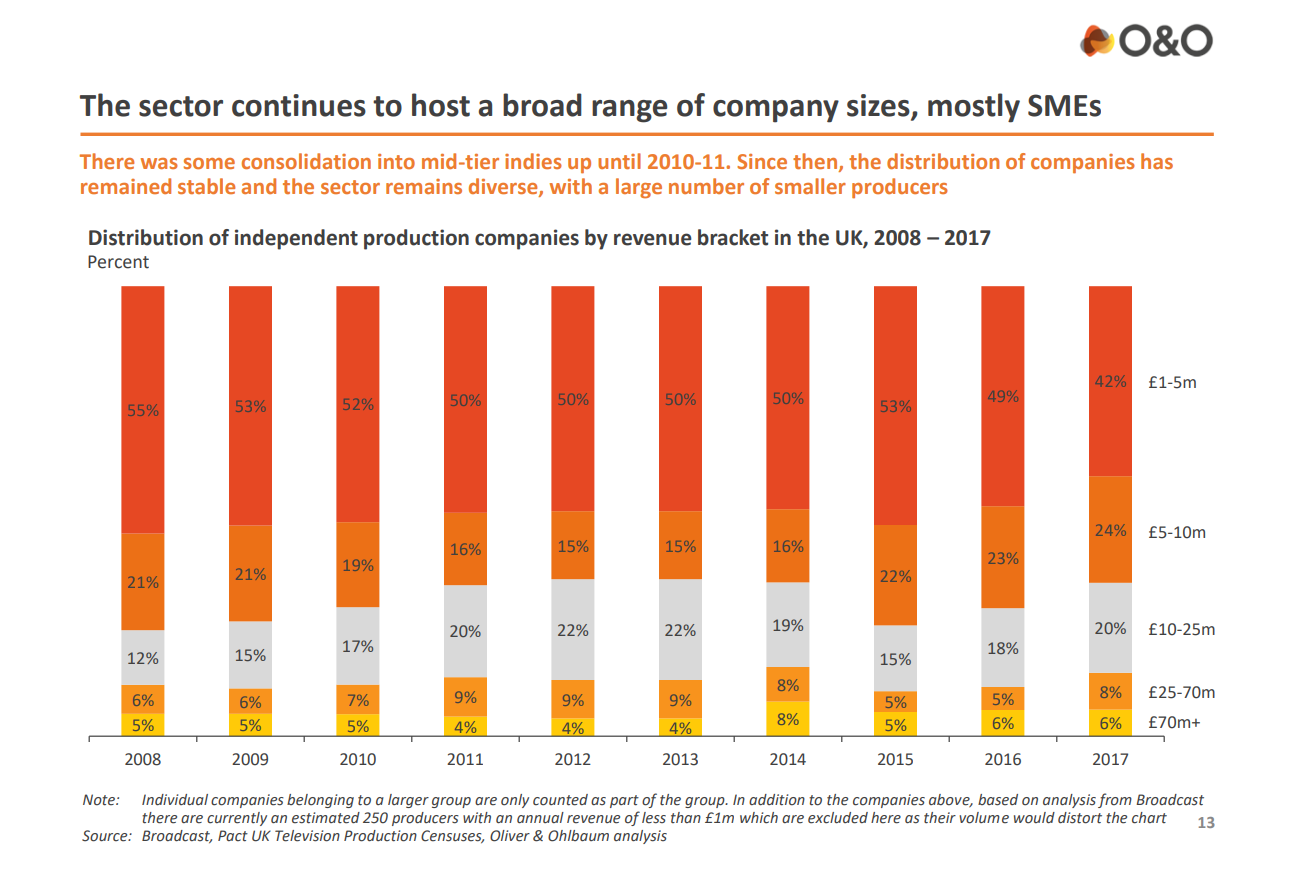
This was a soft break-up of the industry along vertical lines, and it made the U.K a great place to do business. As the CEO of the firm that makes American Idol, The X Factor, and Britain's Got Talent said, "There is no other country where you have these terms of trade. In the UK, it's brilliant!" In 2010, independents held 50% of the market, beating in-house network programming. Exports of British content exploded.
In the U.S., by contrast, legal changes over the last thirty years stripped independent producers of their bargaining power with distributors, diminishing the ability to create great products. In 2019, I laid it out in one of my first newsletter issues, titled The Slow Death of Hollywood < https://mattstoller.substack.com/p/the-slow-death-of-hollywood > , explaining why weirdly themed movies like Back to the Future became smash hits in the 1980s, and why that wouldn’t happen today.
In 1985, theater owners had more choices about what content to sell, and could decide to distribute content that was well-liked and popular without assuming a massive barrage of marketing would force them to stock the most popular stuff immediately. So they could afford to show different movies, experiment, and then bring in the popular ones over time. The industry was more decentralized. Stars, directors and writers with good track records, studios, distributors, movie theaters, critics, and moviegoers shared power.
[This market structure harkens] back to bitter battles in the 1930s and 1940s between New Deal antitrust attorneys and studio heads, which culminated in the Paramount Decrees of 1948 < https://www.justice.gov/atr/paramount-decree-review > and the end of the autocratic so-called ‘Studio System.’ These decrees forced studios to sell their theaters, and prevented them from engaging in tying and bundling practices to force theater owners to take their films. New Hollywood, with countercultural stars like Jack Nicholson, emerged in the 1960s to revamp the industry. In 1985, weird popular movies like Back to the Future took advantage of this open market structure.
A similar situation existed in the television industry, which was broken apart in 1970 by Richard Nixon’s FCC with Financial Interest and Syndication Rules (‘fin-syn’) < https://www.csmonitor.com/1991/0404/finsyn.html > , and a related rule called the Prime-Time Access Rule (PTAR). These rules blocked TV networks from distributing their own content in prime time, opening the market for TV content to third party producers who would take more creative risks. The Cosby Show, Seinfeld, The Mary Tyler Moore Show, and All in the Family were some of the results of this policy choice to open up the TV market.
Both the Paramount Decrees and the Fin-syn rules were designed to eliminate conflicts of interest by splitting the studio from the distribution. Studios had to create high quality work, and if they didn’t, distributors could choose to sell someone else’s art.
The rules structured a profitable and high-quality industry, with different kinds of TV shows and movies. Media was a series of markets, from movie theaters and prime time TV, to hundreds of local TV networks for syndication, to video tapes and DVDs, to foreign markets. Creators experimented, while audiences ruled with their preferences. Hollywood is a politically left-wing place, but conservative religious hits, like The Passion of the Christ, got into theaters, and sold tickets.
In the 1980s, antitrust enforcers, influenced by Chicago School scholars like Robert Bork, became far more tolerant of concentration economy-wide. This legal revolution had significant implications for movies. In 1995, the top five movie chains owned a third of U.S. theaters, with the biggest, Carmike, owning < https://www.nytimes.com/interactive/2016/03/07/business/media/amc-biggest-movie-theater-chain.html> around 2,500. By 2016, the top five held over 53% of the movie theaters in the country, with the largest, AMC, owning 8,380.
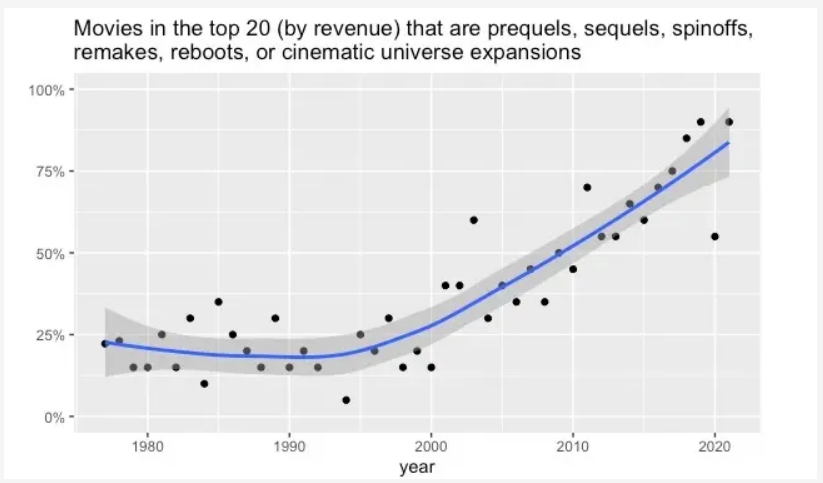
This consolidation changed movies. In the late 1990s, giant new multiplexes “jolted the Hollywood power structure,” < https://www.wsj.com/articles/SB885343258697290000 > as theater operators played the biggest hits on several screens at once. Films began to do most of their business in the first few weeks, so well-branded tent pole movies with strong IP - aka Marvel-style movies - displaced word of mouth. As Adam Mastroianni noted with this chart, movies, along with much of pop culture, became an oligopoly. < https://www.experimental-history.com/p/pop-culture-has-become-an-oligopoly?s=r >
The Clinton administration enacted another legal change by ending fin-syn rules, causing a merger boom of content and distribution. Immediately, for instance, Castle Rock Entertainment, the production company behind shows like Seinfeld, sold out to Turner Broadcasting, which in turn sold out to Time Warner. Disney bought ABC, and then rolled-up a series of rivals < https://mattstoller.substack.com/p/its-time-to-break-up-disney-part > to acquire large amounts of well-known intellectual property - like Marvel and Star Wars.
Then came streaming, which wasn’t very important at first. Prior to 2010, the major studios sold movies to theaters, and TV shows to cable and TV networks. Several sold to Netflix, which they saw as just another distributor. But in 2010, the Obama administration approved the merger of NBC and Comcast, a further erosion of the vertical separation at the heart of the Paramount Decrees and the fin-syn rules.
Technological innovation happens along the legal framework it is born into, so streaming, which could have decentralized had it happened in another era, did the opposite.
When Comcast bought NBC, Netflix, then a minor player, feared it would lose access to content from studios. So it began buying its own movies and shows, combining distribution and production as the first studio-streamer. Apple and am*zon, for whom Hollywood revenues were a rounding error, eventually entered the business. Netflix, Apple, and am*zon put pressure on the traditional studios, who were judged based on profit and loss. Studios realized Wall Street was valuing Netflix stock more highly as a ‘tech’ company. They wanted in on that as well. All except Sony followed Netflix and became studio-streamers.
But something wasn’t right with the streaming model Netflix introduced. There was no way to know ratings or box office take, since Netflix held its own data without third party auditors. Its then-CEO, Reed Hastings, pretended Netflix used its data to scientifically know what users wanted. But that wasn’t true. (See “The Algorithm is a Lie.” < https://entertainment.substack.com/p/the-algorithm-is-a-lie?s=w > ) Netflix was just overpaying for content, and losing money to acquire market share, a technique known as predatory pricing (that used to be illegal until the Supreme Court de facto legalized < https://supreme.justia.com/cases/federal/us/509/209/ > it in 1993.)
Netflix’s model was an attack on the bargain between creators and studios at the heart of the industry. This bargain is that everyone who makes movies or shows - production houses, studios, writers, actors, or directors - split the profits from any individual piece of content, profits generated by selling movies or shows into actual markets. Producers, for instance, often retained the intellectual property of a show, and licensed it. Traditional labor compensation packages, known as ‘residuals,’ are based on theatrical releases, or what ratings TV shows achieved when broadcast. Additionally, both categories might qualify for additional compensation through syndication or DVD sales, foreign market sales, and sometimes streaming. (It’s why the cast of Friends is still making millions of dollars a year even today.)
When Netflix sought to fully integrate the production and distribution, this bargain broke down, because there were no markets or prices to use to value anything. Netflix paid creators an upfront fee, and then that content was on Netflix, with no opportunity to syndicate or sell it elsewhere. Beyond breaking down price signals, Netflix wouldn’t even tell creators how their shows did in terms of ratings. It also refused to allow American production houses to retain IP. Other studios copied Netflix, upending the labor model for content. No one knew what anything was worth.
The lack of market signals screwed up the industry because markets, as it turns out, have an important function in Hollywood. They represent a feedback loop to the studios, telling executives the preferences of the audience, based on whether the audience (or advertisers) are willing to pay. The tacky way to understand this dynamic is that when a movie did well at the box office, other studios would often copy that kind of movie, in hopes of appealing to the large audience that saw the original. But what happens when you can’t get distribution for mid-market movies because the few theater chain owners don’t want it? What happens when there are no TV ratings because it’s all streamed? What happens when, as happened during the pandemic, there is no box office?
Obviously, at some level, people are still paying money in the form of subscription fees. But decisions for what to make happen about individual pieces of content are difficult without this feedback from the audience. A creative executive can’t, after all, green light a streaming service, they can only green light a movie or TV show.
When pricing went away, when customers were simply paying a subscription fee every month instead of buying tickets or DVDs, executives had no way to know what to make or how to value anything. As just one example, in 2021, Warner Brothers put their whole slate of films onto their streaming service at the same time as they went into theaters, revealing how executives were mis-pricing their products. Another illustration of a deep structural problem with the industry is that bankable movie stars, the most important commodity in Hollywood, are aging, because you can’t break new stars.
In an attempt to monopolize, studio-streamers accidentally transformed a high-wage, high-profit business into a low-wage low-profit commodified one. For a time, this decline in industry health wasn’t obvious. Netflix had told Wall Street a story that its overall goal was to get customers locked in, and this convinced the street to give the capital to make lots of content regardless of profit. Other studios followed, overpaying for content in the hopes of being the last man standing, in the era of what was known as “Peak TV.” < https://slate.com/culture/2023/03/peak-tv-over-golden-age-hbo-streaming.html > As Discovery board member John Malone put it < https://www.hollywoodreporter.com/business/business-news/john-malone-talks-streaming-wars-1235264416/ > , “Everyone went for this mad Oklahoma land rush of streaming … That was a fool’s errand.”
The lock-in was a mirage, as consumers switched services to find content they wanted to watch. No one, as it turns out, wanted a streaming service, they wanted individual shows and movies. Vertically integrated streaming services, contrasted with markets where consumers pay for what they want, aren’t very profitable. HBO, Peacock, and Paramount all lost money < https://www.vox.com/recode/2023/1/5/23539590/streaming-losses-netflix-hbo-peter-kafka-media-column > in the first three quarters of 2022, and this year, Disney’s streaming services raised prices < https://deadline.com/2023/05/disney-pulling-content-off-streaming-in-strategic-rethink-1235362374/ > and removed content, and still can’t make a penny.
Most of the consolidation discussed so far is vertical, where studios and distributors combined. But throughout this period, traditional mergers, where rivals bought rivals, also continued. In 2019, Disney bought Fox, shrinking the number of major studios into a narrower oligopoly (and cutting the output of films < https://theankler.com/p/the-disney-fox-deal-whos-right?utm_source=post-email-title&publication_id=15657&post_id=97369692&isFreemail=false> ). Last year, Discovery bought Time Warner, combining two big buyers of reality TV.
Consolidation, combining both production and distribution, and shrinking the number of studios, led to budget cuts. For writers, this meant smaller writer rooms, shorter seasons, and worse terms. Writer pay fell by 14% over < https://www.wcvb.com/article/what-do-striking-hollywood-writers-want/43791834 > the last five years, with sweatshop conditions < https://theankler.com/p/showrunner-crisis-its-a-sweatshop > even for those with the most creative control, the showrunners. Others felt it too; independent TV production houses, such as firms who create reality TV shows, struggled. They no longer have any choice but to sell to one of a few studio-streamers. Streamers demanded the intellectual property of anything they bought, which meant independent production houses began working as contract players for a fee, almost like chicken farmers or gig workers. There was no point in creating something great, since all the upside went to the streaming giants.
Nothing in Hollywood, in other words, is working now that the underlying pricing system has been reduced in importance. The studio-streamers aren’t making money, the workers aren’t getting compensated like they used to, and the cultural relevance of Hollywood is declining. (And that last point is very weird, because Hollywood should have been able to take advantage of the remarkable telecommunications revolution of the last thirty years, but hasn’t.)
This industry-wide collapse is at the heart of the writers strike that’s taking place right now, ever since the industry contract with screenwriters expired at the beginning of the month. What the Writer’s Guild of America (WGA) wants, is a fix to the devastation vertical integration has wrought on the industry. Their official demands are more money, access to data on how their shows do, as well as also minimum staffing requirements for shows and better lengths of employment for writers. To add to the pressure, over the next few months, the Director’s Guild and the Screen Actors Guild will also be renegotiating < https://abc7.com/hollywood-writers-strike-los-angeles-guild-of-america-directors/13229141/#:~:text=The Writers Guild of America's,Editor in Chief Cynthia Littleton. > their contracts.
Some of the WGA demands address the power imbalance more directly than others. More residuals is a standard labor demand, while better data on streaming would actually ameliorate industry structure. Minimum staffing requirements are a bit more controversial, according to The Ankler’s Richard Rushfield. But fundamentally, the problem the writers face is much bigger than an unfair deal. It is in fact the same problem that everyone - writers, actors, directors, producers, crew members, and executives - all face; the industry itself is badly structured, and there is no political leadership < https://theankler.com/p/rushfield-the-very-bad-choices-that > among studio CEOs to address the dysfunction.
Most in Hollywood feel in their gut the dysfunction, and the proof is in the support unions are showing one another. Believe it or not, labor solidarity in the industry is rare. During the 2007 writers strike, for instance, Teamsters would drive past picket lines and give the strikers the middle finger. Two weeks ago, however, Teamster leader Lindsay Dougherty told < https://strikegeist.substack.com/p/rushfield-day-3-netflix-bears-the > writers at a strike rally, “If you put up a line, the trucks will fucking stop... The only way we’re gonna beat these mother fuckers is if we do it together."
It’s not just unions. Agents are pitching in, even though agents and writers had been at war relatively recently. And the producers are backing the writers as well, quietly. One strike captain told Elaine Low that “they’ve received boxes of doughnuts from producers who refused to share their names,” but that “the anonymous drive-by doughnuts were well received.” It’s remarkable that producers are afraid to have their names associated with a strike they support, but in a sense, the fear is the point.
Even the Wall Street financiers themselves see the problem, in the form of stagnating share prices. From their point of view, however, the problem isn’t that studio-streamers are too powerful, but that they are too weak. As media tycoon John Malone last year told the New York Times, studios, especially smaller ones, don’t have enough pricing power, and will ”inevitably have to combine in order to try and become profitable.” This view is near-consensus in the C-Suite; former WarnerMedia CEO Jason Kilar recently wrote in the WSJ < https://www.wsj.com/articles/jason-kilar-chaotic-streaming-wars-11670177734 > , he expects there will only be two or three studios remaining after another merger wave, and a bevy of billionaires from Comcast and Discovery are all planning < https://puck.news/lazard-fears-nbcu-c-suite-tea-leaves/?_cio_id=f6c60604e79a01a8c408&utm_campaign=The+Daily+Courant+-+LEADS+(5%2F1%2F23)&utm_content=The+Daily+Courant+-+LEADS+(5%2F1%2F23)&utm_medium=email_action&utm_source=customer.io > for the “inevitable” merger of NBC and Warner Bros. Discovery. And am*zon is reportedly interested < https://nypost.com/2023/03/28/am*zon-reportedly-interested-in-buying-amc-entertainment/ >
in buying the AMC theater chain.
In other words, rather than returning the industry to profitability by separating out distribution and studios once again, the goal is to further consolidate Hollywood to squeeze pricing power out of consumers and creators.
And that’s why this fight is existential. For the strikers, the problem is how to negotiate a deal providing a reasonable living making commercially viable TV shows and movies. For the studio-streamers, however, preserving a domestic creative industry is fundamentally unimportant. Their problem is a lack of pricing power, aka too much competition among relatively undifferentiated streaming services who must bid against each for both talent and audience. Their way out is to drive a hard bargain, while trying to engineer another set of mergers.
As the Entertainment Strategy Guy notes < https://entertainmentstrategyguy.com/2023/05/09/sending-a-strategy-postcard-from-strike-land/> , and as the reality TV imports from the U.K. show, there is now production capacity all over the world, and shows and movies are regularly imported into the U.S. The South Korean show Squid Game was the most popular show on Netflix, ever. This CNBC headline says it all: “‘Squid Game’ success shines a light on how cheap it is to make TV shows outside the U.S.” < https://www.cnbc.com/2021/10/16/netflixs-squid-game-success-shines-light-on-international-discounts.html > As unimaginable as it might be to think of Hollywood itself disappearing, why couldn’t TV and movies just be one more industry the U.S. outsources?
In other words, this strike is more than just a problem for the writers, it’s about whether the U.S. wants to have the capacity to make commercially viable movies and television shows. If we do, then we’ll need a real political coalition to break up the studio-streamers.
It’s a good moment to have this conversation, because the strike has focused everyone in Hollywood on problems in the industry. Different stakeholders in the industry are going to have to build a political argument for a revival of some form of the fin-syn or Paramount Decrees. We need Congressional hearings, and industry commissions with recommendations. It could be a Terms of Trade type arrangement so producers get to keep IP, or it could be something else. But it will have to split the industry giants so they are either distributors or studios, but not both. Markets have to exist again. I don’t know how to address consolidated theater chains, but that’s a problem as well.
Finally, I would note that this strike is just one of a series of battles over who controls our media systems. There are of course many legislative proposals and antitrust suits to address social media and big tech, but it goes far beyond that. Last year, for instance, the Biden antitrust division blocked < https://mattstoller.substack.com/p/book-publishing-mega-merger-blocked > a merger of Penguin and Simon & Schuster, foiling consolidation in books. At academic publishing monopolist Elsevier, 40 scientists just resigned < https://www.salon.com/2023/05/10/elsevier-editor-resignation-neuroimage/ > from editorial positions at a journal on brain imaging to protest the “greed” of their publisher.
There is also anger in the national security world, and on the right, over this problem. Congressman Mike Gallagher, from the Special Select Committee on China, led a delegation < https://deadline.com/2023/04/disney-china-bob-iger-mike-gallagher-interview-1235322443/ > to Hollywood to meet with CEOs about Chinese influence in the industry (which is another consequence of consolidation). There’s a public fight between Tucker Carlson and Fox News, which is about media control as well. Carlson was fired, and was subjected < https://www.axios.com/2023/05/07/fox-news-tucker-carlson > to a non-compete agreement to block him from creating a rival. And who else is fighting with studio giant Disney? That would be Florida Governor Ron DeSantis, and at some level this conservative anger is with corporate power. Maybe a ‘break up Hollywood studios’ battle cry would have some pull with them.
America is a fractured society, but the truth is, most of us have something in common. We love storytelling, and we don’t want a small group telling us what stories we can tell one another. A coalition is possible to save this magnificent art form. When push comes to shove, very few Americans, in Hollywood or elsewhere, are happy “about the whole corporate dominance of America.”
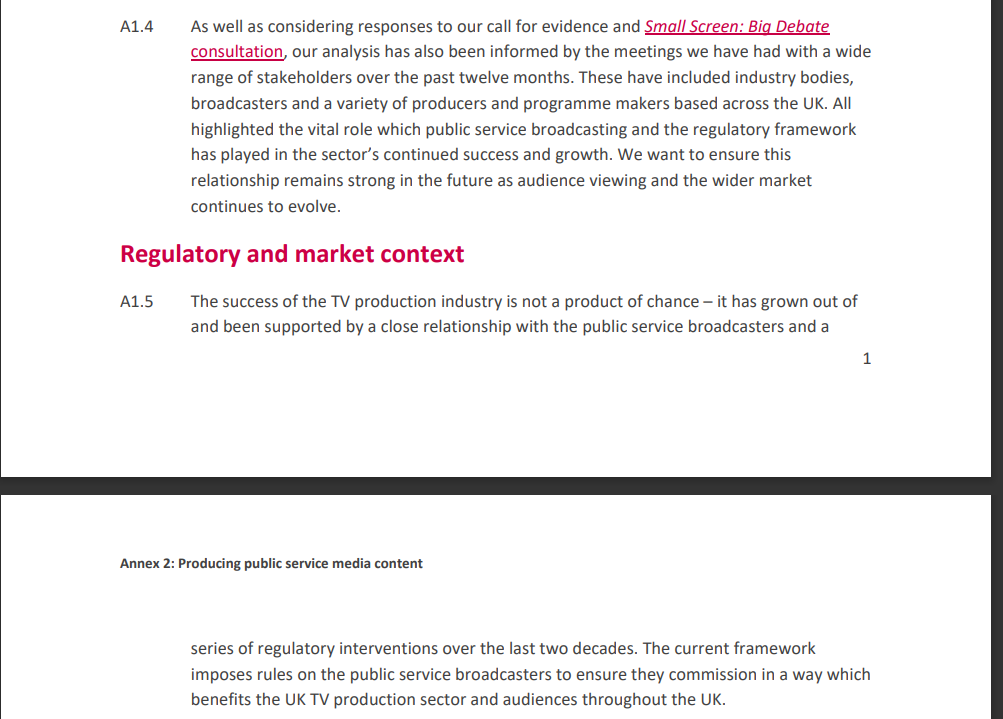
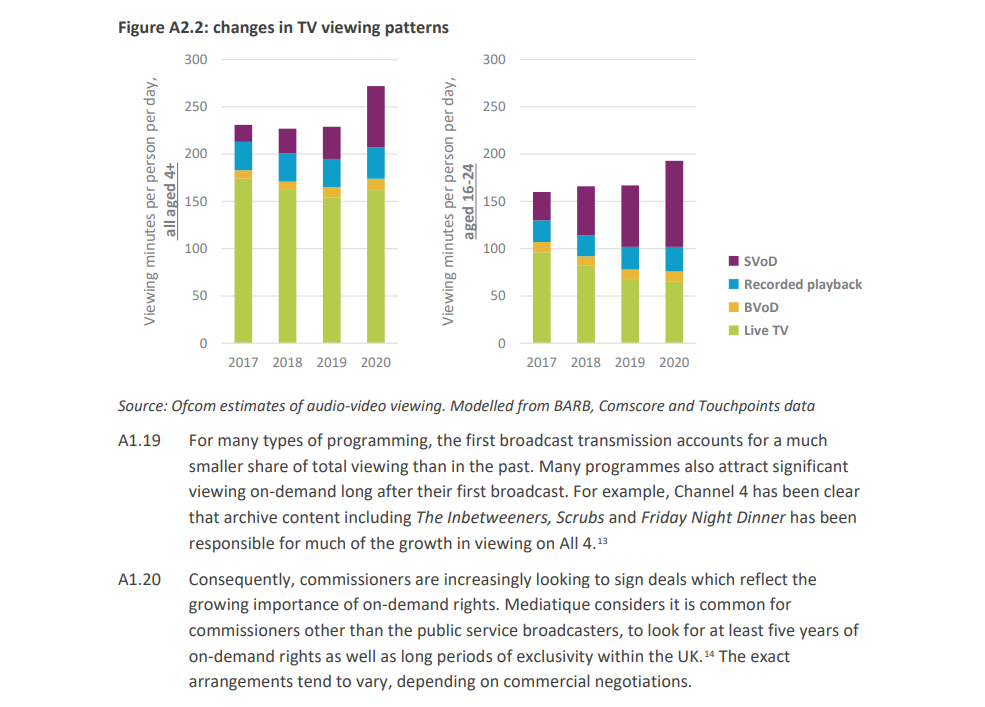
THE IMPACT OF TERMS OF TRADE ON THE UK's TELEVISION CONTENT PRODUCTION SECTOR
PRODUCING PUBLIC SERVICE MEDIA CONTENT
-
forum post
-
-
and simple connections @Chevdove you know media is a business but it is that raw sometimes. You got a friend connected or you don't. most don't right.
-
Tell Me: What's Wrong With This Story And Picture?
richardmurray replied to Pioneer1's topic in Culture, Race & Economy
@ProfD I quote myself when did I say that biological race didn't exist or that humans shared the same biological race with the killer whale? -
@Pioneer1 functional too, looking at the films inspired you most, they have many discrepancies with uptight in story in production
-
Tell Me: What's Wrong With This Story And Picture?
richardmurray replied to Pioneer1's topic in Culture, Race & Economy
@Troy In my reply I quoted researchers at oxford who clearly stated genes are behind appearance, in particular melanin production. So why can't melanin production be used to dictate phenotypical race? But I do comprehend the problem. You and others seem to think phenotypical race is or can be substituted for biological race. Again, each type of race has rules. Gender race <male/female/hermaphrodite>isn't based on the air. it is based on sexual organs within members of the same species. biological race<human/cro magnon/bluejay/tigershark/fern> isn't based on the sea. it is based on the variance of the dna molecule between species. phenotypical race<black/white> isn't based on the stars, it is based on appearance which is derived from elements of the dna sequence... between members of the same species. Linguistic race<anglo/latin/sino/bantu> isn't based on fire. it is based on the language someone speaks most effectively. Geographic race < african/european/asian> isn't based on the sun. It is based on the geography of where one's ancestry comes from. You and others seem to think, very erroneously, that discussion or concepts around phenotypical race can justify or prove that members of the same species are not members of the same species. Who told you that? Yes , white europeans have tried to use and still try to use and do legalize to suggest or had laws stop that suggest phenotypical race or geographic race can can lead to a determination of a different species for humans with an appearance other than white or a geographic root other than european. But, that is merely a false conclusion that they used their military power to instill. But that doesn't mean that any two members of the same species are the same. They are not. Similar? yes. Identical or essentially identical or near identical? 100% no. I want to say , I will always refute 100% that genetics makes any two members of the same species essentially identical or near identical or functionally identical or identical. My comprehension of chemistry or biology or cellular activity or the delicacy that is biocellular activity does not allow for such a position to be deemed true. -
Tell Me: What's Wrong With This Story And Picture?
richardmurray replied to Pioneer1's topic in Culture, Race & Economy
@Troy I will provide my attempt at an answer to your question. But I want you to answer mine first. Here is my preface to my question. Race comes in many forms. Two forms are gender + phenotype <appearance> Now in my life many, not most or all, black people in my offline life, have spoken as you and said: Phenotypical race can't be proven. But I don't even comprehend that statement. Gender race is based on the same system that phenotypical race is. The biomolecular system in living organisms, based on cells working with DNA + RNA. Your brain, your phenotype <what you call race> your gender all based on said system. What needs to be proven? Now, Phenotypical race doesn't suggest a leap outside of a species. In my attempt to comprehend, maybe you side other blacks seem to confuse phenotypical race as a pathway to an ahumanization, meaning a thing making something human outside humanity. But while I call myself Black and other humans white I don't think white people are inhuman. So I don't comprehend what you side other black people's real goal is. Do you want black people to stop calling themselves black, or white people to stop calling themselves white? Do you want to stop those, white or black, who want to use phenotype to suggest a species split? Do you want want human beings to stop being human, it is in human nature to love plus hate? I don't comprehend what you side black people who share your need to have some mythological grand proof of phenotypical race truly want. I admit ignorance. I don't get what you really want in the discourse, cause no study in the world to anything is faultless or perfect. Now to my attempt at an answer, but I must repeat beforehand, no study in the world to anything is without fair refute, it is the nature of philosophy or knowledge to have refute. That is why in arithmetic, every algorithm has the unknown constant, even when not written. Anyway, I quote, this is from the introduction but I took these statements specifically cause they refer to past studies not the study of the article. "Several genome-wide association studies for pigmentation have now been conducted and identified single nucleotide polymorphism (SNP) markers in known, TYR, TYRP1, OCA2, SLC45A2, SLC24A5, MC1R, ASIP, KITLG and previously unknown SLC24A4, IRF4, TPCN2, candidate genes. The contribution of SNP polymorphisms present in populations from South Asia have been tested and alleles found at TYR, SLC45A2 and SLC24A5 can largely account for differences between those of darkest and lightest skin reflectance using a simple additive model. Skin and hair colour associations in Europeans are found within a range of pigmentation gene alleles, whereas blue-brown eye colour can be explained by a single SNP proposed to regulate OCA2 expression. Functional testing of variant alleles has begun to connect phenotype correlations with biological differences. Variant MC1R alleles show direct correlations between the biochemical signalling properties of the encoded receptor and the red-hair fair skin pigmentation phenotype. Direct testing of a range of clonal melanocyte cultures derived from donor skin tissue characterized for three causal SNPs within SLC45A2, SLC24A5 and OCA2 has assessed their impact on melanin content and tyrosinase enzyme activity. From a culmination of genetic and functional studies, it is apparent that a number of genes impacting melanosome biogenesis or the melanin biosynthetic pathway are candidates to explain the diversity seen in human pigmentation." https://academic.oup.com/hmg/article/18/R1/R9/2901093 I read one of your questions to Pioneer. Based on how I define, Black, Mulatto, African American, Black American, DOS, I say the following. Please ask for my definition of said terms as they are not universally adopted. Barack Obama is Black, Mulattto, African American, Black American . He isn't a DOSer though. He is a DOW descended of the willing, meaning black people who willingly immigrated to the usa, which is the comparative label to DOSer in the black community in the usa. -
@Pioneer1 what movie has inspired you the most?
-
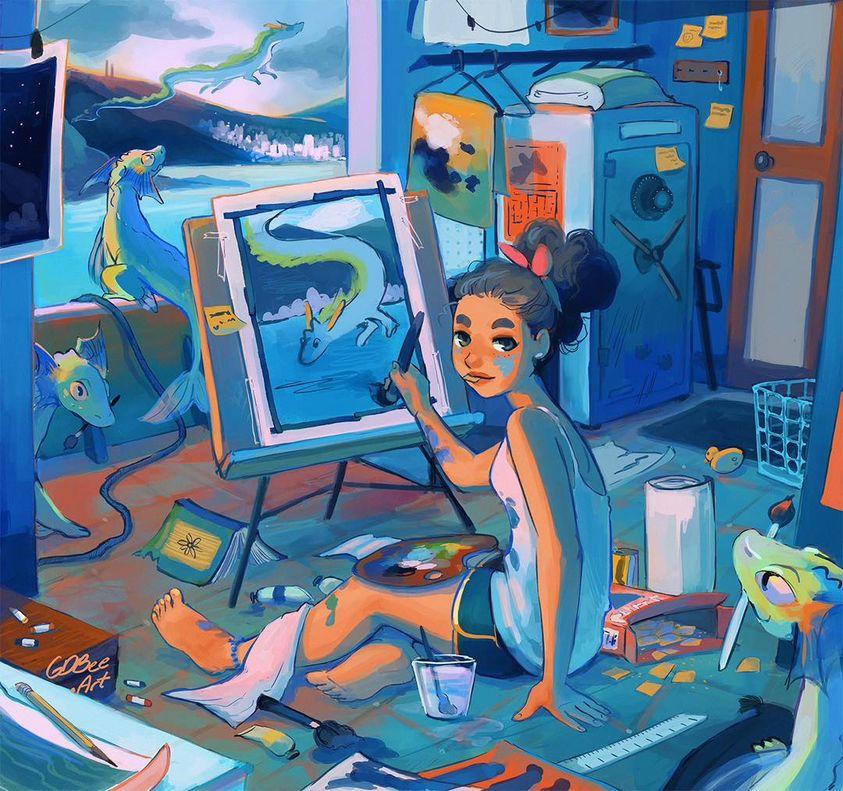
Title: Painter's Space
Artist: GDbee < https://gdbee.store/ >
Prior post
https://aalbc.com/tc/profile/6477-richardmurray/?status=2384&type=status
GDBee Post
https://aalbc.com/tc/search/?&q=gdbee&type=core_statuses_status&quick=1&author=richardmurray&search_and_or=or&sortby=newest -
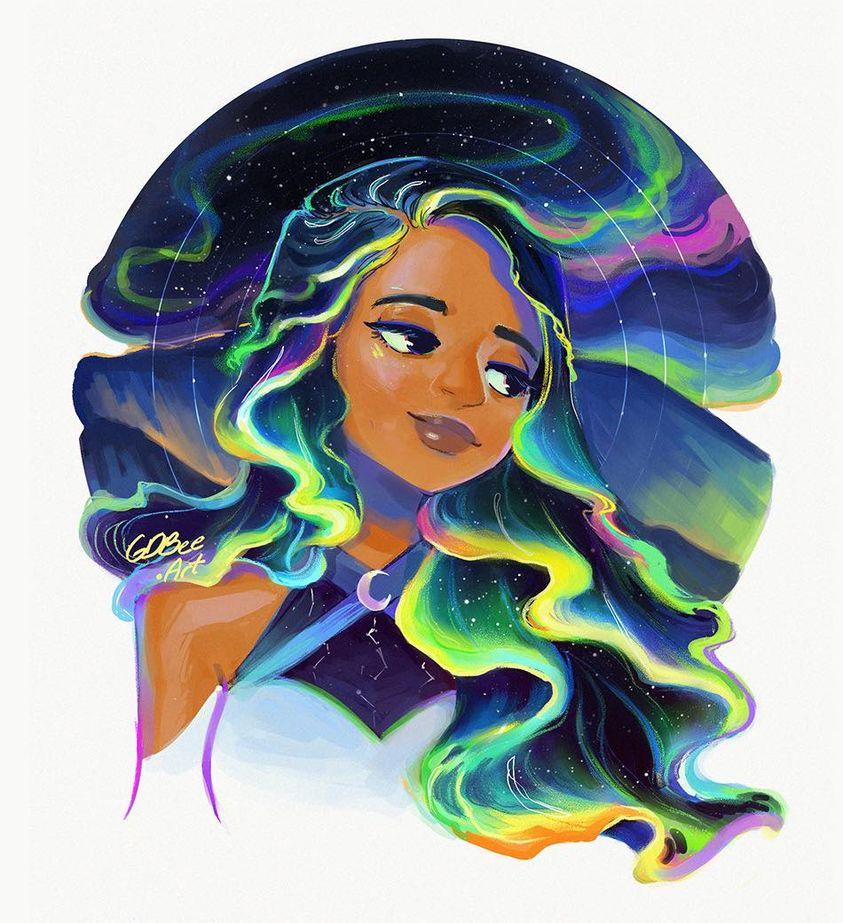
Title: Aurora Borealis hair
Artist: GDbee < https://gdbee.store/ >
Prior post
https://aalbc.com/tc/profile/6477-richardmurray/?status=2376&type=status
GDBee Post
https://aalbc.com/tc/search/?&q=gdbee&type=core_statuses_status&quick=1&author=richardmurray&search_and_or=or&sortby=newest