




richardmurray
Boycott Amazon
-
Joined
-
Last visited
Everything posted by richardmurray
-
The Designer Of The NES Dishes The Dirt On Nintendo's Early Days Masayuki Uemura demonstrates a Famicom at Nintendo's Kyoto headquarters on July 1, 1985. Photo: The Asahi Shimbun (Getty Images) By Matt Alt 7/07/20 5:00PM When discussing Nintendo’s rise as a digital dreamsmith in the ‘80s, game designers like Shigeru Miyamoto and Gunpei Yokoi get most of the limelight. But it was the hardware designed by Masayuki Uemura that served up their fantasies to millions around the globe. I spent 2019 criss-crossing Japan researching my book Pure Invention: How Japan’s Pop Culture Conquered the World, in search of the country’s architects of cool. In March of that year I came face-to-face with a true legend: Masayuki Uemura, the engineer who designed Nintendo’s first cartridge-based game system, the Family Computer, aka the Famicom, aka the Nintendo Entertainment System. With a design based on the arcade hardware that powered Donkey Kong, the Famicom quickly revolutionized home gaming in Japan when it was released in 1983. As the NES, it revitalized the home video game market in the United States after the Atari market crashed. From then on, it proceeded to deliver a steady stream of Japanese fantasies into the hearts and minds of people around the world. It’s hard to imagine a world today without Uemura’s machine. Masayuki Uemura joined Nintendo in 1972. Gunpei Yokoi, the inventor and toy designer whose products like the Ultra Hand had transformed Nintendo from a humble maker of hanafuda, Japanese playing cards, into a well-known toy and game company, recruited Uemura away from his previous employer, the electronics company Hayakawa Electric, known today as Sharp. Uemura retired from Nintendo in 2004, and currently serves as the director for the Center for Game Studies at Ritsumeikan University in Kyoto. The university’s leaf-covered Kinugasa campus is a quiet oasis in what is—or was, before COVID-19—a bustling and tourist-packed city. It is also a 10-minute walk from the ancient Zen rock garden of Ryoan-ji temple, whose evocatively arranged boulders and artfully raked gravel seem to me one of Japan’s earliest “virtual realities.” Departments that teach students how to make video games abound in higher education today, but the Ritsumeikan Center for Game Studies is one of only a handful of academic efforts specifically designed to preserve home video gaming equipment and ephemera. Its archives contain everything from early home versions of Pong to the latest consoles, every controller variation under the sun, and an ever-expanding library of software on tapes, cartridges, and discs. The packed shelves of its climate-controlled storage facility look like something out of a kid’s dream, organized with the obsessive rigor of the Library of Congress. The scent in the air is that paper from countless magazines and strategy guides, tinged with the nostalgic ozone smell of vintage electronics. Uemura was 75 years old at the time of our interview, but seemed much younger. A benefit of a life spent making playthings for the world? Whatever the case, there is no mistaking the amusement and restless curiosity in Uemura’s eyes as we sit down over a round of Famicom Donkey Kong to talk about the little beige and burgundy machine that touched so many lives. < Interview> Kotaku: What was Nintendo like when you joined the company? Masayuki Uemura: One of the things that surprised me when I moved from Sharp to Nintendo was that, while they didn’t have a development division, they had this kind of development warehouse full of toys, almost all of them American. Kotaku: What were your impressions of Nintendo’s former president Hiroshi Yamauchi, who ran the firm from 1949 to 2002? Uemura: He loved hanafuda and card games. I remember once, early on, a birthday party for an employee and he showed up and got right into hanafuda with everyone. He was a Kyotoite. It’s a city with a lot of long-running businesses, some maybe five or even six hundred years old. In the hierarchy of the city, traditional craftspeople rank at the top. Nintendo, as a purveyor of playthings like hanafuda or Western playing cards, originally ranked down at the very bottom. Doing business in that environment made him very open to new ventures. He wasn’t interested in specializing. He was keenly interested in new trends. Here’s an example of what I mean. In 1978, he bought around 10 tabletop versions of Space Invaders and placed them in headquarters and our factory. The idea was that we’d playtest them as a form of research. But what ended up happening was the entire company got so obsessed playing it that we couldn’t get a turn in. It was like a fever. Everyone abandoned their posts and stopped working. I was just bummed out that we hadn’t made it ourselves. Shocked and annoyed [laughs]. Kotaku: Did you feel behind the curve compared to other game companies back then? Uemura: In the 70s, we had no idea what was going on with companies like Namco or Atari because we were here in Kyoto. If you lived in Tokyo, you’d probably pick up lots of things about companies like Taito or Sega or Namco or even what was happening in America. But none of that filtered down to Kyoto at all. That’s Kyoto for you—a little standoffish, going its own way, and proud of it. To a certain degree, not even caring about the outside world. A little conservative when it comes to new things. When I worked for Sharp, I took many business trips to Tokyo. But when I started working for Nintendo, that completely stopped. It’s pretty shocking when I think back on it, but Kyoto has always been kind of closed off that way. So no, there wasn’t any sense of us being behind. Kotaku: I’ve heard that the atmosphere inside the company was very competitive, with a big rivalry between Nintendo’s two R&D divisions. Uemura: There wasn’t really any R&D 1 and 2! It was just Yokoi and Uemura. There wasn’t any rivalry! Yokoi found me and recruited me to Nintendo; he was my senpai. It was Yamauchi who set us up as rivals. It was symbolic, which is important in any corporate organization. That’s why he created R&D 1 and 2. Kotaku: How did the Famicom project come about? Uemura: It started with a phone call in 1981. President Yamauchi told me to make a video game system, one that could play games on cartridges. He always liked to call me after he’d had a few drinks, so I didn’t think much of it. I just said, “Sure thing, boss,” and hung up. It wasn’t until the next morning when he came up to me, sober, and said, “That thing we talked about—you’re on it?” that it hit me: He was serious. Kotaku: Were you influenced by other companies’ machines? Uemura: No. I mean, after I got the order I bought every single one, took them apart, analyzed them piece by piece. I looked at the chipsets, saw what CPUs they used, checked out the patents, all of it. That took about six months. Most of it I did myself, but I did have some help from outside resources, people who worked at semiconductor companies. I looked into Atari’s [2600] machine, of course—it was the biggest—and the Magnavox machine. Because those two were the biggest hits, and Atari’s biggest of all. Kotaku: How did you analyze rivals’ game consoles? Uemura: I had a semiconductor manufacturer dissolve the plastic covering on the chips to expose the wiring underneath. I took pictures, blew them up, and looked at the circuitry to understand it. I had some experience with arcade games, and right away I knew that none of what I was looking at would be any help in designing a new home system. They simply didn’t have expressive enough graphics. They had a monopoly on patents for them, circuit structures and features such as scrolling. And they were simply old-fashioned. That’s why I couldn’t use anything from them. Kotaku: Did America’s game industry crash scare you? Uemura: Japan didn’t really experience a video game industry crash like America did. What we had was an LCD game crash. They stopped selling at right around the same time—Christmas of 1983. Kotaku: In US the crash made the very concept of games taboo in the industry for a while. What about Japan? Uemura: In Japan, the issue was that toy stores didn’t know how to carry them. Toy stores didn’t carry televisions. So they didn’t see game systems as things they should carry, either. That’s why a lot of companies tried positioning their products as educational products, with keyboards, more like PCs than game systems. The thinking in the industry was that was the only way to go, back then. The only way to sell a video game was showing it on a screen, and it was a big ask of toy stores, making them purchase TVs. LCD games had their own screens; you could just put them out and they’d sell themselves. Kotaku: Is that why you chose to style the Famicom more like a toy? Uemura: It was less of a choice and more that this was the way it had to be. Kotaku: Why is that? Uemura: Because that was the cheapest way to do it [laughs]. The colors were based on a scarf Yamauchi liked. True story. There was also a product from a company called DX Antenna, a set-top TV antenna, that used the color scheme. I recall riding with Yamauchi on the Hanshin expressway outside of Osaka and seeing a billboard for it, and Yamauchi saying, “That’s it! Those are our colors!” Just like the scarf. We’d struggled with the color scheme. We knew what the shape would be, but couldn’t figure out what colors to make it. Then the DX Antenna’s colors decided it. So while it ended up looking very toy-like, that wasn’t the intent. The idea was making it stand out. Kotaku: And it did. Were you surprised when it became a societal phenomenon? Uemura: I didn’t have time to be surprised! When it really took off, I was totally focused on making the NES for the American market, and also on making the Disk System. I had my hands full. And we were swamped with defective returns. At first we had a very high percentage of defective machines being returned to us. We were just getting so many returns, far more than anything we’d ever seen before. That’s when I realized just how many people out there were playing with them; there hadn’t ever been a system this popular before. That was about the time Super Mario Bros. came out, 1985. Everyone in the company realized we were going to be swamped. Super Mario was fuel on the fire of the fad. Kotaku: Mario arguably became even more of a phenomenon than the Famicom itself. Uemura: Super Mario Bros. was the first to really bring a kawaii perspective to game characters. Actually, Donkey Kong was first to do it, in the arcades, and it established that unique sense of design. Until that point, most games followed the arcade style of shooting game design. Super Mario is often cited as the very first game to connect that style of cute character and cute music together. I’m not sure who specifically on Miyamoto’s team connected the dots, but that’s what happened. Probably Miyamoto himself. Kotaku: After Nintendo went from 3rd or 4th place to 1st in the ‘80s, was there a sense things changed, among people inside the company? Uemura: No! We’re in Kyoto [laughs]. Well, my salary went up. That’s a fact. So I was getting paid more, but the flip side was my job got a lot harder. President Yamauchi’s attitude played a big part in this, but my feeling was one of “seize the day.” Just go for it. You have to remember, there was a time, after Donkey Kong, that we really didn’t make another game for about two years. Well, not exactly, but pretty much. That’s the period Super Mario Bros. was being developed. That game basically ended up including everything and the kitchen sink, gameplay-wise. Kotaku: What led to the decision to export the Famicom abroad? Uemura: There’s a rule in the game industry that fads last for three years. That’s why President Yamauchi targeted America—to get around that. The prevailing sense at the time was that television games would fade into history as they were replaced by personal computers. So we were shocked that the fad kept going. It was Kudo-san, the president of a company named Hudson, one of the Famicom’s first licensees, who said to Yamauchi, “this is a culture.” Yamauchi was like, “What are you talking about?” Kotaku: Japanese games swept the globe starting in the late 70s: Space Invaders, Pac-Man, Donkey Kong. Why do you think this made-in-Japan culture resonated with people all over the world? Uemura: Actually, that’s what I want to ask you [laughs]. Super Mario Bros. isn’t set in Japan, but the character’s Japanese. The name Mario sounds Italian, but he isn’t Italian. They were really able to capture that ambiguity. The number of dots you could use to draw the characters was extremely limited, so Miyamoto was forced to use colors to differentiate them. He spent a lot of time working on the colors. In the end, it became the template for how a designer might express themselves through a game. It was a whole new world. Until video games became able to portray characters, they were nothing more than strategy games like shogi or chess. Once hardware developed to the point where you could actually draw characters, designers had to figure out what to make. Subconsciously they turned to things they’d absorbed from anime and manga. We were sort of blessed in the sense that foreigners hadn’t seen the things we were basing our ideas on. The Designer Of The NES Dishes The Dirt On Nintendo's Early Days (kotaku.com)
-
Hacking Nintendo Punch-Out To Control It With Actual Punches By Ian Charnas November 17th, 2021 I recently adopted a kitten I found on the street, and every morning we play with the laser pointer. She gets a lot of fun and exercise out of this single-pixel video game, and it got me thinking I should make a video game where I get exercise too! Fast forward 3 months and I’ve hacked a Nintendo Punch-Out boxing game so that you control it with actual punches instead of a controller. It gives you the feeling of actually being inside the video game! You can watch me build and test the game on my youtube video. VIDEO The hardest part of the project was hacking the game to slow the opponents. You see, punching into the air is much slower than pressing a button on a control pad. So, the opponents were moving too fast, relatively, and it wasn’t a fair fight. I had to reverse engineer the source code (a process called “disassembly”) and slow each opponent down one by one. The result is a very fun and playable game that you can try yourself — entirely in your browser — by visiting RealLifePunchout.com ARTICLE LINK https://makezine.com/2021/11/17/hacking-nintendo-punch-out-to-control-it-with-actual-punches/
-
You own a video game company. YOu have a round table for the games 5 years down the road. I say , The Wiz video game, what say you? Holly Wood Tonya is with Necole Collie and Rashad Muhammad Hasan. Ease on down the road. #blackfamilies https://aalbc.com/tc/profile/6477-richardmurray/?status=1671&type=status

-
Do you comprehend these two ideas in terms of programming or technology? By Oct 15th, consider below. Satellite A bluesky contest Our digital identities are like satellites we launch into cyberspace. You may link one to another here and there, but how would you link all of them, systematically, in a way that proves to others they belong to you? Let’s try an experiment: A contest to demonstrate how to link your accounts and content. $300 in BTC awarded to the top three submissions, to make it worth your time. Choose at least 3 of the following. Link them in a way that anyone can verify you are the author/owner of all. Explain how you did it, and what properties you were designing for. A Twitter account A Reddit account A website... or two A Matrix account A Mastodon account An SSB account A PGP key A piece of content on IPFS A cryptocurrency address Another decentralized social network Another service/platform of your choosing Have an answer in something that already exists? Feel free to use it, but describe how it works, the tradeoffs, and how it can be improved. Implement your solutions as much as possible. If you don’t want to actually link two of your accounts, create a new one for this purpose. Include any documentation or code needed to explain it. We’ll be scoring on a rubric of: thoroughness, robustness, originality, decentralization. Download the rubric and template here. Email solutions to join@blueskyweb.org. Multiple submissions allowed. We’ll keep a leaderboard up with pseudonyms of the authors who submitted the top solutions, so you can check if you’re on it. At the end of the contest, we’ll publish the top solutions and reveal their authors. End date: Oct 15. https://blueskyweb.org/satellite MORE INFORMATION Single Status Update from 10/02/2021 by richardmurray - AALBC.com’s Discussion Forums
-
BlockChain Protocol https://aalbc.com/tc/profile/6477-richardmurray/?status=1645&type=status
-
Caleb KRaft is a great maker, this is a video with examples on how to aid gamers with disabilities. The Controller Project This site is a place where you can find documentation on how to modify game controllers for people with physical disabilities. Most of my mods have been used for assistance muscular dystrophy, but the library is an ongoing process and people may find the modifications and accessories helpful for other physical needs. I will be adding other modifications from around the web as I find them. If you need a controller modified, or want to share a modification tutorial or 3d printable files, contact me at Hello(at)calebkraft.com http://thecontrollerproject.com/
-
How many black female gamers do you know personally? From Mergirl Dunne of Black Games Elite
-
What's up fam of BGE I was having a conversation early today with two young brothas talking bout video games..... One of these bros mentioned that he did not know one black female gamer. (Till he saw me rocking my RE2 GRAPHIC T-SHIRT) I'm like We are out there but unfortunately we don't get the same recognition as the bro's. 😔 My questions to BGE..... How many black female gamers do you know personally....And Why the exclusion From Mergirl Dunne of Black Games Elite BGE mewe page https://mewe.com/group/5f6a6b1e9bfa191d3a68cc0c/profile/5c3e37f67f857d550f1d9eea Mergirl Dunne Mewe page https://mewe.com/i/mergirlwhitedunne
-
With the industrial explosion of handheld gaming consoles in the year 2021, what does it mean the video gaming industry is missing? One thing all the entries in the assessment below have in common is all the games are already inside and all are circa 100$ to buy the basic version. The cheapest is 60 dollars usa. It was the 9th entry. And they all are trying to emulate games already made, not make new games with the same quality. Anbernic is sighted as the best. Rg351M is their best model in the description below. IT can play the old games, doesn't need to be adjusted when it comes out of the box. To me, it is clear, the handheld market is open to a high powered system with more ingenious games. These games play already developed games in a collage ... like having a bunch of old cars you are able to ride whenever you want. But, what about new games or ideas? I think space exists for new games new user interfaces in the handheld market. Phone games are still too limited or unfocused. A systems power is needed for higher level games. What are your thoughts? Video of the handheld retro gaming market assessment A small history for consoles Thanks again to MErgirl dunne of BlackGamesElite
-
Didn't know magnavox was bought out in 1974 , they were making versions of their game system until 1978. interesting. Didn't know coleco meant the conneticut leather company:) Photo information in 1977, magnavox/atari/coleco all USA based companies dominated the gaming market. A telling thing that all three corporations are gone. in 1982, Atari was the distanced leader, while three other usa based makers , mattel had joined, aside japan's nintendo were all equal as second. Atari is an interesting story. 1985, all the usa makers plans with their systems all were negative,in comparison to nintendo's vision. this is the key year. all four Atari/Coleco/Magnavox/MAttel needed to come together and make one system or at least rethink their strategy together as they are all based in the usa and are losing significantly to a non statian firm. 1987, when you look at Sega or NEC they came in as Nintendo had an unrivaled competitor. the usa firms for various reasons were mismanaged in their strategy or finance and wasn't competing and thus it opened the market for more japanese firms to get involved. 1992, this has been very helpful to see the industrial change. in 1992 by console sales, Atari was still the third biggest maker in the gaming industry... A firm based in NYC. Born in the west coast but by now, owned by a firm in nyc. 1994, when you look at the video gaming industry today and you realize that Magnavox/Coleco/Mattel/Atari ,all are usa based and all are losing to a group of japanese led firms in Nintendo/Sega/NEC and Sony starting that year, it says alot about industrial management. Why couldn't they come together to try something, something. wow! The owners quit on the idea didn't they? 1996, Nintendo/Sega/Sony all japanese dominate the video gaming market. Atari is still 4th. Hell, Atari join with NEC. I have real problem with the 4th biggest firm in a market , not having any sort of viable plan. 2002, microsoft came in, but I am looking at Atari/Coleco/Mattel/Magnavox/NEC , I don't recall Microfot involving them at all. 4 usa based firms, with properties, video game properties, Microsoft didn't think they warranted getting their properties or working with them or former engineers developers from their time. I even include NEC, why not. you are the last entry, coming real later. Consider that Microsoft was founded in 1975. So they were founded in an era when usa gaming companies was at the top. It took them a long time to want to join the video gaming industry? odd and explains with their lack of interest in aligning with older competitors the fact that they have not made a dollar on consoles. 2006 Sony accepted selling playstation three with a lose of 240 dollars per console, that is over half the price of the system. Very bad business model in my view. And I think sony has never stopped trying to make some high priced system be worth so much even the affordable buyer risks getting it 2019, a great lesson in industrial history here, thanks to MErgirl Dunne of Black Games ELite
-
thanks for the shout out @Troy I create illustrations @Delano you can see my deviantart at the following link https://www.deviantart.com/hddeviant
-
I can't recall any video games made from a movie mostly involving black people. A black film I define as a film which is produced or financed, written, directed, and mostly acted by black people. Every other film where black actors are mostly utilized is a non black film that mostly involves black people, ala Black PAnther. With definitions out of the way, will you want to see a Candy man video game? the way most black people love the horror genre, especially in the usa, plus the way most black gamers seem to love the horror video games, I think the candyman video game is... inevitable? thoughts? #blackgameselite
-
A video, take a look https://photos.app.goo.gl/XzverpLwzdMtXU69A
-
glad she is well:)
-
I will add, assuming absent knowledge to all comments, one key point; how many people discuss in their home ? We talk of discussions online; if you do not discuss in your home, offline, then will you want to discuss elsewhere? I doubt it. The passion to discuss must stem offline and in the statian contingent in modern humanity, human beings are reared with a computer as their sole companion whose structure is designed to reflect a slave, not an engaged companion
-
Dear Readers, I tend to enjoy reading various articles on writing , the industry, the concepts, et cetera. parallel to craft articles. These topics can be fun or engaging. As some of you know, I have a controlled electronic footprint, meaning, I don't keep old posts. This blog never had fifteen posts and never will cause I don't like ejunk. But, I realize, aside my posts to what I created and create, I need a post to just chit chat if you will. So this post will serve that function, through its comments I will posts various topics concerning writing. Work Cloud EBook List- see below , Onmyoji Contest Entry , Pacific Rim contest Entry , Bettering American Poetry Anthology Entry , White House Carol , Maple Me entry , We Happy Few Wellington Wells entry, Fiyah Magazine- , Killens Review-, Audiobook list , Concrete Fables Creative Cloud Questions to think about , How We Define Art a response , Lessons from Last Action Hero , Black Soldiers fighting for the British against the USA during USA secession why no memorial , Levar Burton Reads , Ethiopian apocalyptic film , Is Biography the biggest genre today circa 2018 , if they remade Cleopatra jones? , which cliche you dislike most? , Grammar Check , those who write love are making money, have you done a collaboration .. on a train , be your character on social media , who are afro latinos ? , a short history to the internet , What describe best the Native American experience in fiction , Get Out early - what do you think compared to the final film? , Prince and religious friction in film , Let us compose something together using these rules, what other language will you say if you can? , AALBC community book- in progress till made , not any time soon but... , A Glengarry Lead , silhouette in film , Get Out defined , inspiration listings, the return of poetry and some fun , written and sun by Aretha Franklin , Unconventional art , Der Tchrumpfs , Selections from poetry through the native female pen , a question to multiculturalism , Nonqonqo in A Warm December , Peola Edit- Immitation To Life 1934 , concealed carry models , Ann Gorman Edit- Follow Me Quietly 1949 , censoring online , MLKjr2019 , Black Party to governance , Star spangled why, Audio EXcerpts , False Civility , US , Glass submission story , code geass, Juju webseries official poster , acting , lee daniels workshop , black anti immigration , silent sundays , a positive child bride story? , a fictional character to be president of the usa? , Ta-Nehisi Coates , George Lucas , open marriage in fiction, kobo audiobook , Fiyah nanowrimo writing groups , Black Solidarity day 2019 , The Comeback Of Sexual Chocolate , no time to die poster content , Overdrive , lt uhura dollypartonchallenge , emoney, a day and most night at the uffizi , raprushmore , Malcolm 2020 , daylight savings time 382020 , the black fratrem , a saint patrick day past, heavymetal sixart challenge, startwithlove , to arbery from maurice jackson, from owner's choice to merit , FIYAHCON 1 , Flashfiction 7142020 , Radical Racer , 20th anniversary Deviantart , the ethics of lust , Sanctimony Literature , ? Calligraphy Mirror Kiss of a dagger , Angelique Noire , ? Anthology Sentences Breonna Taylor , ? Engineering Cloud Fixing Plastic , Blacksmithing Basics , multi electromagnetic wave observation , AMP in Email , Makers jobs or cosplay , ? Email Gazette Fragments fifth issue , tenth issue, eleventh issue , twelfth, thirteenth , fifteenth ,sixteenth, seventeenth ,eighteenth , 19/20/21/23 ,24/25/27/29/30/31/32 , 33/34/35/36/37 ,38/39/40/41/42/43 , 44/45/46/47/48/49/50/51/52/53/54 , 55/56/57/58/59/60/61 , 62/63/64/65/66 , 67/68/69/70, 71/72/73/74/75/76 , 77,78,79,80,81,82,83,84,85,86,87,88,89,90 , 91<->130 , ? Question Cloud The Internet without the USA, are marvel movies theme parks or cinema, joker of our times , the greatest native american warrior in film , is dr serikawa the special effect , isn't it time for a pro nazi german film, Ligt and Daenerys , liking online , what does joker 2 after the joker film with joaquim phoenix mean , when is a culture allowable , history book Kamala Harris side Corey Booker , who will be your fictional fertilizer , MLK jr. day 1202020 , what tropes are you tired of , still alive obstinate , What is the July 5th speech fo FRederick DOuglass ,Has the Black community in the usa repeated the mistake of the black soldiers of the 13 colonies throughout its existence in the usa, 9112020 , ? EBook LIST Richard Murray Short Story Collections Kobo Link OverDrive Link JIHI series Kobo Link Overdrive Link Poetry or More Audiobook link Kobo Link Visasiki Audiobook link Kobo Link Gospel of Joseph Kobo Link Overdrive Link Richard Murray Collages Kobo Link SanaTambo Versions Overdrive Link Kobo English Kobo Francais Kobo Portugues Kobo 日本語 Kobo 中文 Der Tchrumpfs Kobo Below is a collage i made to Ty Wilson Art Be Safe
-
My opinion as I read the essay Well modern media has created a pathway for individuals of the people, the polis, to relate to all, to create a rigid framework of morals, or rules or ethics, to anything. The article suggest correctly modern politicization isn't about governing or government, a thing that governs; it is about people making things of themselves, political. The author makes one mistake, the politics of ethics is not complicated to comprehend if you accept that ethics do not have a universally accepted form. Once you comprehend ethics are defined by each individual or group, then ethics by default is a subset of politics. Aesthetics , meaning what is perceived, is also a subset of politics. The author hits on the head, albeit with a geographic absence, when they describe the truth; modern humanity in the places where the internet is available, which is still not most humanity actually, , the readership is groomed by its communication to itself to have a very selfish sense of character. In an international communication hub, the people in it are learning to be more individual, not more communal, or tribal not integrated. I enjoyed this prose from the essay in brackets <Emma Cline’s The Girls, a gem of a sanctimony novel, is full of such shards: “Mothers glancing around for their children, moved by some feeling they couldn’t name. Women reaching for their boyfriend’s hands.” > I Quote the essay again in brackets <Later, Frances the communist avows that she “want[s] to destroy capitalism and consider[s] masculinity personally oppressive.” > That line to be fair proves the authors point. Anyone who has drifted online to the bright or loud places, if they dare read the comments, knows many people recite that thinking in so many words. I will not spoil the essay, but if you get to the point where Ligaya Mishan is quoted and you read a Dance of Dragons then think Shame^INF and then Cerci's smile in the arms of the mountain made some sort of zombie thing. The author of the article missed a chance to relate the history of self flagellation in the counter-reformation in Europe. Self-flagellation is a strong cultural element in European and by extension, European imperial culture. From baptisms that nearly or sometimes drown throughout the christian communities, to the remnant of impatience to black children in black parenting stemming from a time when black people were the auto child to whites, to the strength of arranged marriage among people who are labeled: educated, wealthy, modern, throughout latin america or asia <even though one's knowledge, finances,time of birth, or culture does not deny them the willingness to suffer in a marriage they didn't want> . So, the self cancellation is merely a current form of self flagellation. The nathan Goldman quote made me laugh. But I disagree with the word Juvenile being used by the author. Children have fought wars. Some children have a complexity of life that will make larvae out of the supposed mature intelligentsia. I don't think the issue is age, but scope. Simplicity is the goal, simplicity with a language of adult tweets woven tight around the face. His point on paradise lost is well done. To be blunt, I think an enlightening or at least exposing panel will be with many writers today discussing that book and its unapologetic glory for "a bad man" Reading the paragraphs concerning the need of the human individual to be present in fiction , for fiction to be valuable made me think of FLannery O'Connor whose work, by default is the opposite. I argue that the characters in her work, ask the writers or readership the author refer to face the magic mirror gate in Die unendliche Geschichte; most of them clearly running away screaming!, forgive me. The study of human communalism is not all that is written. I paraphrased the quote the author used of baldwin. I concur with the writer, the question of what if is interesting in literature. If what if does not exist but only of course exists in literature, then literature becomes purely commercial, like glowing vampires in the bright sunlight who have nothing to fear. I am reading Nella larsen but I can suggest, Alice Dunbar Nelson. In a number of her works, you gather the voice of the multiracial world in the black community in the usa, which is rarely emitted in most financed media. I recall reading that essay from Viet Than Nguyen , I thought and think him wrong, even on a monday. I like this line: In a better literature than the sanctimonists’, the frequent distance between our ideals and our practices would itself be the subject of interesting novels. I amend that novels where characters lives show the variance between how we want to act while how we act returns to the earlier point about being human. The author is being a little verbose. The author continues on restating points. He isn't preaching Trilling on a pulpit but he is now using more words to restate what he already described, the frustration is coming out. I comprehend the author's frustration. No one has quoted Richard Murray yet, to RIchard Murray's knowledge at least, but I recall asking questions in a writing group, and being excommunicado-ed for it. The questions, the what if, ask not only the readers but other writers to see where they may be uncomfortable. Writers , reared in modernity, not only want to covet the tribal audience but are in the coven of tribalist. And, it has created rifts in the literary creators community, which is not uncommon in history, but evident in the literature of a day. ... What say you? Article from the author https://libertiesjournal.com/now-showing/sanctimony-literature/
-
After VuaKal I find myself, at the end of my time, I have to come back to this project at a time I prescribed later in the year, though I am not publishing it. I am always open to work on this project but it will not be the main focus. Trying to get the audio work took three weeks to merely get it to work in my testing code, and the testing code has serious errors in checking the audio tools for the mass public to use or view. The tragedy is each of these games from a design level took minutes but acquiring the correct code to implement what was designed took longer than I liked, especially with VuaKal , near a month trying to get the correct code and I merely shoe horned a solution in the end. Though I admit I have an answer designed out.Hello to the late readers, Yes mind reading... In the year 2020, I said to myself, I will make a video game. It is not a hard task in all earnest. It is also not an easy task. The greatest challenge is... fun. Yes, the greatest challenge in making a video game is fun. When I was in college I made games few , excluding me, could master or have fun playing. I took the Will Wright masterclass on Video Game design. The best idea I garnered from it was the 365 game a day challenge. I thought to myself cool. But, I hit the snag I had in college. What is that snag you say?! I started on intricate, complicated games, absent an idea of fun. Who will have fun with the games I had begun developing. Then, 24 hours before this post was created, I realized I was making the same error, as in the past. So, I rebooted my structure. What if I went for simplicity. 365 simple games to test the waters, what people like. This will allow the BlackGamesElite group to engage better. At least I hope so:) ... Without further rambling, I introduce the MSinChe project. 365 games in 365 days. The goal of the project is to Engage the BlackGamesElite members on creating games ourselves Find out what games we actually like to design as a group or individually Create a code base for the future for the group to use Have fun! I will add a forum entry for the MSinChe project , but this post will hold the simple list of games per day. I hope all the members have fun and those not members, I hope are inspired to create. 1. KumRan playable link Comment link 2. NyoKuun Playable link Comment link 3. HazMin Playable Link 4. MoyoSaa Playable Link 5. VuaKal Playable Link 6. ?Play the game https://aalbc.com/tc/blogs/entry/273-moyosaa-of-the-msinche-series-the-heartbeats-game/ some screenshots of results https://aalbc.com/tc/topic/7215-msinche-photos-or-videos-of-being-played/?do=findComment&comment=43884These are my screenshots of playing MoyoSaa in testing phase, before I added some cosmetics. The first, I was unsure I determined to end the game The second, it sped up, definitely a timing issue for the next version How far I got in total!:) I wonder can any match me Have fun!


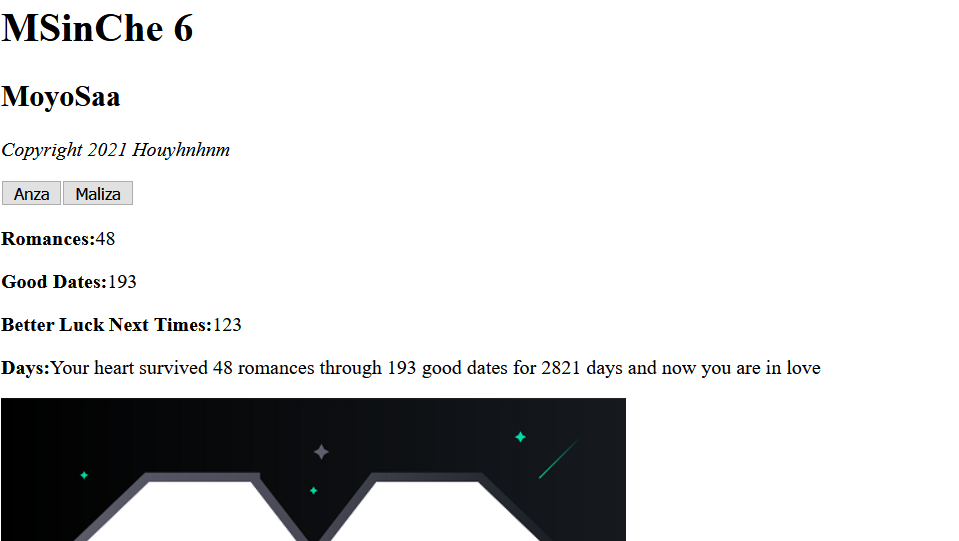 Click Anza to start the game, Maliza to end it. Listen to the music of Scott Joplin, the Ragtime dance, while you wait for the beats. A Red beat is a date so great it is valued twice. A green is a date that went well. A pink is a date that is going poorly. Click the red or green, don't click the pink, if you click anywhere inside the heart or outside the heart the game is over. Do you have the patience to wait for love? Is love always at the end of the journey? Play MoyoSaa! and find outThe third game is finished. I have to still work on errors in the array when the age goes above 3. I probably need to reduce the percentage of squares that go green, but I will check on that later. Onto the next game:)Have fun playing the game https://aalbc.com/tc/blogs/entry/272-hazmin-of-the-msinche-series-the-treasure-tower-series-remember-your-way-back-down/