




richardmurray
Boycott Amazon
-
Joined
-
Last visited
Everything posted by richardmurray
-
@Chevdove now during the march equinox, if you draw two lines from the center of the earth, one to the center of the sun and one to the angle of tilt going northward it will look like an L or right angle sign Now toward the june solstice, The L or right angle sign will become an obtuse angle till the most lean at the june solstice then the obtuse angle will go toward being an L to it is a right angle at the september equinox then from the september equinox the tilt will seem more acute till the december solstice when it is most acute and then it goes toward a right angle again , going to the march equinox when it is most acute. and on and on, remember it doesn't matter which one you start with. After the March Equinox is toward the June Solstice After the June Solstice is toward the September Equinox After the September Equinox is toward the December Solstice After the December Solstice is to the March Equinox After the March Equinox is to the June Solstice ...


-
@Chevdove I see, in a cycle the position stated first doesn't matter cause it has no start all four of the following are equivalent TOP -> september equinox ->december solstice -> march equinox-> june solstice->back to TOP TOP ->june solstice-> september equinox ->december solstice -> march equinox-> back to TOP TOP -> march equinox-> june solstice-> september equinox -> december solstice->back to TOP TOP ->december solstice -> march equinox-> june solstice-> september equinox -> back to TOP but use the following TOP -> march equinox-> june solstice-> september equinox -> december solstice->back to TOP so now do you comprehend the cycle? it does not end, after the december solstice is the march equinox and on and on for the life of the earth do you comprehend?
-
@Chevdove i have confused you the following is the cycle TOP ->december solstice -> march equinox-> june solstice-> september equinox -> back to TOP So before I go into the seasons starting do you comprehend the cycle?
-
@Pioneer1 right, a truly internally variant multiracial populace is by default harder to find a peaceful balance than one where most share most racial labels
-
Coming Soon April 13- Moon farthest from earth, at apogee 15- 1865 Abraham Lincoln was murdered Was his death the most potent in terms of how it changed the subtlety of the federal government? 16- Mercury Neptune conjunction 18- moon is closest to the south pole of earth , runs low Image The Great Original Character Snowfight MY LINKTREE https://aalbc.com/tc/clubs/page/2-rmworkposts/ RM WORK CALENDAR The Great Original Character Snowfight Cento series episode 99 https://aalbc.com/tc/events/5-rmworkcalendar/week/2025-04-12/ RM COMMUNITY CALENDAR https://aalbc.com/tc/events/7-rmcommunitycalendar/week/2025-04-12/

-
The Great Original Character Snowfight TGOCS 04/10/2025 I had a lot of fun making this collage of my own characters. I admit I learned alot about a work of this type. I didn't take into account the amount of time it will take for me to go back and check over my own work. The tedious but needed repititions is what kept me going longer. I admittedly was reviewing books and making other art simultaneously, outside of merely, living so more time was needed. But I truly enjoyed making this map of my own creations:) Tell me which of my characters do you like? Each relate to galleries specific to each character. The Great Original Character Snowfight TGOCS text listing https://www.deviantart.com/hddeviant/art/1181758432 Gallery better to see them all https://www.deviantart.com/hddeviant/gallery/96468098/tgocs-snowglobes Journal for ease of seeing each https://www.deviantart.com/hddeviant/journal/THE-GREAT-ORIGINAL-CHARACTER-SNOWFIGHT-1181771081 Commission info - to get a character of your own in this style. https://www.deviantart.com/hddeviant/commission/Your-Character-In-The-Following-Style-1715303 Status Post https://aalbc.com/tc/profile/6477-richardmurray/?status=2852&type=status IN AMENDMENT Canon concerning by Leonard Nimoy, which I think applies to all fantasy worlds. Canon is only important to certain people because they have to cling to their knowledge of the inutia, open your mind! be a star trek fan and open your mind and say, where does star trek want to take me now
-
@Chevdove hmmm well ok i see,well the tilt of the earth acts cyclically, to visualize on a line, one end is an extreme tilt, for example december solstice, and the other end is the other extreme, june solstice, at the middle is equinox, when you go from december to june it is the march equinox, from june to december it is the september equinox.
-
@Mel Hopkins thank you, I made the error i tell others not to make. what i meant by "universal equal rights" is a system that provides for global protection for each individual in humanity alongside provisions for welfare. The ancient egalitarianism you speak I know of but the use of technology in negative ways plus the growing complexity of humanity , what i will call the patriarchy, warrants said system to reach an egalitarianism that can exist alongside the modern and future greed. It isn't the only way , but is one way. yes, christianity as an engineered religion based on a jewish movement has many emphasis that are not from the commonly called ancient world. @Pioneer1 haha:)
-
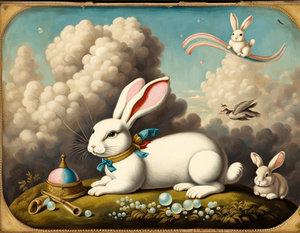
Coming Soon April 6- mercury appear stationary, retrograde 10- moon at equatorial plane; moon crossing north to the south of the ecliptic, the path of the sun in the sky; venus appear stationary in the sky, retrograde 12- full pink moon Image Cotton Candy Cloud Rabbit MY LINKTREE https://aalbc.com/tc/clubs/page/2-rmworkposts/ RM WORK CALENDAR Cotton Candy Cloud April Fool's Day Sudoo Cento series episode 98 https://aalbc.com/tc/events/5-rmworkcalendar/week/2025-04-05/ RM COMMUNITY CALENDAR is tribalism natural? https://aalbc.com/tc/events/7-rmcommunitycalendar/week/2025-04-05/
-
CENTO Series episode 101 I became a ghost of my former soul And I could no longer find peace within All these joys that lit my heart on fire https://www.deviantart.com/jcsolis-lit/art/The-Unclean-Man-Sonnet-1033194861 And to his dying breath carry our Standard. May no single man know true power, And despite ridicule and taunts, At the reward of understanding. These are worthy goals. To invoke the yolk, so that progress can be relished. Made only so by the Dead architect, So there upon the precipice https://www.deviantart.com/the-anariarch/art/Shadow-to-Light-1003569205 IN AMENDMENT Cento List - enjoy the poetry https://aalbc.com/tc/search/?q=cento&quick=1&type=calendar_event&nodes=5&updated_after=any&sortby=newest Enjoy the 2023 Centos https://www.kobo.com/us/en/ebook/richard-murray-centos-2023 Epub link https://www.kobo.com/us/en/ebook/poetry-or-more-1 Epub series https://www.kobo.com/us/en/series/richard-murray-short-story-collection Audiobook link https://www.kobo.com/us/en/audiobook/the-last-flail Audiobook series https://www.kobo.com/us/en/series/richard-murray-tip-jar-audios If you really want to follow what I am doing please subscribe to my calendars. I wish I would had used the calendar tool with all my work from the beginning. Like alot of the internet I didn't really think on it when I started, like with many I just started using. Why do we create linearly when a lot of times, what I have to say is repeats from yesteryear. Richard Murray's Work Calendar webcal://aalbc.com/tc/events/5-rmworkcalendar/download/?member=6477&key=9b0dbd4939faea9d5408174d9601d576 Richard Murray's Community Calendar webcal://aalbc.com/tc/events/7-rmcommunitycalendar/download/?member=6477&key=9b0dbd4939faea9d5408174d9601d576
-
CENTO Series episode 100 I can't stop from crying Eventually getting lost Looking for a place to belong https://www.deviantart.com/thecosmictraveler/art/Rolling-Stone-1028718844 You visit us at night You visit us at day This is it, this is my demise You burned my life away My dark and shining knight https://www.deviantart.com/3p1cfa1l/art/Plague-Doctor-Plague-Doctor-1028569268 IN AMENDMENT Cento List - enjoy the poetry https://aalbc.com/tc/search/?q=cento&quick=1&type=calendar_event&nodes=5&updated_after=any&sortby=newest Enjoy the 2023 Centos https://www.kobo.com/us/en/ebook/richard-murray-centos-2023 Epub link https://www.kobo.com/us/en/ebook/poetry-or-more-1 Epub series https://www.kobo.com/us/en/series/richard-murray-short-story-collection Audiobook link https://www.kobo.com/us/en/audiobook/the-last-flail Audiobook series https://www.kobo.com/us/en/series/richard-murray-tip-jar-audios If you really want to follow what I am doing please subscribe to my calendars. I wish I would had used the calendar tool with all my work from the beginning. Like alot of the internet I didn't really think on it when I started, like with many I just started using. Why do we create linearly when a lot of times, what I have to say is repeats from yesteryear. Richard Murray's Work Calendar webcal://aalbc.com/tc/events/5-rmworkcalendar/download/?member=6477&key=9b0dbd4939faea9d5408174d9601d576 Richard Murray's Community Calendar webcal://aalbc.com/tc/events/7-rmcommunitycalendar/download/?member=6477&key=9b0dbd4939faea9d5408174d9601d576
-
CENTO Series episode 99 Nothing is ever in balance To prove you are not dead Hell is close Heaven is near For that I now care https://www.deviantart.com/the-utopia-code/art/Heaven-and-Hell-1030669059 And when one Life is saved, We move on forth For they left all of their woes to the past How can we tell them it’s not yet the end… For then we wish to not live anymore https://www.deviantart.com/jcsolis-lit/art/How-to-Save-A-Life-Poem-1031193972 IN AMENDMENT Epub link https://www.kobo.com/us/en/ebook/poetry-or-more-1 Epub series https://www.kobo.com/us/en/series/richard-murray-short-story-collection Audiobook link https://www.kobo.com/us/en/audiobook/the-last-flail Audiobook series https://www.kobo.com/us/en/series/richard-murray-tip-jar-audios If you really want to follow what I am doing please subscribe to my calendars. I wish I would had used the calendar tool with all my work from the beginning. Like alot of the internet I didn't really think on it when I started, like with many I just started using. Why do we create linearly when a lot of times, what I have to say is repeats from yesteryear. Richard Murray's Work Calendar webcal://aalbc.com/tc/events/5-rmworkcalendar/download/?member=6477&key=9b0dbd4939faea9d5408174d9601d576 Richard Murray's Community Calendar webcal://aalbc.com/tc/events/7-rmcommunitycalendar/download/?member=6477&key=9b0dbd4939faea9d5408174d9601d576
-
CENTO Series episode 98 We are already there ! Far away, past seven seas, Isolated from reality https://www.deviantart.com/mybigwords/art/The-godforsaken-1029744310 Would You ever stop ? I fear I could turn into You... I feel the need to kill You ! https://www.deviantart.com/mybigwords/art/Kill-you-881249979 IN AMENDMENT Epub link https://www.kobo.com/us/en/ebook/poetry-or-more-1 Epub series https://www.kobo.com/us/en/series/richard-murray-short-story-collection Audiobook link https://www.kobo.com/us/en/audiobook/the-last-flail Audiobook series https://www.kobo.com/us/en/series/richard-murray-tip-jar-audios If you really want to follow what I am doing please subscribe to my calendars. I wish I would had used the calendar tool with all my work from the beginning. Like alot of the internet I didn't really think on it when I started, like with many I just started using. Why do we create linearly when a lot of times, what I have to say is repeats from yesteryear. Richard Murray's Work Calendar webcal://aalbc.com/tc/events/5-rmworkcalendar/download/?member=6477&key=9b0dbd4939faea9d5408174d9601d576 Richard Murray's Community Calendar webcal://aalbc.com/tc/events/7-rmcommunitycalendar/download/?member=6477&key=9b0dbd4939faea9d5408174d9601d576
-
@Pioneer1 I see your position. I comprehend it. All i will add now is one reminder, all countries in human history change as they gain or lose power through war, and while some changes are planned by the powerful in any country , some are not planned or wanted.
-
@Pioneer1 I will answer your questions, but i want to go back and say, you suggested black people, which i consider a global populace, is better off with the usa as the utmost. But my problem is most black people on earth do not live in the usa, so to assume the ascendency of another country wouldn't do better for most black people is unfounded. I am not saying I know the future, I am saying no one does. Now if you would say that the betterment to black people in the usa is conditional as you say based on the usa, then I am in full agreement. But to suggest that black people who are larger in number in multiple places outside the usa will all do worse with a fall of the usa can't be proven. It is assumption. Now to your questions Yeah but what are the Black folks in Brazil and the rest of Latin America DOING? In my opinion the same as the black folk in the usa or north america. most black folk in either region are simply the financial poor in a country dominated by a people who don't look like them with a black financial aristocracy in government/entertainment that don't lead the larger black populace. Do they have as much political and social power as us in their society? I say yes. You have to comprehend that phenoptyical race has a variance in history in brasil compared to the usa. Are they making as much money as us in their society? I think relatively yes, brasil doesn't make as much money as the usa, so I think and the existence of quilombos in brasil as compared to the gullah/geechee and similar folk in the usa is a balance. Do they have as much global influence as Black Americans? white brasilians don't have as much global influence as white statians. When I think about regga , capoeira, samba, and so much that has been influenced by black people of brasil . Your questions are about influence but wasn't the question the betterment of black people in humanity and I argue it is possible that most black people in humanity are better off absent the usa ap top.
-
@Lee and Low Books New Voices april 1st t june 30th Please pass this along, two and a half months to write+ illustrate a book for children. I ask any of you to go through my public gallery of written work and find anything you think interesting and tell me why https://www.deviantart.com/hddeviant/gallery/81311721/my-tales-or-poetry More details and all pertinent links New Voices Award 06/30/2025 - RMCommunityCalendar - African American Literature Book Club

-
ABOUT THE NEW VOICES AWARD from @Lee and Low Books Established in 2000, the New Voices Award is given biennially to an unpublished writer of color or Native/Indigenous writer for a picture book manuscript. Manuscripts may be FICTION, NON-FICTION, or POETRY for children ages 5 to 12. Manuscripts should address the needs of children of color or Native/Indigenous children by providing stories with which they can identify and relate, and which promote a greater understanding of one another. Themes relating to different family structures, gender identity, LGBTQ+ communities, or disabilities are also of interest. The submission period for entry will begin on April 1, 2025 at 12:01 a.m. Eastern Time and will end on June 30, 2025 at 11:59 p.m. Eastern Time. New Voices Award winners receive a standard publication contract, including Lee & Low Books’s basic royalties and an advance in the amount of $5,000. Winners are also given close publishing mentorship as they work to develop their first book for publication. Nurturing manuscripts takes time, and Lee & Low’s commitment to this contest represents over two decades of dedication. We ask for the same commitment and courtesy from applicants. Please make sure you are able to abide by the eligibility and manuscript submission guidelines before entering. I ASK FOR HELP DECIDING A STORY THAT I SHOULD USE AS AN INSPIRATION FROM THE FOLLOWING https://www.deviantart.com/hddeviant/gallery/81311721/my-tales-or-poetry AALBC COLLAB group @Dee Miller @Rosey Lee Thoughts? Contest Rules https://www.leeandlow.com/wp-content/uploads/2025/03/2025-New-Voices-contest-rules_updated3-10-25.pdf New Voices Award FAQ https://www.leeandlow.com/authors-illustrators/writing-contests/new-voices-award/new-voices-faqs/ Submission form https://forms.zohopublic.com/leelowbooks/form/NewVoicesSubmissionForm/formperma/skImqvLtrSEzWlRCEpt0CcbbOWXvNa6pw5XIUdwoti4 URL https://www.leeandlow.com/authors-illustrators/writing-contests/new-voices-award/ forum page https://aalbc.com/tc/topic/11565-new-voices-from-lee-and-low/
-
Pioneer asked Do you think was as AfroAmericans are actually "tribal" by nature or do you think this was instilled into our people by outside forces? MY ANSWER Boycott am*zon 3.1k Posted just now @Pioneer1 all humans are tribal by nature, the only question as you so well put it, is how are the lines drawn. @ProfD exactly , and I argue from the time of the Royals who were crowned first along the nile river, human populaces have always been complex , where an individuals associations are not simple one to ones 7 hours ago, ProfD said: Most tribes are formed the moment a man and woman decide to procreate and become a family. you make a hell of a point, it is religious history but, adam and eve was a tribe of two , i think that is one of the points of the story, that that wife and man is a tribe of two first and foremost:) @Mel Hopkins hahaha well done 10 hours ago, Mel Hopkins said: For example, my second cousin is married to a woman whose uncle is Eric Adams, the Mayor of New York. So, through marriage, one of my family/tribe members just escaped federal indictment because one member has ties with Donald. protection + procreation both played a historic role in clan membership, I think today some humans don't know or forget that the concept of universal equal rights, is not common and is relatively new in humanity. And is mandatory for individual rights to be expanded universally or to exist. as for procreation or lust, i think what is most interesting is how what is at the federal level in the usa deemed child marriages or adult vioaltion to a child still occur in some states in the usa / or throughout india/ or many other places today, 2025. Aside that, what is legally or culturally deemed incest in the usa, is done so commonly in many places in humanity, including in the usa, in 2025. And of course, prostitution happens so commonly so many places. Of the three I really think prostitution shouldn't be illegal anywhere anymore. Thought shall not kill makes sense as a moral law, a rule, cause most humans don't kill. yes in wars armies kill a lot or weapons of war kill, but most human beings don't kill anyone else their entire life, so killing being immoral, against a rule based on human activity, makes sense, but not prostitution, that is way too common in my opinion. URL FOR OFFICIAL LINK https://aalbc.com/tc/topic/11563-are-we-tribalistic-by-nature/#findComment-72580
-
@Pioneer1 all humans are tribal by nature, the only question as you so well put it, is how are the lines drawn. @ProfD exactly , and I argue from the time of the Royals who were crowned first along the nile river, human populaces have always been complex , where an individuals associations are not simple one to ones you make a hell of a point, it is religious history but, adam and eve was a tribe of two , i think that is one of the points of the story, that that wife and man is a tribe of two first and foremost:) @Mel Hopkins hahaha well done protection + procreation both played a historic role in clan membership, I think today some humans don't know or forget that the concept of universal equal rights, is not common and is relatively new in humanity. And is mandatory for individual rights to be expanded universally or to exist. as for procreation or lust, i think what is most interesting is how what is at the federal level in the usa deemed child marriages or adult vioaltion to a child still occur in some states in the usa / or throughout india/ or many other places today, 2025. Aside that, what is legally or culturally deemed incest in the usa, is done so commonly in many places in humanity, including in the usa, in 2025. And of course, prostitution happens so commonly so many places. Of the three I really think prostitution shouldn't be illegal anywhere anymore. Thought shall not kill makes sense as a moral law, a rule, cause most humans don't kill. yes in wars armies kill a lot or weapons of war kill, but most human beings don't kill anyone else their entire life, so killing being immoral, against a rule based on human activity, makes sense, but not prostitution, that is way too common in my opinion.
-
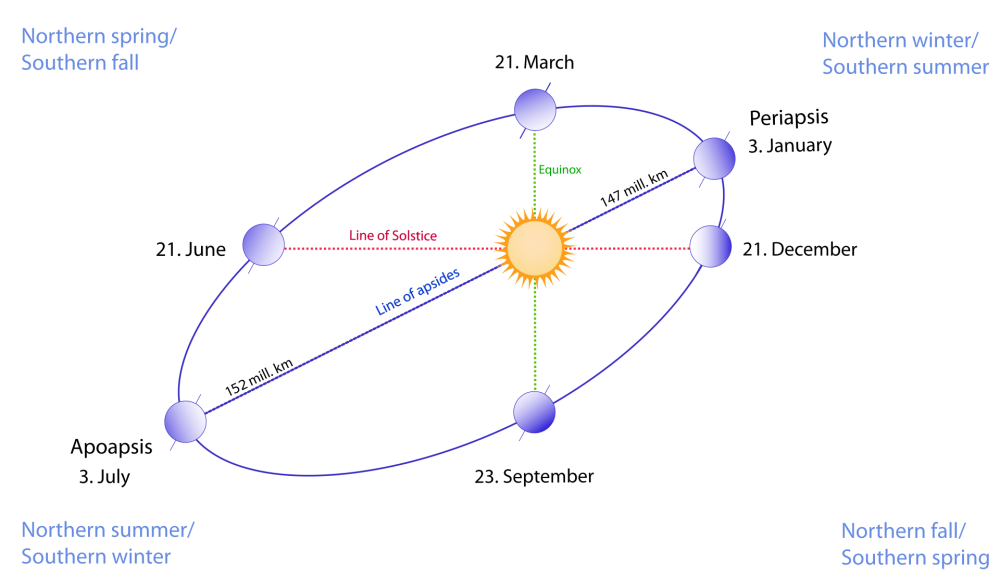
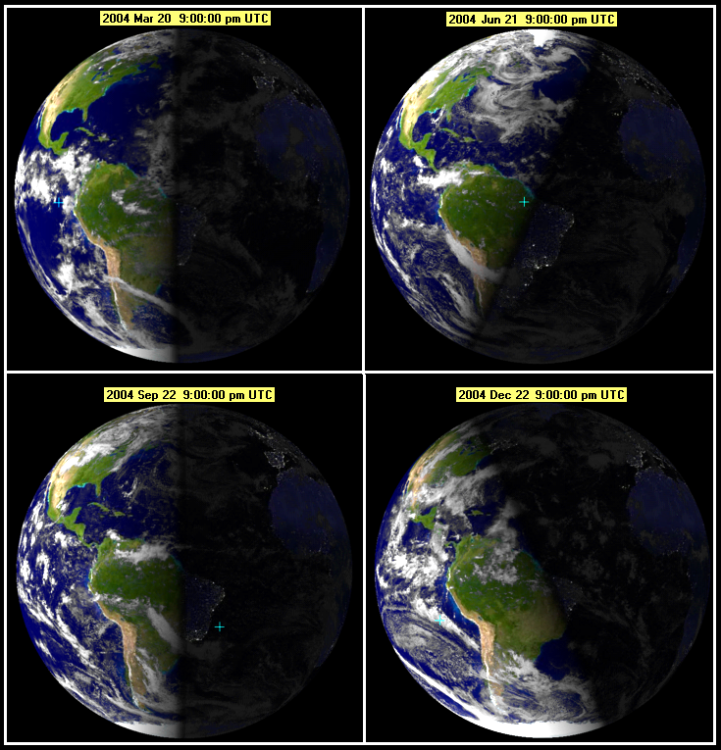
@Chevdove The key to the equinox or the solstice is the tilt of the earth. look at the dates in yellow. notice that in each image the side of the earth is similar but the angle of light is different. I have an experiment for you. Get a spinning top and a flashlight. Then at night outside, where it is dark, spin the top and place the flashlight where it spins and keep the flashlight still. At first the spinning top will be perpindicular but as it losses energy, it will tilt in various ways and that tilting is what the earth always does and you will see how the light of the flashlight off of the top changes based on the tilt. The key to the earth unlike the spin top is that the earth because of the sun's gravity, it's size, and the environment of space doesn't have a friction to slow it down like the spin top. Any more questions you can ask me the following graphic explains the perihelion and aphelion, in terms of distance to the sun @umbrarchist I want to know where are they now:) do their children or grandchildren know?:)
-
I am a Val Kilmer fan, while he had a wide array of roles in various genres that succeeded at box offices, my favorite two visual , not including voice work are the following Willow, many mention top gun or batman forever, but that is the movie. I remember Willow and yes, i flicked my fantasy blades in my mind once or twice. but the background of Willow is for me forever underrated. George Lucas had promised Warwick Davis he would star in a film and he delivered with Willow . Willow itself was meant to be Lord of The Rings in the original screenplay and was manipulated into the original Willow. But here is the thing, Val Kilmer playing Madmartigan was supposed to be Aragorn and when I think on that... Gavan O'Herlihy playing Airk Thaughbaer was supposed to be Borimer while Joanne Whalley as Sorsha was meant to be arwyn or aeowyn. But,while Willow was inspired by Lord of the Rings it is in truly a story unto itself. Like Krull which was started as Dungeons and Dragons and retains elements but really is its own thing with a fable storytelling way that is interesting, Willow retains elements of Lord of the Rings but really is its own thing with a world structured more honestly and less simply. well.. Kilmer's MAdmaritigan has the social width lacking in Aragorn. Marmartigan is just a guy, I think that is so underrated. Unlike Aragorn in Lord of the Rings who is descended from an ancient bloodline, and is over one hundred years old and looks thirty, Madmaritigan based on the words of himself side Airk is a peasant/swindler/carnivaler/theif who became a soldier , a foot soldier to decent reknown but got caught thiefing and rejecting his bound word and was exiled. He is just a very skilled swordsman. No land, no title, no background of note. I think it is more inspiring that than spoiled Aragorn who has been catered to his whole life while rejecting the duties of his bloodline. Willow is not sheltered from the negativity of the world while willing to leave his safety or peace of mind to help a total helpless stranger, not to have an adventure. Madmartigan meets Sorsha Madmartigan versus General Kael - yes he was meant to be the Nas Ghoul Willow's theme The Nelwyns are great, less naive or more circular than hobbits part 1 part 2 willow soundtrack, from james horner https://www.youtube.com/playlist?list=PLZ5jmAKbKFZ2NO1YA1mVlZhFlE4fS4aZD Mike Clark in USA Today wrote that "The film is probably too much for young children and possibly too much of the same for cynics. But any 6–13-year-old who sees this may be bitten by the ’movie bug’ for life." [Hearn, p.156-157] The Seal Son from Kilmer's Batman Forever and I can't leave without Doc Holiday vs Johnny Ringo from Tombstone- Val Kilmer vs Sean Bean- bill paxton is in the scene- playing brilliantly, billy zane, nice set of actors
-
Sudoo https://www.deviantart.com/hddeviant/art/Sudoo-1177858677 IN AMENDMENT Curse of immortality vocal essay from Jess of the Shire- transcript or video after that is THE ISLAND OF THE IMMORTALS of URSALA K LEGUIN Curse of immortality vocal essay from Jess of the Shire video https://www.youtube.com/watch?v=zVL1P2_lavc My Reply to the Video so anne rice vampires are of house dorian grey? wowbagger:) is hilarious nice comparison of immortalities Tolkiens- spiritual knowledgeable immortality, all things are known and those who don't are others, even living aside them Rice's- invaluable immortality, the rare few find value in it Herbert's- immortality prisons, leto jailbroke it LEguins- natural immortality , weathering is immortal hmmm favorite immortals in fiction hmmm I think Mr. Bloom in the remake of Kick the can, George CLayton Johnson wrote the original kick the can in the original show and it had elders , led by one elder who holding on to fun or life took a simple can kids were playing with and got the other elders to play kick the can and escaped the prison/old folks home, leaving the one elder who didn't want to play alone, with the can, a living death , as the other elder are eternal children playing in the parks/forest/green spaces of the world, uncatchable by the old folks home agents. In the remake, Mr Bloom, who already is in the old folks home , arrived at some unstated time, enjoys his time in the old folks home simply, as one of the crew, but after a discussion on games occurs, he organizes a game of kick the can all but one elder plays, and as in the original, the elders who play turn into children and play but Mr Bloom doesn't. One of the elders ask, why don't you turn into a child , and Mr. BLooms answer I will never forget. I learned a long time ago, that I wanted to stay my own age in my own body. and as the other elders continue to play , they start to realize what being young would mean. all the things in their life they weren't ready to deal with again "I have to go to school again!" or deal with for the first "we will just to our son's house and say murray, its your parents" and so all the elders save one decide to return to elders, as Mr. Bloom asked one, do you want to see the comet at eight or eighty and an elder replies, eighty. Mr Bloom tells them, to keep a fresh young mind. And they chant it like a prayer or hymn or mental training, fresh young mind. back in thier rooms, the old folks home guards find them but they are all back to their old selves but one. The one who has stayed a child, mr agee with a kind of silver technicolor light, the elder who didn't play recognizes, and they sadly depart as the elder who didn't play hears his oldest friend , an immortal youth among the parks/forest/green spaces yell, it is young being young again. And the next day, all the remaining elders who played are active or busy, doing, not sitting, not waiting to die, not dwelling on a routine made for them. the one who didn't play is now playing kick the can alone with a smile on his face. And Mr Bloom sees all of this "he'll get it" and then we end with Mr BLoom going on to another old folks home. It is interesting for me as a writer, George Clayton Johnson, got to rewrite a story he had written as a younger person. I ponder what stories I will change on rewrite when my hair is bone white. How perspectives of an artist can change. He went from immortality being strictly to those elder to become immortal child free spirits, to now one singular immortal who travels as an elder by their own choice who offers elders a chance to see/find the happiness in their mortal life even with full acknowledgement it has less time left, or happiness as an immortal child free spirit and offers both paths effortlessly Mr. Bloom is an immortal who has discovered powers to control his very interface to the mortal while purpose in an immortal life in guiding the mortal elderly to enjoy their existence more. Transcript 0:00 for as long as humans have lived we have on some conscious or unconscious level 0:06 feared death and tradition dictates that some might respond to that fear by 0:11 trying to escape it by seeking immortality from the philosophers stone to the fountain of youth seeking 0:17 immortality has been the quest of many a hero but what happens once they achieve 0:23 that quest how does a mortal bear the burden of immortality and questions like 0:29 this tend to only ask a whole lot more questions we wonder what would become of 0:34 a race that couldn't rely on the certainty of death we wonder what would become of a mortal human mind trapped in 0:42 a timeless body what could drive someone to choose the path of immortality and 0:48 perhaps the most important question if we are no longer mortal can we still 0:54 call ourselves human today we're talking about elves vampires worms and so much 1:00 more so that we can try and explore these questions after all in the immortal words of Queen who wants to 1:08 live forever i think that it will surprise absolutely no one to find out that we're going to be starting with the 1:13 Lord of the Rings and that's not just because this is largely a Tolken themed 1:19 channel it's also because Tolken's elves are very unique in that they are an 1:24 entire race born into a very particular kind of immortality you see although 1:30 they are functionally immortal technically it is only the souls of elves that cannot die and their spirits 1:37 are bound to the physical creation of Arda this means that when one of them dies their soul leaves their body and it 1:44 is either re-mbodied or reincarnated or it just drifts either way it will 1:51 continue to be in existence in physical existence until physical creation itself 1:58 comes crashing down until the world ends this is a sharp contrast to the second 2:04 born of God who is named Illuvatar mankind when humans die their souls do 2:11 not linger but rather fly out of Arda out of physical creation to an unknown 2:18 place to await an unknown fate and to men this unknowingness is terrifying 2:26 they long for the immortality that the elves have to so easily be able to 2:31 escape death and they really struggle to see their mortality as the gift that it 2:37 was originally intended to be but that jealousy is understandable with their 2:42 prolonged lifetimes the elves have been able to become masters of any craft that 2:48 they take on they are wise learned aware of the immediacy and importance of the 2:55 past in a way that humans just never could be but this also means that to 3:00 them time looks very different as the elf legal explains nay time does not t 3:08 he said but change and growth is not in all things and places alike for elves 3:14 the world moves and it moves both very swift and very slow swift because they 3:20 change little and all else fleets by it is a grief to them slow because they 3:26 need not count the running years not for themselves the passing seasons are but ripples ever repeated in the long long 3:34 stream this timelessness has left them with a profound sense of foroding they 3:41 know that no secret destiny awaits them there are no surprises they can depend 3:46 on their future but they know that their future holds eventual nothingness tolken 3:53 explains "The Elvish weakness is in these terms naturally to regret the past 3:59 and to become unwilling to face change as if a man were to hate a very long 4:04 book still going on and wish to settle down in a favorite chapter in a perfect 4:10 world the fixed perfection of Elven Living would be a blessing but this is 4:16 not a perfect world it's a world marred by sin by war by the eventual death of 4:23 everyone outside of their race their only respbit is to eventually pass out 4:29 of Middle Earth over the sea and into the timeless land of Valinor a place 4:35 that is as evergreen and unchanging as the elves this heavenly stasis is a 4:42 comfort to them but it's nothing compared to the bright excitement and 4:48 uncertainty and freedom granted to men by the gift of Ovatar their beautiful 4:54 lives come with one great big inescapable expiration date and I think 5:00 it's hard for any of us to say whether if we were given the choice whether we would choose blissful stagnation or 5:07 unsettled freedom there are actually a few characters in Tolken's larger 5:12 legendarium that are put face to face with this choice and one of the most notable is Baron and Lucian the tale 5:20 tells of Lucian an immortal elf and Baron a mortal man who fall in love and 5:26 are forced to face mortality face to face in their adventures Baron is killed 5:33 and Lucenne is so distressed that her soul leaves her body and flies out after 5:39 him although she is immortal she dies prompted by the connection of their love 5:45 Baron's soul lingers in the halls of death while Lucian stands before the 5:50 gods and makes her final plea for Baron's soul the sorrow of her tale is 5:56 so profound so deeply felt that the gods give her a choice they will take her 6:02 sorrow away and she can pass into unchanging Valinor or she and Baron will 6:07 be returned to Middle Earth as mortals to live for a time together and die 6:13 together their souls passing hand in hand into the unknown lucian chooses 6:20 mortality on the face this seems like an inconceivable decision who if born with 6:26 it would be willing to give up immortality to give up endless bliss but 6:32 for Lucian she would rather live one chaotic mortal life than to have to 6:38 endure all of the ages of the world in solitude this choice is later faced 6:45 again by Arwin Lucian's descendant as a half- elf she's granted a choice when 6:51 her father Eland leaves for Valinor Arwin may go with him or she may stay 6:58 this choice is complicated by Aragorn a mortal man who sees Arwin and instantly 7:05 knows that she is his soulmate eland explains her plight that she may very 7:11 well leave with him to be immortal in Valinor forever but Aragorn is undeterred his heart has been set arwin 7:19 falls in love with Aragorn as well and it is this love that drives her to 7:24 sacrifice her immortality and die by his side she tells him "There is now no ship 7:31 that would bear me hence and I must indeed abide the doom of men whether I will or nil the loss and the silence but 7:40 I say to you king of the Num Manorans not till now have I understood the tale of your people and their fall as wicked 7:48 fools I scorned them but I pity them at last for if this is indeed as the Eldar 7:54 say the gift of the one to men it is bitter to receive arwin having 8:01 experienced both the promise of life eternal and the painful reality of 8:07 mortality understands the difficulty of this decision more than most and 8:12 compared to Lucenne where her story kind of fades to black as soon as she makes that choice we see how much Arwin 8:20 struggles with this decision uncertainty is painful and she just doesn't know 8:25 what's going to become of her soul and in the end when Aragorn grows old and 8:31 dies Arwin fades away surrendering her spirit to the halls of Mandos facing a 8:37 fate unknown at Aragorn's side in a letter Tolken admitted "The real theme 8:43 of the Lord of the Rings for me is about something much more permanent and difficult death and immortality the 8:51 mystery of the love of the world in the hearts of a race doomed to leave and seemingly lose it the anguish in the 8:58 hearts of a race doomed not to leave it until its whole evil aroused story is 9:04 complete neither mortality nor immortality carry the secret to life in 9:10 Tolken's world and I think that seems fitting after all I I'm pretty sure that 9:16 most of us have also been blessed with the gift of a Louis Vuitar we've been left with the the painful uncertainty 9:24 and the freedom that comes with not knowing how or when or where we're going 9:30 to die not knowing what is going to become of our souls after we are gone 9:36 but by presenting us with the alternative of Elvish immortality I do 9:41 believe that Tolken was trying to comfort us of course elves are immortal 9:46 and beautiful they're so much more wise and powerful than we ever could be 9:53 they've had entire lifetimes to perfect the crafts that they perform and yet 9:58 there are still some of them that are able to be swayed some that have tasted 10:03 the beauty of this immortality and still choose mortality and while it may not 10:10 cure our fear of death Tolken urges us to see the promise of death and the 10:16 freedom that may come with it not as a curse but as a gift and you know what 10:22 would also make a great gift and actually what would be almost as longlasting and beautiful as the 10:27 lifetime of the elves the posters from this video's sponsor Displate displate 10:33 makes unique durable metal posters that are designed to capture all of your interests and passions they have over 10:40 two million designs to choose from in the Displate catalog everything from new and original art to officially licensed 10:48 designs from your favorite fandoms like Star Wars Marvel The Witcher and of course The Lord of the Rings confession 10:55 time i actually did not have any of the Middleear maps hanging on my walls as 11:00 art before this but now I have these two 11:05 absolute beauties to hang up above my TV i also got this giant one to sit in my 11:11 dune corner and it looks absolutely beautiful in the space and it's way more sturdy than the flimsy little paper one 11:18 that I had taped to the wall previously it is so easy to set these things up they come with a tool-free magnet-based 11:25 mounting system and as someone who has tried a lot of techniques to get posters to hang up you know sticky strips tacks 11:32 nails tape you name it I've tried it this is by far the easiest and most 11:38 efficient way to do it plus it doesn't damage your walls at all which is great if you're renting even better Displate 11:44 shipping is super fast so these make a great emergency gift for that very special nerd in your life displate's 11:50 latest edition is their textra products that have a texture and it really makes 11:56 the details pop my Middleear map is actually a texture one and I don't know 12:01 if you can see that on the camera but it really makes the details pop and the light catches it in an interesting way 12:07 that you just don't see in paper posters go ahead and check them out through the link down there in my description and if 12:14 you go and order there right now or over the next couple of days you can get 25% 12:19 off your order of one to two disc plates or if you order three disc plates you can get 30% off that deal only lasts for 12:28 the next couple of days so definitely go and check that out now again the link is right down there in the description and 12:34 thank you so much to Displate for sponsoring this video and supporting the channel the elves whilst being a 12:41 beautiful portrayal of timeless life are somewhat unique in that they are a race 12:46 born into and intended for immortality but what happens when you take someone 12:52 who is meant to be mortal and make them immortal well Tolken gives us an idea of 12:59 what that might look like in the character of Bilbo whose life was unnaturally extended by the influence of 13:06 the ring bilbo explains i am old Gandalf i don't look it but I am beginning to 13:13 feel it in my heart of hearts well preserved indeed he snorted why i feel 13:19 all thin sort of stretched if you know what I mean like butter that has been 13:24 scraped over too much bread that can't be right i need a change or something 13:30 fortunately for Bilbo though his regular lifespan was able to resume after he gave up the ring but what about those 13:38 characters who aren't able to give it up what about the characters that are coerced into immortality that seems like 13:44 it's going to last forever the vampires of Anra's Vampire Chronicles are one of 13:52 my favorite examples of the angsty immortal i want to issue a quick warning 13:57 that there will be spoilers ahead for the first interview with the vampire book and hints towards the vampire list 14:04 but nothing serious and that also means that the first two seasons of the show will be completely spoiled you can go 14:10 ahead and skip to this timestamp right here if you want to avoid all spoilers of all of Van Rice's many very angsty 14:18 vampires the cream of the crop is the protagonist of the first book Louie 14:24 Deuontulak life has made Louie grim and pessimistic even before he became a 14:30 vampire and I would argue that that's probably one of the things that drew Lestat to him louie was frustrated by 14:38 the injustices he saw bitter towards death and he had a sharpedged desire to 14:44 find something anything that could make life worth living in sweeps the vampire 14:51 Lestat de Leonor promising Louie that through the dark gift of vampirism he 14:56 may experience a life without fear without regret without the looming presence of death in the book Louis's 15:04 transformation scene into being a vampire is a little bit rushed but in my 15:09 opinion the show elaborates this scene beautifully lestat is offering Louis 15:14 vampirism as a cure for the lifetime of pain that he's endured be my 15:23 compion be all the beautiful things you are and be them without 15:32 apology for all eternity with the dark gift Louie wouldn't need to fear the 15:38 society that had hemmed him in the racism the homophobia the unfairness the 15:44 cruelty as the apex predator Louieie could make whatever life he wanted to 15:50 live but once changed Louie unfortunately discovers that vampirism 15:56 was not the solution to all of his problems his underlying issues his misanthropy his depression his 16:03 self-loathing they've gone nowhere and he is no better equipped to handle them in fact the idea of immortality the idea 16:12 that he has to keep living the life that he is currently stuck in for the rest of 16:17 time becomes torturous for him lat tries to remedy this the only way that he 16:22 knows how introducing Lousie to his rather lazair attitude and philosophy 16:28 teaching him the joy of the kill the joy of debauchery but Louie is not like 16:33 Lasat he's trying desperately to cling to some semblance of human morality but 16:40 that just makes things worse how can you live a good life when you are consciously performing acts of evil 16:47 lestat and Louie try to bring themselves back to life by turning a girl named Claudia into a vampire and treating her 16:55 as a daughter and for a time this seems to soothe them louiesie takes on the 17:00 role of fatherhood and he's trying to foster within Claudia the spark of joy 17:06 that he himself does not have and all this time I was educating Claudia 17:12 whispering in her tiny seashell ear that our eternal life was useless to us if we 17:17 did not see the beauty around us the creation of mortals everywhere i was 17:23 constantly sounding the depth of her still gaze as she took the books I gave her whispered the poetry I taught her 17:30 and played with a light but confident touch her own strange coherent songs on 17:35 the piano but even that falls flat claudia doesn't stay a little girl forever and eventually she wants answers 17:43 she wants to find some kind of meaning and she is not satisfied with what Louie and Lat are capable of teaching her and 17:51 their illusion of a sweet nuclear family is shattered they all begin lashing out 17:56 at each other and eventually Claudia and Louie killat or at least they think they 18:02 do and they head off to Europe to find vampires that may understand them better but for Louie it's too late he's not 18:10 expecting to find any answers he thinks that life has become truly meaningless 18:17 what does it mean to die when you can live until the end of the world and what 18:22 is the end of the world except a phrase because who knows even what is the world 18:28 itself i had now lived in two centuries seen the illusions of one utterly 18:34 shattered by the other been eternally young and eternally ancient possessing 18:39 no illusions living moment to moment in a way that made me picture a silver 18:45 clock ticking in a void the painted face the delicately carved hands looked upon 18:52 by no one looking out at no one illuminated by a light which was not a 18:58 light like the light by which God made the world before he had made light 19:04 ticking ticking ticking the precision of the clock in a room as vast as the 19:12 universe it makes you wonder does a clock count as a clock if there's no one 19:18 there to read the time it's telling does a light really matter if there's no one there to see it shine and is it really a 19:26 life at all if it has no meaning despared and empty Louisie and Claudia 19:33 make their way to Paris and it is there that Louis is revitalized by meeting the 19:39 vampire Armand armand is the antithesis to Lestat while Lestat was closed off 19:47 and cy Armand seems open he's telling Louie about his own history about what 19:53 he knows about vampirism he wants to probe Louis's mind about the purpose of their existence the meaning of evil in 20:01 the lives of evil creatures and Louie falls head over heels for him it is here 20:06 that Armand explains to Louie how the immortal life of the vampire may come to 20:13 an end how many vampires do you think have the stamina for immortality they 20:18 have the most dismal notions of immortality to begin with for in becoming immortal they want all the 20:24 forms of their life to be fixed as they are and incorruptible carriages made in 20:30 the same dependable fashion clothing of the cut which suited their prime men attired and speaking in the manner that 20:37 they have always understood and valued when in fact all things change except 20:44 the vampire himself everything except the vampire is subject to constant corruption and 20:51 distortion soon with an inflexible mind and often even with the most flexible mind this 20:57 immortality becomes a penitential sentence in a mad house of figures and 21:03 forms that are hopelessly unintelligible and without value one evening a vampire 21:09 rises and realize what he has feared perhaps for decades that he simply wants 21:15 no more of life at any cost and that vampire goes out to die 21:22 this is to be the true fate of the vampire the end of it all although their 21:27 bodies are safe from age and time their minds are not their minds will continue 21:33 to age continue to sustain and hang on to hurt they watch horrified as all the 21:41 beauty of their youths passes down the river of time into history for a 21:48 400year-old vampire like Armand the only way that he's been able to persist is by 21:54 anchoring himself wherever he can by clinging to new people new vampires new 22:00 points of view digging into their passion their drive drinking them dry to 22:05 help moore him to a new place and time louie is to be his next victim he tells 22:12 him "It is through you that I must make my link with this 19th century and come 22:18 to understand it in a way that will revitalize me which I so desperately need." "Oh but you'd be making a 22:25 terrible mistake," Louie said "don't you see i'm not the spirit of any age i am 22:30 at odds with everything and always have been i have never belonged anywhere with anyone at any time." It was too painful 22:39 too perfectly true but his face only brightened with an irresistible smile he 22:44 seemed on the verge of laughing at me and then his shoulders began to move with this laughter but Louie he said 22:51 softly this is the very spirit of your age don't you see that everyone else 22:58 feels as you feel your fall from grace and faith has been the fall of a century 23:04 louie and Armand are both using each other louie clings to Armand because he 23:10 thinks that because Armand is old he must have discovered some kind of a secret to life and living and he hopes 23:16 to someday unlock that secret to infuse his own life with meaning armand clings 23:22 to Louie for the sake of companionship he hopes that Louie will teach him how to live how to love how to survive in 23:29 this new age but they are both sorely disappointed to find out that neither of 23:34 them holds the secret that the other was looking for all of their disillusions come crashing down as Arman's coven 23:42 kills Claudia and although Louie and Armand go through the motions traveling 23:47 the world making a life together it is all for not louie confesses "I never 23:53 changed after that i sought for nothing in the one great source of change which 23:59 is humanity and even in my love and absorption with the beauty of the world 24:04 I sought to learn nothing that could be given back to humanity i drank of the beauty of the world as a vampire drinks 24:12 i was satisfied i was filled to the brim but I was dead and I was changeless 24:19 armand comes to recognize this despair in Louie and he's heartbroken he tries 24:25 to provoke a reaction from him tries to get him to do or say anything he admits 24:30 to Louie that he had a part in the death of Louis's beloved Claudia but even that 24:35 doesn't get a response to Louie louie has drank in the entire world and he has 24:41 nothing to show for it armand leaves to find his next victim his next anchor to 24:46 the new age and the interview with the vampire book concludes with Louie left 24:52 utterly a drift his immortality stripping him bare of any semblance of 24:58 hope or humanity but existential despair is not to be the lot of every vampire 25:06 for those like Lestat who truly embrace their vampirism there is hope that they 25:12 will find meaning louie explains that for Lat being a vampire for him meant 25:18 revenge revenge against life itself every time he took a life it was revenge 25:26 lestat has taken advantage of being a vampire to do all of the things that he 25:32 could not do as a human he lives passionately and recklessly he falls in 25:38 love he breaks hearts he creates and he destroys and although by our human moral 25:44 standards he's not exactly living the purest life by vampire standards he's 25:49 living the only life you can this sentiment is actually perfectly expressed by Meline Claudia's companion 25:57 in the show when Meline cuts through Claudia's very Louisesque existential 26:02 despair and tells her that if she feels like it's all too much if she feels like it's all building and she's just going 26:08 to go bang that she should just go bang go bang or go flag go cold i mean that's 26:16 fine then you'll be fine again and then bang and then Okay and then bang 26:22 and just get used to it like weather meline in the show is actually one of my 26:29 favorite examples of someone who has figured out the key to living as a 26:34 vampire without completely losing your mind she is a human that has experienced 26:39 all of the horrors and abuse that 1940s Paris has to offer she already 26:44 understands what it is to live outside of the standard moral code to live for scant moments of joy whilst enduring the 26:52 agony between them when Claudia meets her she is instantly enamored and it's 26:58 no wonder here's finally someone who's not just moping and whining with existential dread it's someone who wants 27:05 to take life with both hands and make it her own she's perfectly suited to 27:11 becoming a vampire in a conversation with Armand when they're trying to get Meline turned into a vampire he flatly 27:17 presents her with the issue that characters like he and Louie are struggling with how do you deal with the 27:23 times that you remember becoming history and Meline just laughs she has already 27:30 felt the displaced unsettled timelessness of a vampire as a mortal 27:35 and welcomes the new challenges of immortality i think that this really 27:40 reckless zeal for life exhibited by characters like Meline in the show and 27:45 later listat is kind of the only way that you can survive as a rian vampire 27:53 you can't just wait around for perfect transcendental meaning to drop out of a 27:58 book and into your lap the world doesn't make sense it is a chaotic messy savage 28:05 garden and in that garden you have to fight for yourself you have to be willing to scrge for whatever joy you 28:11 can the joy of love the joy of creation you have to be willing to make mistakes 28:17 and then get back up from them it is an utterly imperfect way to live but for 28:23 the imperfect creature of a vampire it might be the only way to survive 28:30 honestly this whole listian life philosophy just makes me 28:36 think of Wow Bagger the infinitely prolonged from the third Hitchhiker's Guide to the Galaxy book douglas Adams 28:42 introduces him those who are born immortal instinctively know how to cope with it but Wow Bagger was not one of 28:49 them indeed he had come to hate them the load of serene bastards he had had his immortality thrust upon him by an 28:56 unfortunate accident with an irrational particle accelerator a liquid lunch and a pair of rubber bands and yet despite 29:04 all of that Wow Bagger just like Leat has found a reason to live even if it is 29:11 a a morally dubious one he would insult the universe that is he would insult 29:17 everybody in it individually personally one by one and this was the thing that 29:23 he really decided to grit his teeth over in alphabetical order is this the 29:29 traditionally morally correct thing to do with your life i'm going to say 29:35 probably not however we're not necessarily following the rules of traditional morality we're already 29:40 breaking the laws of time and space so who's to say that your reason to live has to follow the conventions of 29:47 standard morality either way it's fiction and watching these immortal 29:53 characters fail and struggle and sometimes succeed to make meaning out of 29:59 their immortal lives can be a really great way to reflect on our own lives 30:04 and how we find meaning in a world that sometimes seems insane and chaotic but 30:10 the playing field becomes a little bit more complicated when you consider characters that weren't necessarily born 30:16 into or coerced into immortality but those who chose that path for themselves 30:22 for example the characters of Dune i'm going to issue a spoiler warning for all 30:28 of the Dune books up until the end of God Emperor and then that also counts 30:33 for all three Denal Noob movies that will ever exist so go ahead and skip to this timestamp if you'd like to avoid 30:40 those spoilers in Dune the past and the future frequently impose themselves upon 30:46 the present paul experiences this as he is gradually transformed into a god by 30:52 the Fman people they begin to fit him into prophecies to look gleefully towards his future and by the end of the 30:59 novel although he's lived an entirely mortal human life he has already 31:05 ascended to a certain kind of immortality paul saw how futile were any 31:11 efforts of his to change any smallest bit of this he had thought to oppose the 31:16 jihad within himself but the jihad would be his legions would rage out from 31:22 Arachus even without him they needed only the legend he already had become 31:28 precience the ability to see glimpses of the future imparts a kind of 31:34 timelessness upon Paul that along with the voices of his ancestors awakened in 31:40 his mind give him an unnatural connection to the past and the future 31:45 and in a way they have already immortalized him and yet he finds no 31:50 peace in his prediction of the future it's a trap as his son Leato explains I 31:57 know the trap of precience my father's life tells me what I need to know about it to know the future absolutely is to 32:04 be trapped into that future absolutely it collapses time present becomes future 32:12 i require more freedom than that leato does indeed require more freedom he is 32:18 the one that fulfills the golden path which his father could not humanity has 32:24 become overreiant on faith they anticipate heroes and messiahs they wait 32:30 on saviors and Leato seeks to break them from those delusions but in order to 32:36 fulfill the golden path to make the change that humanity needs Leato must 32:42 become truly immortal with the voices of his ancestors clamoring in his ears and 32:48 the options of the future a glimmer in the corner of his eye Leato immerses 32:53 himself in timelessness taking on a skin of baby sandworms inundating himself 33:00 with a constant cycle of the spice milange with discoursing through him he 33:05 is all knowing all powerful and immortal god Emperor of Dune the fourth book 33:12 launches us over 3,000 years past this transformation when Leato has become the 33:19 god tyrant that he knew he needed to be he is an atrocity in the truest form 33:26 known by many as a god operating the minutiae of his empire with an iron fist 33:31 to nearly everyone who looks upon him there is next to no humanity left in 33:38 Leato he has become a massive bloated worm with a human face and if he is not 33:45 worshiped as a god then he is cursed as the greatest villain that history has 33:50 ever seen and yet the book provides us with a very unique perspective because it allows us to see into Leato's mind it 33:59 allows us to see how despite appearances he has clung desperately onto his 34:05 humanity he mourns the loss of it he recognizes that despite his immortality 34:11 he has never been allowed to live even one singular truly well-lived life he 34:18 has no true friends only the regenerated copies of his old friend Duncan Idaho 34:24 and his rebellious advisors he falls in love with a woman but it is with a woman 34:30 who is specifically engineered to trap his heart their love is true and it is 34:35 beautiful but it can never be fulfilled he will never be a man again it is far 34:42 too late for Leato to be anything except for the god monster that he has made 34:48 himself and yet we can also see just how much beautiful important insight his 34:55 immortality has given him for what do you hunger Lord monae ventured for a 35:01 humankind which can make truly long-term decisions do you know the key to that ability Mano you have said it many times 35:08 Lord it is the ability to change your mind change yes short-term decisions 35:15 tend to fail in the long term this is a key insight the true power of humanity 35:23 the thing that will allow us to continue to persist for eons to come is our 35:29 ability to change no humanmade decisions no matter how long-term you were 35:35 thinking when you made that decision can be upheld through all of history if humanity wanted to survive they could 35:42 not be like Leato they could not be still and unchanging in the sea of time 35:48 they would have to learn how to not be part of the precient vision that Leato 35:53 once had and that is the secret to the golden path the golden path can only end 36:01 in one way with the death of the god emperor Leato atrades through his 36:07 sister's descendant Siona Leato has bred a race of people who are capable of 36:13 stepping outside of precient vision and making choices that are truly free like 36:19 a closed soda bottle being shaken over the course of 3,500 years Leato's death 36:25 results in an explosion of humanity taking in their freedom and making truly 36:32 free decisions and they will certainly think twice before they place a tyrant 36:37 god emperor on the throne again in Dune immortality is a sticky and painful 36:45 thing and it's not the clean noble agony of Tolken or the angsty passion of Anne 36:53 Rice it is self-imposed torture but in a way the immortality that Leato aspires 37:01 to might just be the most lasting form of immortality of all standing over the 37:08 decrepit corpse of Leato Siona and Duncan Idaho muse on this and everyone 37:13 thought he was immortal idaho said "Do you know what the oral history says?" Siona asked "if you want immortality 37:22 then deny form whatever has form has mortality beyond form is the formless 37:29 the immortal that sounds like him idaho accused i think it was she said Leato 37:37 has transformed himself into an idea a chapter in every philosophy textbook 37:44 that will ever be written in this new universe a nameless fear that will catch 37:49 in the back of the throats of anyone who finds themselves falling under the spell of a new charismatic leader in carrying 37:56 out his terrible purpose upon himself and upon the universe Leato has made 38:02 himself truly immortal but all of these characters I've discussed have something 38:08 in common and that is that they were nonhuman elves are a completely 38:13 different species uh vampires have supernatural abilities and Leato tapped into supernatural powers in order to 38:20 gain immortality but what about the human who without thought or supernatural 38:25 intervention is launched into immortality whilst still being human 38:31 through and through i do usually try and limit myself in these trope videos to just three particular tropes because 38:38 they get very long and I could ramble on forever however I couldn't help myself 38:43 from talking about this short story by Ursula Ka The Island of the Immortals if 38:50 you watching this video right now have not read this story I'm going to urge you right now to click off this video 38:56 and go and read it i'm going to link it in the description but you can also just Google the Island of the Immortals and 39:01 it'll pop up it's a 10-minute read and it does hurt me in my algorithm to tell you to click off of this video but you 39:07 seriously should read it because it's very good and you're going to have a great experience reading it versus me 39:13 just poorly recounting it to you but for those of you that are driving while listening to this or doing laundry or 39:20 just have this on in the background while you're playing a video game and you're not going to go through that effort allow me to summarize this story 39:27 for you if you just finished reading it and you don't need it summarized for you you can skip to this point or you can 39:33 listen to me talk because at least that's good for my algorithm we're introduced to an unnamed protagonist who 39:39 is on vacation in the Yendi Plains while there she catches word of an island 39:45 there where there are people that are immortal obviously she's fascinated by 39:52 this idea and she wants to go to this island and check it out for herself and so she speaks to a travel agent but when 39:58 she tells the travel agent about where she wants to go she's immediately met with disdain the woman doesn't seem to 40:05 understand why she would want to go to that island still she reluctantly makes the plans for the protagonist to go to 40:11 the island but before she leaves the protagonist stops off in a library while trying to research this island in the 40:17 library she finds suspiciously little information whatsoever about the island 40:23 there's an old account of a man who traveled there long long ago there's a 40:28 report on the diamonds that are sometimes mined on the island but other than that there is very suspiciously 40:35 little information about this island where apparently people are immortal on 40:41 the boat ride to the island the protagonist thinks to herself "If a virus that made you immortal turned up 40:46 in my country vast sums of money would be poured into studying it and if it had bad effects they'd alter it genetically 40:53 to get rid of the bad effects and the talk shows would yatterder on about it and the news anchors would pontificate 41:00 about it and the pope would do some pontificating too and so would all the other holy men and meanwhile the very 41:06 rich would be cornering not only the market but the supplies and then the very rich would be even more different 41:13 from you and me what I was really curious about was the fact that none of this had happened the Indians were 41:19 apparently so uninterested in their chance to be immortal that there was scarcely anything about it in the 41:26 library once on the island the protagonist finds it dilapitated and 41:31 depressed the residents all wear gauze suits and fly masks to keep away the 41:37 omnipresent herds of flies that are in the air flies that allegedly carry the 41:43 virus that makes you immortal once again the protagonist finds herself wondering who in the world would intentionally 41:51 avoid the fly bite of eternal life so she asks a local boy "if you could would 41:57 you like to live a long time?" "Sure," he said with as much enthusiasm as a Yandian is capable of "you know but you 42:04 don't want to be immortal you wear the fly gauze." He nodded he saw nothing to 42:10 discuss in all this she makes it out to a remote village where supposedly an 42:15 immortal person lives and there she sees someone leaning against the well that has been afflicted by a rare tropical 42:21 disease akin to leprosy their legs have been rendered into stumps their face is 42:27 completely melted away and scarred their hair is long and matted they can't see 42:34 they can't speak it seems like they're barely hanging on this disease has utterly ravaged them and so the 42:40 protagonist avoids the leper and instead finds the local tour guide and pays the 42:46 tour guide so that she can go and meet the immortal person and then of course the woman then brings her right back to 42:52 the disfigured person by the well you are looking at the immortal of our village the woman said in the practice 42:59 sing song of the tour guide it has been with us for many many centuries in this family it is our duty and pride to look 43:06 after the immortal feeding hours are 6:00 in the morning and 6:00 in the evening it lives on milk and barley 43:12 broth its legs were lost when there was an earthquake 1,000 years ago it was also damaged by fire and by other 43:19 accidents before it came into the care of the Roya family the legend of my family says that the immortal was once a 43:25 handsome young man who made his living for many lifetimes of normal people by hunting in the marshes this was 2 or 43:33 3,000 years ago it is believed the immortal cannot hear what you say or see you but it is glad to accept your 43:40 prayers for its well-being and any offerings for its support as it is entirely dependent on the Roya family 43:45 for food and shelter thank you very much i will answer questions after a while I 43:51 said it can't die it seems that in our 43:56 minds no matter what the Oxford dictionary definition is being immortal 44:02 is not the same as just never dying stricken the protagonist asks if this is 44:08 the only immortal on the island oh no she said there are others all around in 44:13 the ground sometimes people find them souvenirs the really old ones ours is young you know she looked at the 44:20 immortal with a weary but proprietary eye the way a mother looks at an unpromising infant "the diamonds," I 44:27 said "the diamonds are immortals," she nodded after a really long time she said 44:33 as the protagonist wanders off in the direction of home completely gutted she notes we are a carbon-based life form as 44:41 the scientists say but how a human body could turn into a diamond I do not know 44:47 unless through some spiritual factor perhaps the result of genuinely endless 44:54 suffering and perhaps diamond is only a name the Indians give these lumps of 44:59 ruin a a kind of euphemism to me this is the horror of all horrors when it comes 45:07 to the already terrifying prospect of immortality what if we aren't part of 45:13 some special sacred race promised a cushy retirement until the heat death of 45:19 the universe what if we aren't a a a hot moody vampire surrounded by other hot 45:25 moody vampires to canoodle with what if we don't have some great larger than us 45:32 purpose driving us forward what if it just happened one day and then suddenly 45:39 the life that you're living right now with all of its tedium was just what you had to do for the rest of time and space 45:48 think about all the things that you've been putting off all the stuff that you're kind of like maybe I'll just never get around to 45:56 that you know the the overdue credit card bills the relationships in slow decline the dreams that you just never 46:02 quite got around to fulfilling the aching hearts the aching souls the life 46:07 that you have today riddled with holes and flaws and pain stretched out as it 46:13 is into eternity and maybe that is why immortality is at its most 46:21 tantalizing when it's kept in fiction because when we get down to brass tax 46:26 I'm fairly certain that most of us wouldn't actually want to be immortal we 46:31 wouldn't accept it if it was presented to us but within the safe dreamland of 46:37 fiction we can imagine what it would look like if we could skirt this great 46:43 specieswide fear we can plan out what we would do if instead of decades we had 46:49 centuries the skills that we would learn the places that we would see the people that we would become if the final bell 46:56 never rang when we seek to learn the secret to immortality the secret is not 47:02 how to become immortal the secret is how to cope with the mortality that from our 47:09 very first breath we have all found ourselves trapped in we can see who we 47:14 are and the lives that we are leading with entirely new eyes humans are 47:20 trained to believe that the grass is always going to be greener on the other side but through the lens of fiction we 47:25 can catch a very rare glimpse at the grass on our own side we can see that it 47:30 looks pretty green over here too those skills that we would perfect if we ever 47:35 randomly became immortal if we start today we can at least get passively good 47:41 at those skills within a year or two we might not see every corner of the world 47:46 but we can look at the things that we see every day the streets the trees the 47:52 sky we can see that with new eyes and see it for how absolutely beautiful it 47:57 really is we may not be able to become the superheroes that we could be if we had all of time to figure it out but we 48:05 can still try and become the best version of ourselves that our mortal lives will allow for despite the 48:11 chokeold that it has had on storytelling and human life since the Epic of 48:17 Gilgamesh 4,000 years ago I would like to declare today in this video that 48:23 immortality is kind of overrated after all we have read story after story where 48:29 immortal people want nothing more than to be like us to have these simple 48:35 bright beautiful lives that we are all gifted from birth and so I'd think or at 48:41 the very least hope that we might eventually get the message that it's no bad thing to celebrate a simple mortal 48:49 life i like to consider myself a fairly rational person when it comes to what I 48:54 fear my phobias are things like the ocean and outer space which are perfectly reasonable however I do have 49:01 an unreasonable fear of randomly being turned immortal that's terrifying that's 49:07 I'm not ready to handle all of that but I would like to hear in the comments what your favorite story is about 49:14 immortal people i know that most of the things that I talked about today were people that hated being immortal but I'm 49:19 fairly certain that there is stuff that exists out there where people are immortal and also managed to be happy so 49:26 please do let me know in the comments what your favorite literature or media is about immortal people so I can check 49:32 that out give this video a like if you enjoyed it or you learned something new and do consider subscribing if you want 49:38 to tune in to hear me talk about stuff almost every single week thank you so much for joining me this week and I hope 49:45 that you have a very happy hobby day 49:52 [Music] THE ISLAND OF THE IMMORTALS of URSALA K LEGUIN LINK https://www.lightspeedmagazine.com/fiction/the-island-of-the-immortals/ Somebody asked me if I’d heard that there were immortal people on the Yendian Plane, and somebody else told me that there were, so when I got there, I asked about them. The travel agent rather reluctantly showed me a place called the Island of the Immortals on her map. “You don’t want to go there,” she said. “I don’t?” “Well, it’s dangerous,” she said, looking at me as if she thought I was not the danger-loving type, in which she was entirely correct. She was a rather unpolished local agent, not an employee of the Interplanary Service. Yendi is not a popular destination. In many ways it’s so like our own plane that it seems hardly worth the trouble of visiting. There are differences, but they’re subtle. “Why is it called the Island of the Immortals?” “Because some of the people there are immortal.” “They don’t die?” I asked, never quite sure of the accuracy of my translatomat. “They don’t die,” she said indifferently. “Now, the Prinjo Archipelago is a lovely place for a restful fortnight.” Her pencil moved southward across the map of the Great Sea of Yendi. My gaze remained on the large, lonely Island of the Immortals. I pointed to it. “Is there a hotel—there?” “There are no tourist facilities. Just cabins for the diamond hunters.” “There are diamond mines?” “Probably,” she said. She had become dismissive. “What makes it dangerous?” “The flies.” “Biting flies? Do they carry disease?” “No.” She was downright sullen by now. “I’d like to try it for a few days,” I said, as winningly as I could. “Just to find out if I’m brave. If I get scared, I’ll come right back. Give me an open flight back.” “No airport.” “Ah,” said I, more winningly than ever. “So how would I get there?” “Ship,” she said, unwon. “Once a week.” Nothing rouses an attitude like an attitude. “Fine!” I said. At least, I thought as I left the travel agency, it won’t be anything like Laputa. I had read Gulliver’s Travels as a child, in a slightly abridged and probably greatly expurgated version. My memory of it was like all my childhood memories, immediate, broken, vivid—bits of bright particularity in a vast drift of oblivion. I remembered that Laputa floated in the air, so you had to use an airship to get to it. And really I remembered little else, except that the Laputans were immortal, and that I had liked it the least of Gulliver’s four Travels, deciding it was for grownups, a damning quality at the time. Did the Laputans have spots, moles, something like that, which distinguished them? And were they scholars? But they grew senile, and lived on and on in incontinent idiocy—or did I imagine that? There was something nasty about them, something like that, something for grown-ups. But I was on Yendi, where Swift’s works are not in the library. I could not look it up. Instead, since I had a whole day before the ship sailed, I went to the library and looked up the Island of the Immortals. The Central Library of Undund is a noble old building full of modem conveniences, including book-translatomats. I asked a librarian for assistance and he brought me Postwand’s Explorations, written about a hundred and sixty years earlier, from which I copied what follows. At the time Postwand wrote, the port city where I was staying, An Ria, had not been founded; the great wave of settlers from the east had not begun; the peoples of the coast were scattered tribes of shepherds and farmers. Postwand took a rather patronizing but intelligent interest in their stories. “Among the legends of the peoples of the West Coast,” he writes, “one concerned a large island two or three days west from Undund Bay, where live the people who never die. All whom I asked about it were familiar with the reputation of the Island of the Immortals, and some even told me that members of their tribe had visited the place. Impressed with the unanimity of this tale, I determined to test its veracity. When at length Vong had finished making repairs to my boat, I sailed out of the Bay and due west over the Great Sea. A following wind favored my expedition. “About noon on the fifth day, I raised the island. Low-lying, it appeared to be at least fifty miles long from north to south. “In the region in which I first brought the boat close to the land, the shores were entirely salt marsh. It being low tide, and the weather unbearably sultry, the putrid smell of the mud kept us well away, until at length sighting sand beaches I sailed into a shallow bay and soon saw the roofs of a small town at the mouth of a creek. We tied up at a crude and decrepit jetty and with indescribable emotion, on my part at least, set foot on this isle reputed to hold the secret of ETERNAL LIFE.” I think I shall abbreviate Postwand; he’s long-winded, and besides, he’s always sneering at Vong, who seems to do most of the work and have none of the indescribable emotions. So he and Vong trudged around the town, finding it all very shabby and nothing out of the way, except that there were dreadful swarms of flies. Everyone went about in gauze clothing from head to toe, and all the doors and windows had screens. Postwand assumed the flies would bite savagely, but found they didn’t; they were annoying, he says, but one scarcely felt their bites, which didn’t swell up or itch. He wondered if they carried some disease. He asked the islanders, who disclaimed all knowledge of disease, saying nobody ever got sick except mainlanders. At this, Postwand got excited, naturally, and asked them if they ever died. “Of course,” they said. He does not say what else they said, but one gathers they treated him as yet another idiot from the mainland asking stupid questions. He becomes quite testy, and makes comments on their backwardness, bad manners, and execrable cookery. After a disagreeable night in a hut of some kind, he explored inland for several miles, on foot since there was no other way to get about. In a tiny village near a marsh he saw a sight that was, in his words, “proof positive that the islanders’ claim of being free from disease was mere boastfulness, or something yet more sinister: for a more dreadful example of the ravages of udreba I have never seen, even in the wilds of Rotogo. The sex of the poor victim was indistinguishable; of the legs, nothing remained but stumps; the whole body was as if it had been melted in fire; only the hair, which was quite white, grew luxuriantly, long, tangled, and filthy—a crowning horror to this sad spectacle.” I looked up udreba. It’s a disease the Yendians dread as we dread leprosy, which it resembles, though it is far more immediately dangerous; a single contact with saliva or any exudation can cause infection. There is no vaccine and no cure. Postwand was horrified to see children playing close by the udreb. He apparently lectured a woman of the village on hygiene, at which she took offense and lectured him back, telling him not to stare at people. She picked up the poor udreb “as if it were a child of five,” he says, and took it into her hut. She came out with a bowl full of something, muttering loudly. At this point Vong, with whom I sympathize, suggested that it was time to leave. “I acceded to my companion’s groundless apprehensions,” Postwand says. In fact, they sailed away that evening. I can’t say that this account raised my enthusiasm for visiting the island. I sought some more modern information. My librarian had drifted off, the way Yendians always seemed to do. I didn’t know how to use the subject catalogues, or it was even more incomprehensibly organized than our electronic subject catalogues, or there was singularly little information concerning the Island of the Immortals in the library. All I found was a treatise on the Diamonds of Aya—a name sometimes given the island. The article was too technical for the translatomat. I couldn’t understand much except that apparently there were no mines; the diamonds did not occur deep in the earth but were to be found lying on the surface of it, as I think is the case in a southern African desert. As the island of Aya was forested and swampy, its diamonds were exposed by heavy rains or mudslides in the wet season. People went and wandered around looking for them. A big one turned up just often enough to keep people coming. The islanders apparently never joined in the search. In fact, some baffled diamond hunters claimed that the natives buried diamonds when they found them. If I understood the treatise, some that had been found were immense by our standards: they were described as shapeless lumps, usually black or dark, occasionally clear, and weighing up to five pounds. Nothing was said about cutting these huge stones, what they were used for, or their market price. Evidently the Yendi didn’t prize diamonds as we do. There was a lifeless, almost furtive tone to the treatise, as if it concerned something vaguely shameful. Surely if the islanders actually knew anything about “the secret of ETERNAL LIFE,” there’d be a bit more about them, and it, in the library? It was mere stubbornness, or reluctance to go back to the sullen travel agent and admit my mistake, that impelled me to the docks the next morning. I cheered up no end when I saw my ship, a charming miniliner with about thirty pleasant staterooms. Its fortnightly round took it to several islands farther west than Aya. Its sister ship, stopping by on the homeward leg, would bring me back to the mainland at the end of my week. Or perhaps I would simply stay aboard and have a two-week cruise? That was fine with the ship’s staff. They were informal, even lackadaisical, about arrangements. I had the impression that low energy and a short attention span were quite common among Yendians. But my companions on the ship were undemanding, and the cold fish salads were excellent. I spent two days on the top deck watching sea-birds swoop, great red fish leap, and translucent vane-wings hover over the sea. We sighted Aya very early in the morning of the third day. At the mouth of the bay the smell of the marshes was truly discouraging; but a conversation with the ship’s captain had decided me to visit Aya after all, and I disembarked. The captain, a man of sixty or so, had assured me that there were indeed immortals on the island. They were not born immortal, but contracted immortality from the bite of the island flies. It was, he thought, a virus. “You’ll want to take precautions,” he said. “It’s rare. I don’t think there’s been a new case in the last hundred years—longer, maybe. But you don’t want to take chances.” After pondering awhile I inquired, as delicately as possible, though delicacy is hard to achieve on the translatomat, whether there weren’t people who wanted to escape death—people who came to the island hoping to be bitten by one of these lively flies. Was there a drawback I did not know about, some price too high to pay even for immortality? The captain considered my question for a while. He was slow-spoken, unexcitable, verging on the lugubrious. “I think so,” he said. He looked at me. “You can judge,” he said. “After you’ve been there.” He would say no more. A ship’s captain is a person who has that privilege. The ship did not put into the bay, but was met out beyond the bar by a boat that took passengers ashore. The other passengers were still in their cabins. Nobody but the captain and a couple of sailors watched me (all rigged out head to foot in a suit of strong but gauzy mesh which I had rented from the ship) clamber down into the boat and wave goodbye. The captain nodded. One of the sailors waved. I was extremely frightened. It was no help at all that I didn’t know what I was frightened of. Putting the captain and Postwand together, it sounded as if the price of immortality was the horrible disease, udreba. But I really had very little evidence, and my curiosity was intense. If a virus that made you immortal turned up in my country, vast sums of money would be poured into studying it, and if it had bad effects they’d alter it genetically to get rid of the bad effects, and the talk shows would yatter on about it, and news anchors would pontificate about it, and the Pope would do some pontificating too, and so would all the other holy men, and meanwhile the very rich would be cornering not only the market, but the supplies. And then the very rich would be even more different from you and me. What I was really curious about was the fact that none of this had happened. The Yendians were apparently so uninterested in their chance to be immortal that there was scarcely anything about it in the library. But I could see, as the boat drew close to the town, that the travel agent had been a bit disingenuous. There had been hotels here—big ones, six or eight stories. They were all visibly derelict, signs askew, windows boarded or blank. The boatman, a shy young man, rather nice-looking as well as I could tell through my gauzy envelope, said, “Hunters’ lodge, ma’am?” into my translatomat. I nodded and he sailed us neatly to a small jetty at the north end of the docks. The waterfront too had seen better days. It was now sagging and forlorn, no ships, only a couple of trawlers or crabbers. I stepped up onto the dock, looking about nervously for flies; but there were none at the moment. I tipped the boatman a couple of radlo, and he was so grateful he took me up the street, a sad little street, to the diamond hunters’ lodge. It consisted of eight or nine decrepit cabins managed by a dispirited woman who, speaking slowly but without any commas or periods, said to take Number Four because the screens were the best ones breakfast at eight dinner at seven eighteen radlo and did I want a lunch packed a radlo fifty extra. All the other cabins were unoccupied. The toilet had a little, internal, eternal leak, tink … tink, which I could not find the source of. Dinner and breakfast arrived on trays, and were edible. The flies arrived with the heat of the day, plenty of them, but not the thick fearsome swarms I had expected. The screens kept them out, and the gauze suit kept them from biting. They were small, weak-looking, brownish flies. That day and the next morning, walking about the town, the name of which I could not find written anywhere, I felt that the Yendian tendency to depression had bottomed out here, attained nadir. The islanders were a sad people. They were listless. They were lifeless. My mind turned up that word and stared at it. I realized I’d waste my whole week just getting depressed if I didn’t rouse up my courage and ask some questions. I saw my young boatman fishing off the jetty and went to talk to him. “Will you tell me about the immortals?” I asked him, after some halting amenities. “Well, most people just walk around and look for them. In the woods,” he said. “No, not the diamonds,” I said, checking the translatomat. “I’m not really very interested in diamonds.” “Nobody much is any more,” he said. “There used to be a lot of tourists and diamond hunters. I guess they do something else now.” “But I read in a book that there are people here who live very, very long lives—who actually don’t die.” “Yes,” he said, placidly. “Are there any immortal people in town? Do you know any of them?” He checked his fishing line. “Well, no,” he said. “There was a new one, way back in my grandpa’s time, but it went to the mainland. It was a woman. I guess there’s an old one in the village.” He nodded toward the island. “Mother saw it once.” “If you could, would you like to live a long time?” “Sure!” he said, with as much enthusiasm as a Yendian is capable of. “You know.” “But you don’t want to be immortal. You wear the fly-gauze.” He nodded. He saw nothing to discuss in all this. He was fishing with gauze gloves, seeing the world through a mesh veil. That was life. The storekeeper told me that you could walk to the village in a day and showed me the path. My dispirited landlady packed me a lunch. I set out next morning, attended at first by thin, persistent swarms of flies. It was a dull walk across a low, damp landscape, but the sun was mild and pleasant, and the flies finally gave up. To my surprise, I got to the village before I was even hungry for lunch. The islanders must walk slowly and seldom. It had to be the right village, though, because they spoke of only one, “the village,” again no name. It was small and poor and sad: six or seven wooden huts, rather like izbas, stilted up a bit to keep them from the mud. Poultry, something like guinea fowl but mud-brown, scuttled about everywhere, making soft, raucous noises. A couple of children ran away and hid as I approached. And there, propped up next to the village well, was the figure Postwand had described, just as he had described it—legless, sexless, the face almost featureless, blind, with skin like badly burned bread, and thick, matted, filthy white hair. I stopped, appalled. A woman came out of the hut to which the children had run. She came down the rickety steps and walked up to me. She gestured at my translatomat, and I automatically held it out to her so she could speak into it. “You came to see the Immortal,” she said. I nodded. “Two radlo fifty,” she said. I got out the money and handed it to her. “Come this way,” she said. She was poorly dressed and not clean, but was a fine-looking woman, thirty-five or so, with unusual decisiveness and vigor in her voice and movements. She led me straight to the well and stopped in front of the being propped up in a legless canvas fisherman’s chair next to it. I could not look at the face, nor the horribly maimed hand. The other arm ended in a black crust above the elbow. I looked away from that. “You are looking at the Immortal of our village,” the woman said in the practiced singsong of the tour guide. “It has been with us for many many centuries. For over one thousand years it has belonged to the Roya family. In this family it is our duty and pride to look after the Immortal. Feeding hours are six in the morning and six in the evening. It lives on milk and barley broth. It has a good appetite and enjoys good health with no sicknesses. It does not have udreba. Its legs were lost when there was an earthquake one thousand years ago. It was also damaged by fire and other accidents before it came into the care of the Roya family. The legend of my family says that the Immortal was once a handsome young man who made his living for many lifetimes of normal people by hunting in the marshes. This was two or three thousand years ago, it is believed. The Immortal cannot hear what you say or see you, but is glad to accept your prayers for its wellbeing and any offerings for its support, as it is entirely dependent on the Roya family for food and shelter. Thank you very much. I will answer questions.” After a while I said, “It can’t die.” She shook her head. Her face was impassive; not unfeeling, but closed. “You aren’t wearing gauze,” I said, suddenly realizing this. “The children weren’t. Aren’t you—” She shook her head again. “Too much trouble,” she said, in a quiet, unofficial voice. “The children always tear the gauze. Anyhow, we don’t have many flies. And there’s only one.” It was true that the flies seemed to have stayed behind, in the town and the heavily manicured fields near it. “You mean there’s only one immortal at a time?” “Oh, no,” she said. “There are others all around. In the ground. Sometimes people find them. Souvenirs. The really old ones. Ours is young, you know.” She looked at the Immortal with a weary but proprietary eye, the way a mother looks at an unpromising infant. “The diamonds?” I said. “The diamonds are immortals?” She nodded. “After a really long time,” she said. She looked away, across the marshy plain that surrounded the village, and then back at me. “A man came from the mainland, last year, a scientist. He said we ought to bury our Immortal. So it could turn to diamond, you know. But then he said it takes thousands of years to turn. All that time it would be starving and thirsty in the ground and nobody would look after it. It is wrong to bury a person alive. It is our family duty to look after it. And no tourists would come.” It was my turn to nod. The ethics of this situation were beyond me. I accepted her choice. “Would you like to feed it?” she asked, apparently liking something about me, for she smiled at me. “No,” I said, and I have to admit that I burst into tears. She came closer and patted my shoulder. “It is very, very sad,” she said. She smiled again. “But the children like to feed it,” she said. “And the money helps.” “Thank you for being so kind,” I said, wiping my eyes, and I gave her another five radlo, which she took gratefully. I turned around and walked back across the marshy plains to the town, where I waited four more days until the sister ship came by from the west, and the nice young man took me out in the boat, and I left the Island of the Immortals, and soon after that I left the Yendian Plane. We are a carbon-based life form, as the scientists say, but how a human body could turn to diamond I do not know, unless through some spiritual factor, perhaps the result of genuinely endless suffering. Perhaps “diamond” is only a name the Yendians give these lumps of ruin, a kind of euphemism. I am still not certain what the woman in the village meant when she said, “There’s only one.” She was not referring to the immortals. She was explaining why she didn’t protect herself or her children from the flies, why she found the risk not worth the bother. It is possible that she meant that among the swarms of flies in the island marshes there is only one fly, one immortal fly, whose bite infects its victim with eternal life. *** © 1998 by Ursula K. Le Guin. Originally published in Amazing Stories. Reprinted by permission of the author and the author’s agent, The Virginia Kidd Agency.
-
Cotton Candy Cloud Rabbit 03/31/2025 https://www.deviantart.com/hddeviant/art/Cotton-Candy-Cloud-Rabbit-1177735490 IN AMENDMENT Was Kung Fu Ever Used Against Foreign Fighters? https://www.youtube.com/watch?v=3BcMHAMSMA4
-
John McCloskey was the 1st united states catholic christan cardinal 1875, march 15th As arch bishop of New York State he made the first parish for Black Catholics in New York. It was St. Benedict the Moor organized in 1883. This parish was established in an old Unitarian temple on 210 Bleecker Street. photo sources St benedict the moor- don't know photographer https://www.blackcatholicmessenger.org/st-benedict-the-moor-manhattan-sold/ lithography of Mccloskey, 1878 saxony & o'neill - a lithograph is made on a flat surface where drawing is made of an oil based material...so 1) you take any flat material available or after process: stone/metal/wood/plastic. 2) Draw on it with an oily material, for example crayola crayons, but it must be thick for the sequent layers will eat into it... 3)then you make a mixture of water+ gum arabic with nitric acid and layer it on, this is to coat the parts not drawn on with a material that will not accept ink, as it is aqueous it will displace away from the crayola crayon. 4) now set, you can wet the surface with water and 5) and roll over the water with ink and a roller, a dry ink, but experiment, and the ink will repel away from the water and to the ink. 5) apply paper and press. old instructions After the oil-based image is put on the surface, a solution of gum arabic in water was applied, the gum sticking only to the non-oily surface. During printing, water adhered to the gum arabic surfaces and was repelled by the oily parts, while the oily ink used for printing did the opposite. https://archive.org/details/catholicchurches01shea/page/n7/mode/2up?view=theater Lithograph Print Mokulito which is Lithography on wood - moku is the nipppon word for wood- I need to try this From the Black Catholic Messenger St. Benedict the Moor in Manhattan sold to Taiwanese billionaire The first Black Catholic parish north of the Mason-Dixon line has been sold by the Archdiocese of New York. Nate Tinner-Williams January 17, 2023 . 7:18 AM St. Benedict the Moor Catholic Church in New York City, the first Black parish north of the Mason-Dixon line, has been sold to a developer in a $16M deal. The historic property in Hell’s Kitchen, which over its 154-year existence has hosted prominent Black Catholics from around the country, had been deconsecrated since 2017. The buyer is the JMM Charitable Foundation, a nonprofit associated with Taiwanese billionaire Walter Wang. “'It was the first Catholic church [in NYC] to welcome Blacks and was always used to call attention to racial prejudices in America,” said the late Auxiliary Bishop Emerson Moore of New York in 1983, upon the church’s centennial. “'This was the stepping stone for blacks from the Village to Harlem.” The church by those years had become largely Hispanic, according to the New York Times, and had moved from its original location in Greenwich Village, where the congregation was founded in 1883. In the late 1890s, the current property was acquired for the Black Catholic group from a German Protestant congregation. The golden years of St. Benedict the Moor soon followed, with thousands of registered members and a congregation made up of roughly 50% converts; the church served as a national parish for all the African Americans of the city. Black Catholics and others also chose the parish for significant events, including the first stateside High Mass of Venerable Augustus Tolton, held at the original property following his 1886 ordination in Rome as the first openly African-American Catholic priest. Fr Norman Dukette, the first Black priest ordained in Detroit, assisted at the parish's golden jubilee Mass, held at the Hell's Kitchen location in 1933. St. Benedict the Moor was also known to host “lyceums,” discussion groups that attracted Black luminaries such as Hubert Harrison, John E. Bruce, and Arturo Schomburg; by this, the church became known as the “intellectual center of the New York Negro.” The famed Black physician and diplomat John E. W. Thompson was counted among the church’s notable parishioners. The first African-American Catholic seminarian in history, DC area native William Augustine Williams, moved to New York later in life and served as the parish sacristan at St. Benedict the Moor until his death in 1901. Like Tolton, he had been born a slave and was renowned upon returning to the US as a well-educated Black polyglot. The nation’s third-oldest surviving order of Black nuns, the Franciscan Handmaids of the Most Pure Heart of Mary, was also connected to the parish, opening a nursery and convent there as well as operating an associated orphanage. Though St. Benedict the Moor was at one point known as the most integrated within the New York archdiocese, within a few decades of its prime most of the neighborhood’s African Americans had moved to Harlem, portending the parish’s decline as a center of Black life. By the turn of the millennium, the church was rumored for closure—a common fate for Black Catholic parishes following the religious decline of the late 20th century and the developments of desegregation. St. Benedict the Moor ceased operation as a worship site in 2007, and was deconsecrated a decade later. Under the new purchase agreement, consented to by Cardinal Timothy Dolan of New York on January 6, the church itself must remain intact for at least 20 years, but can be repurposed for other (non-profane) uses. The fate of a New York City Landmark application for the church, filed in 2017, is unknown.
-
Al Jarreau born 1940 Legendary vocaleze artist, scatting is when you make instrumentation sounds, vocaleze is when you are saying words but in an instrumentive way. It is a style of singing, so all songs with a vocaleze artist are interpreted in a unique way. single If I ever lose this heaven Duet with Minnie Pippington Listing- from Body Heat album by quincy jones https://www.youtube.com/playlist?list=PLb72gFQdbjPmLFzIx1JeLvgJtSVj9m0tb IF I EVER LOSE THIS HEAVEN If you're foolin', only foolin' All I ask is why? If you're playin' All I'm sayin' is feelin's sure can lie If you're lyin', keep on lyin' Don't tell the truth Don't you dare (don't you dare) You can't drop me 'Cause you still got me After takin' me way up there Whoa-oh-oh-oh-oh If I ever lose this heaven If I ever, ever, ever lose this heaven (hoo!) Whoa-oh-oh-oh I'll never be the same Whoa-ho-ho-ho-ho If I ever lose this heaven If I ever, ever, ever lose this heaven (hoo!) Whoa-oh-oh-oh I'll never be the same When you're kind, extra kind Then suddenly, you'll cross You're so moody You get to me Still can't turn you off You're fascinating More fascinating than the dark side of the moon You're so exciting That I'm rewriting the book of love called You Whoa-oh-oh-oh-oh If I ever lose this heaven If I ever, ever, ever lose this heaven (hoo!) Whoa-oh-oh-oh I'll never be the same Whoa-ho-ho-ho-ho If I ever lose this heaven If I ever, ever, ever lose this heaven Whoa-oh-oh-oh I'll never be the same Whoa-ho-ho-ho-ho If I ever lose this heaven If I ever, ever, ever lose this heaven (hoo!) Whoa-oh-oh-oh I'll never be the same We Got By album single We Got By Listing https://www.youtube.com/playlist?list=PLjdk7cnkokSYPSVpkPWDfFczUBEjjB-x_ We Got By I hardly had a bellyful Never knew a new bicycle Hand-me-down books and shoes They brought the yule tides in July I rode a bus, a train and sometimes Strolling for miles to a movie show Singing a song "Shoobedoo" While birds and rich folks flew right on by But we got by, we got by We got by, Lord knows we got by Winter wishes wait till June We brightened July with that hot dog fun Tell your mama you're with Sue You bring the beans and I will find the wine Them neon lights were bright till 2: 00 And sneaking back home with this girl named Jo I hurried down to say I do And stared my first man-child in the eye But we got by, we got by We got by, Lord knows we got by Sometimes I say And now baby's got his bellyful y'all And finally here's that new bicycle Working, praying, June to June And mama's got L.A. gleaming in her eye And we got by, we got by, yeah We got by, Lord knows we got by See we kept on walking and talking and hawking And ooing, and cooing, and wooing Loving, and tugging, and hugging And a rubbing and sugging, and fugging Laying, praying, swaying, letting And fretting, and betting, begetting Lying, and flying, and trying And dying, and sighing We got by, yes, we got by We got by, yeah, let's now help me sing By and by, by and by By and by, by and by Oh, we gonna sweet, sweet by, and didn't we get there? By, by, by, by Thank you mama provided, thank you papa 'Causing me to tremble Glow album single Rainbow In Your Eyes written by Leon Russell Listing https://www.youtube.com/playlist?list=PLjdk7cnkokSbsAc8sywATxAdIYqbL2mjC Breakin Away element Roof Garden Listing https://www.youtube.com/playlist?list=PLql5iS_v4447oaNOsC3SOntYhXwz59lVB ROOF GARDEN Oh, yeah, That's it, that's it, that's it That's it that's it that's it baby What your mama gonna say when she finds that you party like this girl? Does anyone wanna go waltzing in the garden? Does anyone wanna go dance up on the roof? Does anyone wanna go waltzing in the garden? Does anyone wanna go dance up on the roof? Does anyone wanna go waltzing in the garden? Does anyone wanna go dance up on the roof? Does anyone wanna go waltzing in the garden? Does anyone wanna go dance up on the roof? On the town Sequins, evening gown Climb those stairs To that ballroom in the air Get to poppin' Does anyone wanna go waltzing in the garden? Does anyone wanna go dance up on the roof? Does anyone wanna go waltzing in the garden? Does anyone wanna go dance up on the roof? Does anyone wanna go waltzing in the garden? Does anyone wanna go dance up on the roof? If you dare Dream of yesteryear In the air Do a step with Fred Astaire Get your top hat Does anyone wanna go waltzing in the garden? Does anyone wanna go dance up on the roof? You can be What you want to be Come and waltz like me Or a hot steppin' boogie Funk in the pocket Does anyone wanna go waltzing in the garden? Does anyone wanna go dance up on the roof? Does anyone wanna go waltzing in the garden? Does anyone wanna go dance up on the roof? Does anyone wanna go waltzing in the garden? Does anyone wanna go dance up on the roof? No one stays In downtown these days Country calls Got us one and all Before we end Let me recommend What to do When your heart is light or blue You get to steppin' Does anyone wanna go waltzing in the garden? Does anyone wanna go dance up on the roof? Come on let's party, my good friends. Party; come let's party. Party; come let's party, now. Party; come let's party. Party; come let's party, now. (1981) Songwriters: Tom Canning, Al Jarreau, Jay Graydon 1965 album element My Favorite Things from Rodgers and Hammerstein Listing https://www.youtube.com/playlist?list=PL0y6vXVSWPiQSINGm53RZdX8e8iFF1juQ Jarreau album element Boogie Down element I Will Be Here for You (Nitakungodea Milele) from Richard James Page, John Ross Lang, Steve George Listing https://www.youtube.com/playlist?list=PLjdk7cnkokSYBVNeZO8SO9pobi7G61Vav BOOGIE DOWN LYRICS I can be what I want to And all I need is to Get my boogie down I can be what I want to And all I need is to Get my boogie down You can be what I want to You know all I need is to Get my boogie down You can be what I want to And all I need is to Get my boogie down I got my certain and my sure 'nough on And I'm puttin' on my really for real You face that curtain with your best stuff on You are the winner and you're gonna feel You can be what you want to And all you need is to Get your boogie down I can be all I want to And all I need is to Get my boogie down I got my certain and my sure 'nough on And I'm puttin' on my really for real You face that curtain with your best stuff on You are the winner and you're gonna feel (You're gonna feel) Ooh You can be what you want to And all you need is to Get your boogie down You can be all you want to And all you need is to Get your boogie down Now you go one and two and three Here's a little step for you and me Come and strut your stuff but leave enough For the nearest boogie and truest boogie woogie I can be what I want to And all I need is to Get my boogie down I can be what I want to And all I need is to Get my boogie down (Get my boogie down) I can be what I want to And all I need is to Get my boogie down I can be what I want to And all I need is to Get my boogie down (Get my boogie down) I can be what I want to And all I need is to Get my boogie down I can be what I want to And all I need is to Get my boogie down (Get my boogie down) Songwriters: Al Jarreau, Michael Omartian. Moonlightig Theme from Alf Clausen, Lee Elwood Holdridge HEart's Horizon entry All Or Nothing At All from Bobby Caldwell, Dennis Matkosky. entry So Good from Miles Waters, Peter Benson Vale, Sue Shifrin Listing https://www.youtube.com/playlist?list=PLjdk7cnkokSah3D5MRmMzzjb16tDrqtse Tenderness - live album element Mas Que Nada entry Summertime from gershwin Listing https://www.youtube.com/playlist?list=PL7gp579CMkT8kvW9agRTRRO3BeBEIOtml Mas Que Nada Ô, ariá, raiô Obá, obá, obá Ô, ariá, raiô Obá, obá, obá Mas que nada Sai da minha frente Que eu quero passar Pois o samba está animado O que eu quero é sambar Esse samba Que é misto de Maracatu É samba de Preto Velho Samba de preto tu Mas que nada Um samba como esse tão legal Você não vai querer Que eu chegue no final Ô, ariá, raiô Obá, obá, obá Ô, ariá, raiô Obá, obá, obá Esse samba Que é misto de Maracatu É samba de Preto Velho Samba de preto tu Mas que nada Um samba como esse tão legal Você não vai querer Que eu chegue no final Ô, ariá, raiô Obá, obá, obá Ô, ariá, raiô Obá, obá, obá Songwriters: Jorge Duílio Lima Menezes Translated lyrics Ô, ariá, raiô Obá, obá, obá Ô, ariá, raiô Obá, obá, obá But that's nothing Get out of my way I want to pass Because the samba is lively What I want is to samba This samba Which is a mix of Maracatu It's a samba of Preto Velho Samba of black you But that's nothing A samba like this so cool You don't want Me to get to the end Ô, ariá, raiô Obá, obá, obá Ô, ariá, raiô Obá, obá, obá This samba Which is a mix of Maracatu It's a samba of Preto Velho Samba of black you But that's nothing A samba like this so cool You don't want Me to get to the end Ô, ariá, raiô Obá, obá, obá Ô, ariá, raiô Obá, obá, obá Songwriter Jorge Ben Mas Que Nada Jorge Ben- after listening, do you comprehend vocaleze now as an art form Listing https://www.youtube.com/playlist?list=PLVnkoLiLMTm4nHQm47nAu-i3LY5_hpxkO Tomorrow Today album element Just To Be Loved By You from Bill ChamplinGreg Mathieson Listing https://www.youtube.com/playlist?list=PLjdk7cnkokSYyHkYaXGSnXvE-u83o_6wi a twist of jobim album element Waters of MArch Al JArreau side Oleta Adams check out Dindi cover by El Debarge LIST https://www.youtube.com/playlist?list=PL8633AC31FDCAC018 In the 1960s he was part of the George Duke trio I Love You More 1979 which inspired Daft Punk in their song Digital Love List full film [ I love this!] https://www.youtube.com/playlist?list=PLTT7zbo_Fv8olwazusz7kbZyDf5Oj6FNz Sweet Baby side Stanley Clarke Sweet Baby When I think about your lovin' The Sunday evenings, the fun we used to share Looking through the memories in my mind Since I've laughed and cried and thought it over I finally realize that it's never over, it's only set aside Honey it's you, sweet baby I will never be free from your embrace, sweet baby Only hoping it's not too late to try again Honey it's you, sweet baby Ever lost and captured by your smile, sweet baby I will always be right there by your side Right by your side Lying here alone I'm dreaming My mind keeps wandering, my thoughts are only you Looking through the memories in my mind How could love so real have turned so empty I just keep wondering why Will I ever find the love we shared together, you and I Girl it's you, sweet baby Though we had such a long hard road to climb, sweet baby Only hoping it's not too late to try again It's you, sweet baby Won't you try belivin what i say, sweet baby I will always be right there by your side Right by your side I will always, I will always I will always be right there by your side Songwriters: George Duke